
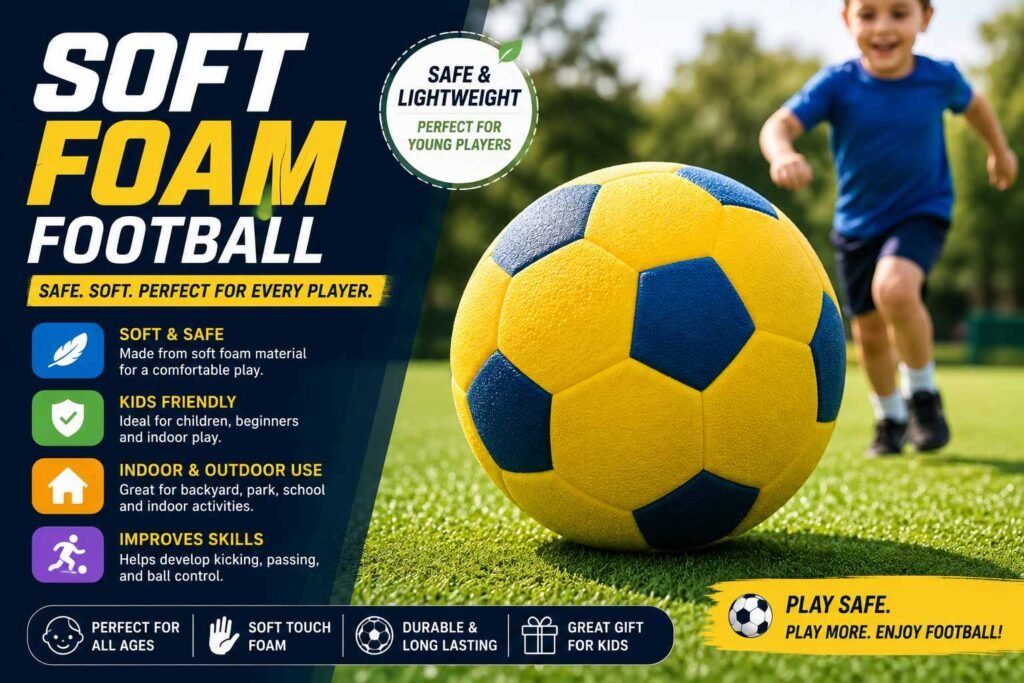
A soft foam football is a practical option for children, beginners, indoor games, recreational activities, and basic football training. Unlike traditional hard soccer balls, foam footballs are designed with a softer construction that makes them easier to handle and more comfortable for casual play.
For parents, schools, coaches, daycares, and families looking for a beginner-friendly ball, soft foam footballs can provide an enjoyable way to introduce players to the fundamentals of the game.
What Is a Soft Foam Football?
A soft foam football is a lightweight ball made primarily from foam or a soft synthetic material. Its flexible construction gives it a softer feel than conventional soccer balls.
These balls are commonly used for:
- Indoor play
- Children’s activities
- Beginner training
- Backyard games
- School activities
- Recreational football
- Coordination exercises
- Basic ball-control practice
Because they are soft and lightweight, they can be easier for younger players to handle during their first experiences with football.
Why Choose a Soft Foam Football?
Traditional soccer balls can feel firm when kicked, caught, or accidentally contacted. A foam alternative provides a softer playing experience, which can be useful when introducing children to the sport.
A soft foam football can help make practice more approachable while allowing players to work on basic skills such as kicking, passing, stopping, and dribbling.
It can also be useful in environments where a conventional ball may be too hard or unsuitable for casual activities.
1. Great for Young Players
Children who are learning football often need equipment that is easy to control.
A lightweight foam ball can be easier for young players to kick and move. It can also make simple practice activities feel less intimidating.
Parents can use a soft foam football for basic games at home, while coaches and teachers can incorporate it into introductory activities.
When selecting a ball for children, always consider their age, physical ability, and the manufacturer’s recommended use.
2. Useful for Indoor Football Activities
Indoor spaces can provide excellent opportunities for football practice, especially when weather conditions make outdoor play difficult.
A soft foam football can be useful for indoor activities where space is limited. Its softer construction can make casual games and skill exercises more manageable.
However, the suitability of any ball depends on the location. Always check that the facility permits ball games and keep enough distance from furniture, windows, electronics, and other fragile objects.
3. Helps Develop Basic Football Skills
You do not need professional equipment to practice fundamental football skills.
A soft foam ball can be used for simple exercises involving:
- Passing
- Ball stopping
- Short-distance dribbling
- Kicking
- Target practice
- Foot coordination
- Reaction exercises
- Basic ball control
These activities can help beginners become more comfortable with the ball before progressing to more advanced equipment.
4. Comfortable for Casual Play
Not every football session needs to be competitive.
Families may want a ball for casual backyard games, children may want something to kick around at home, and teachers may need equipment for recreational activities.
A soft foam football can be a convenient choice for these situations because its construction is designed around comfort and easy handling rather than professional match performance.
5. Lightweight and Easy to Handle
Foam construction can make a football lighter and easier to manage.
This can be particularly useful for younger children who may struggle with heavier traditional soccer balls.
A lighter ball can also be helpful during coordination games where players are learning to control movement and direction.
However, weight varies between products, so check the manufacturer’s specifications before purchasing.
Soft Foam Football vs. Traditional Soccer Ball
The two types of balls serve different purposes.
A traditional soccer ball is designed for structured training, matches, and outdoor play. It generally has a firmer construction and is built to meet specific performance requirements.
A soft foam football, on the other hand, is better suited to casual activities, beginners, indoor games, and introductory practice.
Soft Foam Football
- Softer feel
- Lightweight construction
- Suitable for beginners
- Useful for casual play
- Good for basic skill activities
- Available in child-friendly designs
Traditional Soccer Ball
- Firmer construction
- Designed for regular football play
- Suitable for structured training
- Available in official sizes
- Better suited to competitive matches
- Designed for specific playing surfaces
Choosing between the two depends on the player’s age, experience, location, and intended use.
How to Choose the Right Soft Foam Football
There are several factors to consider before purchasing.
1. Size
Choose a size appropriate for the intended player. Younger children may benefit from smaller, easier-to-handle options.
2. Material
Check what type of foam or soft outer material the manufacturer uses. A quality surface should feel comfortable while maintaining its shape during normal use.
3. Durability
Although foam balls are soft, they should still be able to withstand regular recreational play.
Look for a product designed for the environment in which it will be used.
4. Grip and Surface
A textured outer surface can make the ball easier to control, particularly for beginners.
5. Intended Environment
Some soft foam footballs are designed for indoor activities, while others may be suitable for outdoor recreational use. Always follow the manufacturer’s recommendations.
Soft Foam Footballs for Kids
For children, the right equipment can make learning football more enjoyable.
A soft ball can allow young players to focus on basic movements without immediately having to manage a firm, competition-style soccer ball.
Parents can introduce simple games such as:
Target kicking: Place a safe target on the ground and encourage the child to kick the ball toward it.
Passing practice: Have two players pass the ball back and forth over a short distance.
Dribbling: Set up soft markers and ask the player to move the ball around them.
Stop-and-go: Encourage the player to dribble and stop the ball when given a signal.
These activities can make practice feel like a game rather than a formal training session.
Soft Foam Footballs for Schools and Daycares
Schools and childcare programs often need sports equipment that can be used by children with different skill levels.
Soft foam balls can be useful for introductory football activities, movement exercises, and recreational games.
Teachers can incorporate them into activities that focus on coordination, teamwork, movement, and basic ball control.
Before using them, make sure the equipment is appropriate for the age group and the activity area.
Using a Foam Football at Home
A soft foam football can provide an easy way for families to encourage active play.
If you have a suitable open area, children can practice basic kicking and passing. Indoor use may also be possible in a sufficiently spacious, approved area where breakable objects are not nearby.
Set up a simple practice zone using safe markers and establish clear boundaries.
Supervision is especially important when children are playing around furniture or other household objects.
Is a Soft Foam Football Good for Training?
A soft foam football can be useful for basic skill development, but it should not necessarily replace a standard soccer ball for serious training.
Beginners can use foam balls to develop confidence and coordination. As players progress, coaches may introduce regulation-style balls to help them become familiar with the weight, feel, and movement of the equipment used in structured football.
For competitive players, a match-appropriate ball remains the better choice for advanced technical training.
How to Care for a Soft Foam Football
Proper care can help maintain the ball’s condition.
Keep the football away from sharp objects that could damage the foam surface. Avoid excessive exposure to heat or direct sunlight, particularly if the manufacturer recommends indoor storage.
After use, wipe the ball with a suitable cloth if necessary and store it in a clean, dry location.
Avoid using a foam ball on rough surfaces unless it is specifically designed for them.
Common Uses for Soft Foam Footballs
The versatility of foam footballs makes them suitable for many recreational situations.
They can be used for:
- Children’s football practice
- Indoor activities
- Backyard games
- School sports
- Daycare activities
- Beginner training
- Coordination exercises
- Family recreation
- Football-themed games
- Casual kicking practice
Their usefulness depends on the specific product, so always check its recommended age range and intended environment.
Final Thoughts
A soft foam football can be an excellent introduction to football for children, beginners, and recreational players. Its softer construction and lightweight feel can make basic activities more approachable while giving players an opportunity to develop confidence and coordination.
When choosing one, consider size, material, durability, surface texture, intended age group, and where the ball will be used.
For serious matches and advanced training, a regulation-style soccer ball is usually more appropriate. But for casual play, introductory activities, and beginner skill development, a quality soft foam football can be a practical and enjoyable choice.
Explore SoccerBallClub for more soccer and football equipment, training products, and gear for players of different ages and skill levels.