
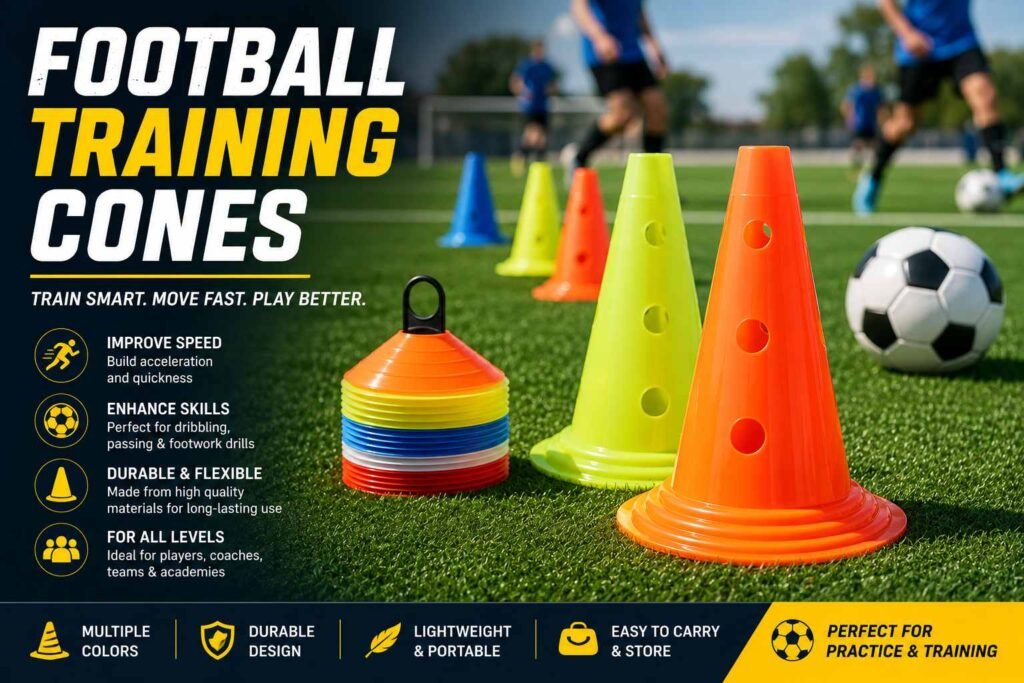
Football training cones are among the simplest and most useful pieces of equipment for improving football skills. They can be used by beginners, youth players, professional athletes, coaches, schools, academies, and clubs to create drills for speed, agility, dribbling, passing, ball control, and movement.
Unlike expensive training equipment, cones are affordable, lightweight, easy to transport, and suitable for many different training environments. A good set of cones can turn an open field, indoor court, or backyard into an organized football training area.
In this guide, we explain how to choose the right football training cones, how coaches can use them, and which drills can help players develop important skills.
What Are Football Training Cones?
Football training cones are lightweight markers used to organize training areas and create drills. Coaches place cones on the ground to establish boundaries, running lanes, slalom courses, passing zones, and target areas.
They come in different sizes, shapes, colors, and materials. Some are flat disc cones, while others are taller traffic-style training cones.
The right type depends on the player’s age, training activity, playing surface, and coaching requirements.
Why Are Training Cones Important?
Training cones may look simple, but they can support a wide variety of football exercises.
Coaches can use them to improve:
- Dribbling
- Ball control
- Passing
- Agility
- Acceleration
- Deceleration
- Change of direction
- Footwork
- Spatial awareness
- Reaction speed
- Movement without the ball
Because cones can be arranged in countless patterns, the same equipment can be used for beginners and advanced players.
1. Choose the Right Type of Training Cone
There are several types of cones available, and each has different advantages.
Disc Cones
Flat disc cones sit close to the ground and are useful for marking spaces, training grids, and movement patterns. Their low profile makes them less likely to interfere with players’ feet.
Standard Training Cones
Traditional taller cones are easy to see and are useful for dribbling exercises, sprint drills, and marking boundaries.
Slalom Cones
Slalom-style cones are useful for exercises that require players to weave between markers while controlling the ball.
Flexible Cones
Flexible training cones can bend when stepped on and are useful for busy training environments where players frequently move around the markers.
2. Consider the Playing Surface
The surface where you train should influence your cone selection.
For natural grass, lightweight and highly visible cones can work well. On artificial turf, coaches may prefer durable cones that remain stable during repeated drills.
Indoor training may require flat markers or cones that are suitable for hard courts and floors.
Always consider whether the cones can remain stable without damaging or marking the playing surface.
3. Select Highly Visible Colors
Visibility is important when players are moving quickly.
Bright colors such as orange, yellow, red, or green can make cones easier to identify from a distance.
Using different colors can also help coaches organize more complicated drills.
For example, a coach might use one color to indicate a starting point and another to identify a finishing zone.
4. Look for Durable Construction
Football training cones can experience plenty of contact during practice.
Players may accidentally kick them, step on them, or run directly over them. For this reason, durability is an important consideration.
Look for cones made from flexible and impact-resistant materials. For clubs and academies that train frequently, investing in durable equipment can provide better long-term value.
5. Use Cones for Dribbling Practice
One of the most common uses for football cones is dribbling.
Place several cones in a straight or slightly curved line and ask players to move the ball through them using controlled touches.
Players can practice using both feet and different parts of the foot.
As their ability improves, coaches can reduce the distance between cones or increase the speed requirement.
This simple exercise can help players become more comfortable changing direction while keeping the ball close.
6. Create a Slalom Drill
A slalom drill is another effective way to use training cones.
Place the cones in a line with enough space for players to move between them. Players then dribble through the course while changing direction around each cone.
To make the exercise more challenging, coaches can ask players to:
- Use only their weaker foot
- Increase speed
- Use specific foot surfaces
- Keep their head up
- Finish with a shot
- Complete the course against a time limit
The drill can be adjusted for different age groups and ability levels.
7. Build an Agility Course
Football requires players to accelerate, stop, turn, and change direction quickly.
Cones can be arranged into an agility course that requires players to move forward, sideways, diagonally, and backward.
A coach can combine sprinting and direction changes to create a more realistic football movement pattern.
Players should focus on maintaining balance and control rather than simply trying to complete the course as quickly as possible.
8. Use Cones for Passing Drills
Training cones are not only useful for running exercises.
They can also help coaches create passing channels and target zones.
For example, two cones can form a small passing gate. Players must pass the ball through the gate to their teammate.
As players improve, the coach can reduce the size of the gate or increase the distance between players.
This can make a basic passing exercise progressively more challenging.
9. Improve First Touch With Cone Drills
First touch is an important football skill.
Coaches can use cones to create receiving zones. A player receives a pass, controls the ball into the designated area, and then passes it back.
The cones provide a visual reference for where the first touch should go.
This type of training can encourage players to think about the direction of their first touch instead of simply stopping the ball.
10. Create Small-Sided Training Areas
Cones can quickly divide a large field into smaller training zones.
Small-sided games can encourage players to make faster decisions because they have less time and space.
A coach can use cones to create:
- 1v1 areas
- 2v2 grids
- 3v3 fields
- Passing zones
- Finishing areas
- Possession boxes
The size of each area can be adjusted depending on the players’ age and training objective.
11. Football Training Cones for Youth Players
Youth players can benefit greatly from cone-based activities.
For younger players, drills should remain simple, enjoyable, and easy to understand. Cones can be used to create colorful courses and games that encourage children to move with the ball.
As players develop, coaches can gradually introduce more complex movements and decision-making challenges.
The most important goal for younger players is to develop confidence and basic football skills while keeping training enjoyable.
12. Use Cones for Speed Training
Speed is valuable in many football situations.
Coaches can use cones to mark sprint distances and create acceleration drills.
For example, place a starting cone followed by several markers at different distances. Players sprint between the markers while focusing on acceleration and controlled stopping.
Training should be adjusted according to player age and ability, with appropriate rest between high-intensity efforts.
13. Combine Cones With Other Training Equipment
Football cones become even more useful when combined with other equipment.
A coach can create a complete training circuit using cones, footballs, agility ladders, hurdles, goals, and rebound equipment.
For example:
Station 1: Dribble through cones
Station 2: Passing through gates
Station 3: Agility movement
Station 4: Shooting
Station 5: Short sprint
Players can rotate between stations, keeping the session organized and active.
14. How Many Training Cones Do You Need?
The number of cones required depends on the type of training.
For individual practice, a small set may be enough for basic dribbling and agility exercises.
A coach working with a youth team may need a larger quantity to create multiple training stations.
For academies and clubs, buying cones in sets can be more convenient because coaches can quickly establish larger training areas.
Before purchasing, consider the number of players, available training space, and types of drills you regularly use.
15. How to Store Your Football Training Cones
Proper storage can help keep training equipment organized and ready for use.
After training, collect all cones and check them for damage. Remove dirt or mud when necessary and allow wet equipment to dry before storing it.
Keep cones together in a training bag, equipment box, or dedicated storage area.
Organizing cones by color or size can also save time when preparing future training sessions.
16. Safety Tips When Using Training Cones
Although cones are generally simple training equipment, coaches should still consider player safety.
Make sure cones are suitable for the playing surface and do not create unnecessary tripping hazards.
Training areas should have enough space around them for players to move safely.
Avoid overcrowding drills with too many players. If several athletes are completing the same exercise, divide them into smaller groups or create multiple stations.
Players should also use appropriate footwear for the surface they are training on.
Football Training Cones for Teams and Academies
For soccer clubs, academies, schools, and training organizations, cones are an essential part of a basic equipment collection.
Buying durable, highly visible cones in larger sets can make it easier for coaches to prepare sessions quickly.
Teams can use them for warm-ups, technical drills, fitness activities, small-sided games, and tactical exercises.
A consistent set of training equipment can also make sessions more organized and professional.
Final Thoughts
Football training cones are simple but extremely versatile pieces of football equipment. They can be used to create drills for dribbling, passing, agility, speed, ball control, first touch, and small-sided games.
When choosing cones, consider durability, visibility, size, flexibility, playing surface, and the type of training you plan to conduct.
For individual players, parents, coaches, schools, academies, and clubs, a quality set of training cones can provide countless ways to improve football practice without requiring complicated equipment.
For more football training equipment, soccer balls, and team essentials, explore SoccerBallClub and build a training setup designed for players of different ages and skill levels.