
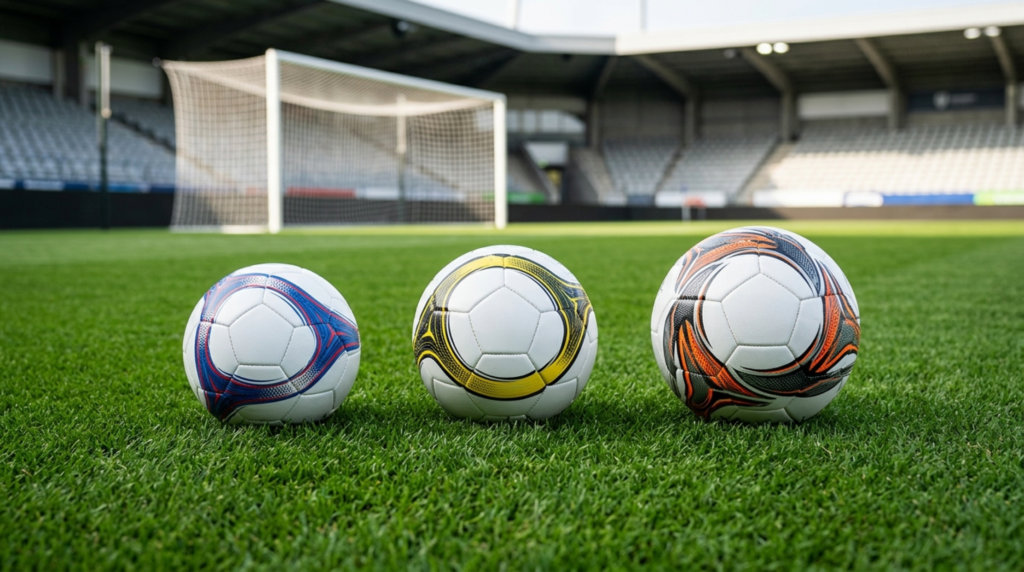
Choosing the right soccer ball size is important for players of every age. A ball that is too large can make it harder for a young player to control, while a ball that is too small may not provide the same feel as a standard match ball for older players.
Whether you are a parent buying a ball for your child, a coach preparing equipment for a team, or an adult player looking for a training ball, understanding soccer ball sizes can help you make a better choice.
In this soccer ball size guide, we explain the differences between Size 3, Size 4, and Size 5 soccer balls and how to choose the right option for training and play.
What Are the Main Soccer Ball Sizes?
Soccer balls are commonly available in three main sizes:
- Size 3: Designed mainly for young children
- Size 4: Commonly used by developing youth players
- Size 5: Standard full-size ball for older youth and adult players
The correct size depends primarily on the player’s age and the requirements of their league or club.
Size 3 Soccer Ball
A Size 3 soccer ball is one of the smallest standard soccer balls used for player development.
Its smaller dimensions make it easier for young children to carry, kick, pass, and control.
Size 3 balls are often suitable for:
- Young beginners
- Introductory soccer programs
- Early skill development
- Basic dribbling practice
- Backyard practice for children
For young players, learning control is more important than using the largest available ball. A properly sized ball can help make early training more comfortable.
Size 4 Soccer Ball
A Size 4 soccer ball sits between Size 3 and Size 5.
It is commonly used by youth players who have progressed beyond beginner-level equipment but are not yet ready for the full-size ball required for older age groups.
A Size 4 ball can be useful for:
- Youth training
- Passing drills
- Dribbling exercises
- Shooting practice
- Skill development
- Recreational games
However, age-group requirements can differ between leagues, so parents and players should always check the rules of their specific competition.
Size 5 Soccer Ball
The Size 5 soccer ball is the standard full-size option used by older youth players, teenagers, adults, and competitive players.
When people search for a standard soccer ball, they are often referring to Size 5.
It is commonly used for:
- Adult soccer
- Competitive training
- Club practices
- Professional-style training
- Match preparation
- Recreational adult games
If you are an adult looking for a regular soccer ball for training, Size 5 will usually be the appropriate starting point.
Soccer Ball Size Chart
| Ball Size | Typical Use | Best For |
|---|---|---|
| Size 3 | Beginner soccer | Young children |
| Size 4 | Youth soccer | Developing players |
| Size 5 | Full-size soccer | Older youth and adults |
These categories are general guidance. Always check your league’s equipment rules before purchasing a ball for official competition.
Why Does Soccer Ball Size Matter?
The size of a soccer ball affects how easily a player can control it.
For younger players, a full-size ball can feel difficult to manage. A smaller ball allows them to work on fundamental skills without having to deal with unnecessary size and weight.
As players become older and stronger, they gradually move toward larger equipment.
Using the appropriate size can help players develop:
- Ball control
- Passing accuracy
- Dribbling
- First touch
- Shooting technique
- Confidence
The goal is not simply to choose the biggest or most expensive ball. The goal is to choose equipment that fits the player’s development level.
What Size Soccer Ball Should Adults Use?
For most adult players, a Size 5 soccer ball is the standard choice.
This applies whether you are practicing with friends, training with a club, or preparing for competitive matches.
A Size 5 ball also helps adult players become comfortable with the same general ball size used in standard competitive soccer.
What Size Soccer Ball Is Best for Kids?
There is no single answer for every child because youth soccer organizations can use different age-group standards.
You should consider both the player’s age and the requirements of their soccer program.
A younger child may be more comfortable with a Size 3 ball, while an older youth player may use Size 4 or Size 5 depending on their competition.
Parents should check with the child’s coach or league before purchasing equipment for an organized team.
Size vs Weight
Soccer ball size and weight are related, but they are not exactly the same thing.
A larger ball generally has different weight and handling characteristics than a smaller development ball.
For official competition, governing organizations establish specific requirements for the ball’s circumference and weight.
For example, the Laws of the Game specify that a standard match ball must have a circumference of 68–70 cm and weigh 410–450 g at the start of the match.
This is one reason Size 5 balls are commonly used for older competitive players.
How to Choose a Soccer Ball for Training
Size is only one part of the decision.
If you are purchasing a soccer ball for training, also consider the following factors.
1. Playing Surface
Think about where you will use the ball.
Will you train on natural grass, artificial turf, or an indoor surface?
Choose a ball designed for your regular training environment.
2. Frequency of Use
A ball used several times every week needs to withstand more wear than one used occasionally.
For frequent practice, prioritize durability and reliable construction.
3. Player Level
Beginners may not need the same type of ball as competitive players.
Choose equipment based on actual training requirements rather than simply buying the most expensive option.
4. Construction
Check how the ball is constructed and what materials are used.
Quality construction can influence durability, shape retention, touch, and overall performance.
5. Air Retention
A good training ball should maintain its inflation effectively between sessions.
A reliable valve and bladder system can help reduce the need for frequent reinflation.
Common Soccer Ball Buying Mistakes
Buying the Wrong Size
One of the most common mistakes is choosing a ball without checking the player’s age group or league requirements.
Choosing Based Only on Appearance
Bright colors and attractive designs can be appealing, but appearance should not be your main purchasing factor.
Ignoring the Playing Surface
A ball used outdoors should be suitable for outdoor training, while indoor soccer may require different equipment.
Buying Without Checking the Purpose
A recreational training ball and a competitive match ball can have different characteristics.
Think about how the ball will actually be used before making your purchase.
Can You Use a Size 5 Ball for Youth Training?
Sometimes, but it depends on the player’s age, development level, and training goals.
A coach may occasionally use different equipment for specific drills. However, players preparing for competitions should practice with the ball size required by their league.
Using the correct competition size during regular practice can also help players become comfortable with the equipment they will use during games.
Final Thoughts
Choosing the right soccer ball size does not have to be complicated.
Size 3 is generally associated with younger beginners, Size 4 is commonly used for youth development, and Size 5 is the standard full-size option for older youth and adults.
Before buying, check the player’s age group, league requirements, playing surface, and training needs.
The right soccer ball can make practice more comfortable and help players focus on developing important skills such as passing, dribbling, shooting, and ball control.
If you are unsure which size to choose, checking your local league or asking the player’s coach is one of the easiest ways to make the right decision.