
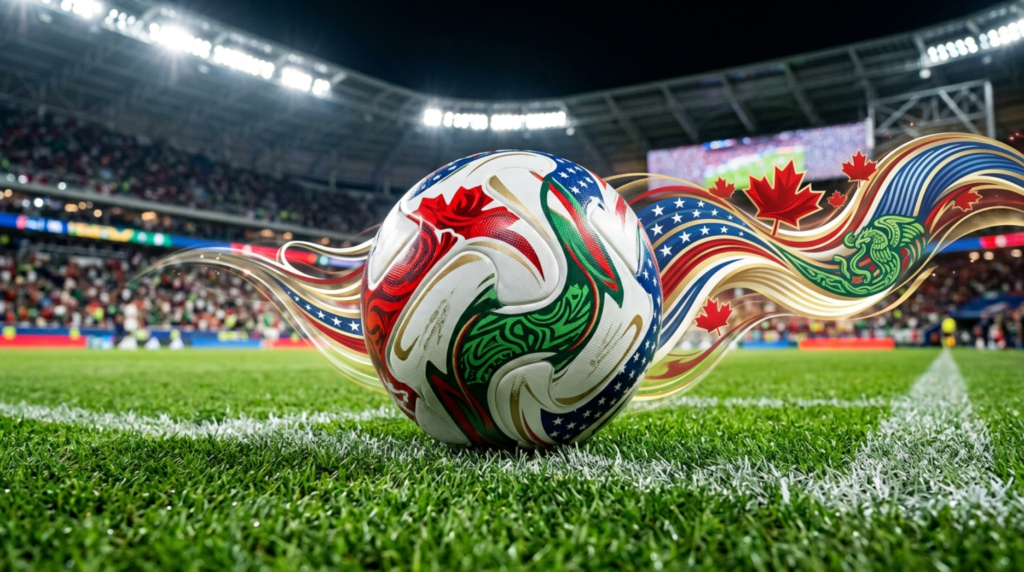
The 2026 World Cup soccer ball is one of the most exciting pieces of football equipment connected with the biggest tournament of 2026. Officially named TRIONDA, the ball was created by adidas for the FIFA World Cup 26™ and combines a bold design with modern football technology.
The 2026 tournament is being hosted across Canada, Mexico, and the United States, and the ball reflects this three-nation partnership. Its name, design, construction, and technology all connect to the spirit of the tournament.
Unlike an ordinary soccer ball, the official World Cup ball is designed to meet strict professional standards. It must perform consistently during fast passes, powerful shots, crosses, dribbling, and different weather conditions. TRIONDA brings several new features designed to support accuracy, stability, and match officiating.
What Is the 2026 World Cup Soccer Ball?
The official 2026 World Cup soccer ball is the adidas TRIONDA. FIFA announced the ball in October 2025 as the official match ball for the tournament.
The name TRIONDA comes from the combination of “Tri,” referring to three, and “Onda,” meaning waves. The idea represents the three countries hosting the 2026 FIFA World Cup: Canada, Mexico, and the United States.
The ball has a distinctive four-panel construction with flowing shapes inspired by the famous “la ola” wave seen in stadiums across the Americas. The panels meet in the center to create a triangular shape, representing the connection between the three host nations.
This makes the ball more than just a piece of sporting equipment. Its design tells part of the story of the 2026 World Cup.
A Design Inspired by Three Host Countries
One of the most noticeable features of the 2026 World Cup soccer ball is its colorful appearance. TRIONDA uses red, green, and blue elements that pay tribute to Canada, Mexico, and the United States.
The design also includes national symbols connected with each host country. A maple leaf represents Canada, an eagle represents Mexico, and a star represents the United States.
Gold details are also included as a visual reference to the FIFA World Cup Trophy. Together, these elements create a design that feels closely connected to the tournament and its hosts.
The flowing graphics give the ball a modern appearance while keeping the overall shape recognizable to football fans. This combination of symbolism and performance technology makes TRIONDA particularly interesting for collectors and players.
Four-Panel Construction
Traditional soccer balls have often used many panels stitched together. TRIONDA takes a different approach with a four-panel construction.
The four panels use fluid geometry to create the ball’s wave-inspired appearance. Their arrangement is also intended to support the ball’s movement through the air.
According to FIFA, the ball features intentionally deep seams that help create more evenly distributed drag as the ball travels. This can contribute to in-flight stability and a more predictable trajectory.
For professional players, consistency is extremely important. A ball that moves predictably allows players to concentrate on technique rather than constantly adapting to unexpected flight behavior.
Seamless Surface and Improved Ball Control
Another important feature of the 2026 World Cup soccer ball is its thermally bonded, seamless construction.
Instead of relying on traditional visible stitching across the surface, the ball uses thermal bonding. This construction is designed to provide a more consistent surface and predictable performance.
The outer surface also includes texture and debossed details. These features are intended to support precision, touch, and flight stability.
The surface design can become especially important when players compete in wet or humid conditions. FIFA says the embossed elements can help improve grip when striking or dribbling the ball in such environments.
For attackers, midfielders, defenders, and goalkeepers, reliable ball behavior can make a noticeable difference during a match.
Connected Ball Technology
Technology is another major part of the 2026 World Cup soccer ball.
TRIONDA includes adidas Connected Ball Technology with a 500Hz motion sensor chip. The technology provides detailed information about the ball’s movement and can send data to systems used by match officials.
This technology is particularly important for video-assisted officiating. Ball movement data can help officials analyze situations and support decisions during matches.
It represents another step toward combining traditional football skills with advanced technology. Players still control the game on the pitch, but additional information can help officials make decisions more efficiently.
FIFA Quality Pro Certification
The professional version of the 2026 World Cup soccer ball carries the FIFA Quality Pro certification.
This is the highest FIFA testing category for footballs. Balls under this standard are tested across important performance areas, including weight, water absorption, shape retention, and other characteristics that affect match performance.
For players, this certification provides confidence that the ball has been tested for demanding professional conditions.
The retail TRIONDA range also includes different versions designed for different levels of play. adidas lists the Trionda Pro as the official game ball, alongside Competition, League, Training, Club, and Mini versions.
TRIONDA Pro vs Other Versions
Not every 2026 World Cup soccer ball sold to fans is identical to the official professional match ball.
The TRIONDA Pro is the official game ball and is designed for elite-level play. It features the advanced seamless construction, textured surface, and FIFA Quality Pro certification.
The Competition version is designed for competitive matches while offering a more accessible option.
The League version is suitable for training and matches, while the Training model focuses on regular practice. There are also Club and Mini versions for recreational use and fans.
Choosing the right version depends on how you plan to use the ball. A professional player may want the Pro model, while a young player or casual fan may prefer a training, club, or mini version.
TRIONDA Final: A Special Ball for the Last Matches
The 2026 World Cup introduced another special version called TRIONDA FINAL.
This ball was created specifically for the semi-finals, third-place match, and final. Unlike a simple color variation, adidas gave the final ball its own dedicated design.
TRIONDA FINAL features a premium gold, white, and black appearance inspired by the journey toward the World Cup Trophy. Its design also celebrates the 16 host cities involved in the tournament.
Importantly, the final ball keeps the same core performance innovations as the regular TRIONDA. That includes the construction, surface technology, aerodynamic features, and connected-ball technology.
For collectors, TRIONDA FINAL is particularly significant because it represents the closing stage of the 2026 World Cup.
Why the 2026 World Cup Soccer Ball Matters
A World Cup ball becomes part of football history. Previous tournament balls are remembered by fans because they were present during some of the sport’s most important matches.
The 2026 World Cup soccer ball has an additional story because the tournament is being staged across three countries. Its design brings together symbols and colors associated with Canada, Mexico, and the United States.
Its technology also reflects how modern football continues to evolve. Players expect accurate equipment, while officials increasingly rely on technology to make difficult decisions.
TRIONDA therefore combines three important elements: football tradition, visual identity, and modern innovation.
Is the 2026 World Cup Soccer Ball Good for Training?
Yes, but the best version depends on your training needs.
Players who want a professional-level experience can choose the TRIONDA Pro. Its surface and construction are designed around high-level performance.
For everyday practice, however, buying the most expensive match ball may not always be necessary. Training and League versions can provide practical options for players who regularly practice passing, shooting, dribbling, and ball control.
The most important thing is to select a ball that matches your playing level, playing surface, and frequency of use.
What Makes TRIONDA Different?
Several features make the 2026 World Cup soccer ball stand out.
First, its four-panel construction gives it a distinctive visual identity. Second, its textured surface is designed to support predictable flight and touch. Third, its thermally bonded seamless construction helps provide consistent performance.
The connected technology adds another layer by providing real-time ball movement information for match officials.
Finally, its design represents the three host nations rather than focusing on just one country. This gives TRIONDA a unique place in World Cup ball history.
Final Thoughts
The 2026 World Cup soccer ball, known as adidas TRIONDA, combines the excitement of the world’s biggest football tournament with modern sporting technology.
Its four-panel construction, wave-inspired graphics, textured surface, seamless design, and connected technology make it much more than a traditional soccer ball. The red, green, and blue design also celebrates Canada, Mexico, and the United States, the three nations hosting the 2026 FIFA World Cup.
For professional players, TRIONDA is built around consistency and precision. For fans, it offers a memorable piece of World Cup history. And for collectors, the special TRIONDA FINAL adds another important chapter to the story.
Whether you are following the tournament, training on the pitch, collecting World Cup memorabilia, or simply looking for a high-quality soccer ball, TRIONDA represents the technology, culture, and excitement surrounding the 2026 World Cup.