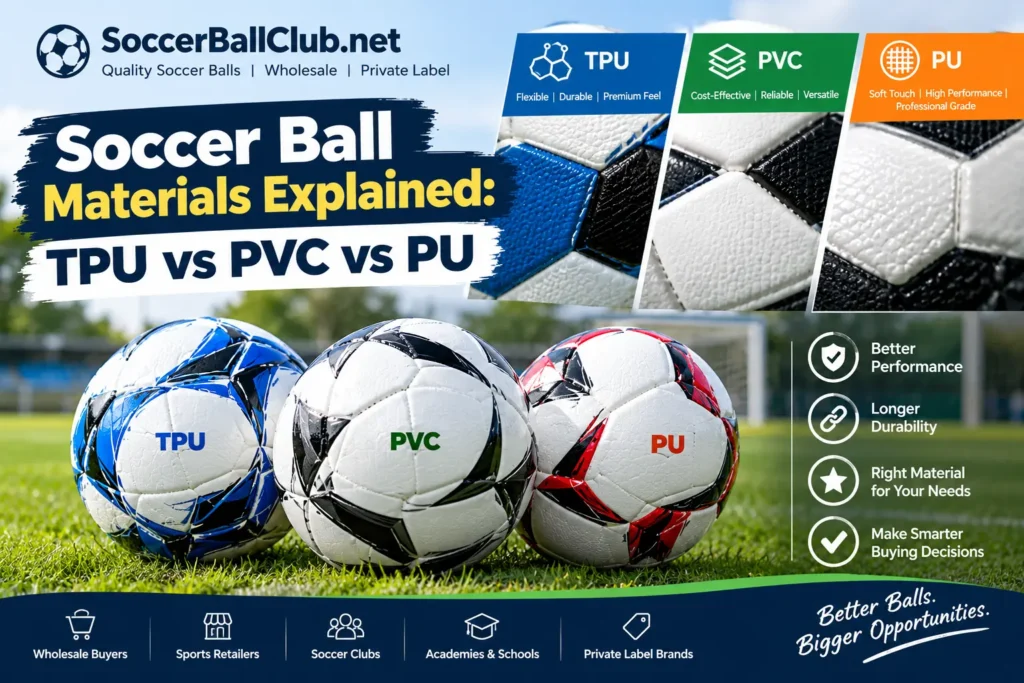
Choosing the right soccer ball involves more than selecting a size, color, or design. The material used in the outer cover can influence how a ball feels, how it performs in different conditions, and how well it suits its intended use.
For soccer clubs, schools, academies, sports retailers, and wholesale buyers, understanding soccer ball materials can make purchasing decisions easier. Three materials commonly discussed in soccer ball manufacturing are thermoplastic polyurethane (TPU), polyvinyl chloride (PVC), and polyurethane (PU).
Each material has different characteristics, and the best choice depends on the ball’s construction, intended use, quality requirements, and budget.
This guide explains the differences between TPU, PVC, and PU soccer ball materials and what buyers should consider before purchasing individual balls or ordering in bulk.
Why Do Soccer Ball Materials Matter?
A soccer ball’s outer cover affects its surface texture, touch, appearance, and resistance to wear. However, the cover is only one part of the complete ball.
Other components also influence performance, including the bladder, backing layers, panel design, seams, and overall construction. Manufacturing quality and the way these components work together can make a significant difference.
When comparing soccer balls, buyers should evaluate the complete product rather than assuming that one material automatically produces a better ball.
For example, a ball designed for recreational play may prioritize affordability and general durability, while a ball intended for competitive use may require more specific performance characteristics.
1. What Is TPU in Soccer Balls?
TPU stands for thermoplastic polyurethane. It is a flexible polymer used in many sporting goods and synthetic surface applications, including soccer ball covers.
Depending on its formulation and the ball’s construction, TPU can provide a combination of flexibility, surface feel, abrasion resistance, and design versatility.
Advantages of TPU Soccer Balls
Flexible surface: TPU can provide a flexible cover suitable for different soccer ball designs.
Design options: Manufacturers can produce TPU covers in different colors, textures, and panel designs.
Potential durability: Appropriate TPU formulations can offer useful resistance to everyday wear, although actual performance depends on material quality and construction.
Multiple applications: TPU is used in soccer balls for different playing environments and product categories.
What Should Buyers Consider?
Not every TPU soccer ball offers the same quality. Cover thickness, formulation, backing material, panel construction, and manufacturing standards can affect the finished product.
Buyers should request product specifications and evaluate samples rather than relying on the TPU label alone.
TPU may be worth considering when comparing training balls, recreational products, and other models where flexibility, appearance, and wear resistance are important.
2. What Is PVC in Soccer Balls?
PVC stands for polyvinyl chloride. It is another synthetic material used in soccer ball covers and other sports products.
PVC soccer balls are available in different grades and constructions. Some products are designed for economical recreational use, while others may have different specifications depending on the manufacturer’s materials and production methods.
Advantages of PVC Soccer Balls
Budget flexibility: PVC is used in a range of products, including some cost-conscious soccer ball options.
Variety of finishes: Manufacturers can produce different surface appearances and designs.
Suitable for selected uses: Depending on the specific product, PVC balls may be appropriate for casual play, basic practice, or promotional applications.
What Should Buyers Consider?
PVC formulations vary, so it is important to check the actual product specifications. Surface feel, flexibility, resistance to cold conditions, and durability may differ between products.
A low purchase price should not be the only deciding factor for a bulk order. Buyers should assess whether the ball’s performance and expected service life suit the intended users.
For schools, clubs, and retailers purchasing multiple balls, requesting a sample can help determine whether a PVC model meets their requirements.
3. What Is PU in Soccer Balls?
PU stands for polyurethane. It is used in various synthetic cover materials and can be formulated to provide different surface characteristics.
In soccer balls, PU-based covers may be selected for their touch, softness, surface finish, and performance characteristics, depending on the formulation and construction.
Advantages of PU Soccer Balls
Touch and feel: Certain PU covers can provide a softer or more responsive surface feel.
Surface quality: PU-based materials can support a range of textures and finishes.
Performance-oriented designs: Some higher-specification soccer balls use PU-based cover systems designed around particular performance goals.
What Should Buyers Consider?
PU is a broad material category rather than a guarantee of premium quality. Different formulations and manufacturing processes can produce different results.
The backing layers, panel construction, surface texture, and other components remain important. Buyers should compare the complete specifications and test the ball where possible.
A well-made soccer ball should be evaluated on its intended application, not simply on whether its cover is described as PU.
4. TPU vs PVC vs PU: Key Differences
The following table provides a general comparison. Actual characteristics vary according to the material formulation and the complete ball construction.
| Feature | TPU | PVC | PU |
|---|---|---|---|
| Common applications | Training and various recreational or performance models | Some budget-friendly and recreational models | Various recreational and performance-oriented models |
| Surface feel | Depends on formulation and texture | Depends on formulation and finish | Some formulations provide a softer feel |
| Durability | Depends on material quality and construction | Depends on grade and construction | Depends on formulation and construction |
| Design flexibility | Available in varied colors and finishes | Available in varied colors and finishes | Available in varied textures and finishes |
| Cost | Varies by specification | Often used in cost-conscious products | Varies widely by specification |
| Best selection method | Evaluate the complete ball | Evaluate the complete ball | Evaluate the complete ball |
There is no universal winner in this comparison. Two soccer balls made with the same cover material can perform differently because of their design, construction, and manufacturing quality.
5. How Soccer Ball Construction Affects Performance
The cover material is important, but it should not be considered in isolation.
Panel Construction
Soccer balls use different panel layouts and construction methods. Machine stitching, hand stitching, thermal bonding, and other methods can affect the product’s feel, consistency, and suitability for particular uses.
The best construction depends on the model and its intended purpose.
Backing Layers
Layers beneath the outer cover can influence shape retention, feel, and structural consistency. Buyers should ask manufacturers about the full construction rather than only the visible cover material.
Bladder Quality
The bladder helps the ball retain air and maintain its shape. Different bladder materials and designs have different characteristics.
For regular training or bulk purchases, ask the supplier about inflation retention and recommended maintenance.
Surface Texture
Surface texture can influence grip and ball contact. When performance matters, evaluate the actual product instead of assuming that a smoother or rougher surface is automatically better.
6. Which Soccer Ball Material Is Best for Training?
The right choice depends on how frequently the ball will be used, the players’ ages, the playing surface, and the available budget.
For school programs and youth academies, prioritize a suitable size, consistent construction, and a product that can withstand the expected training routine.
For adult recreational teams, consider the ball’s touch, durability, and suitability for the intended playing surface.
For competitive teams, confirm the specifications required by the relevant competition. If an official approval is necessary, verify it independently.
Regardless of the material, regular inspection and correct inflation help support the ball’s usable life.
7. How Should Bulk Buyers Compare Soccer Ball Materials?
If you are purchasing soccer balls for a retailer, school, club, academy, or distribution business, compare products systematically.
Define Your Requirements
Identify the intended users, ball sizes, expected quantities, playing conditions, and quality expectations before requesting quotations.
Request Complete Specifications
Ask manufacturers to identify the outer cover material, backing layers, bladder type, construction method, and other relevant details.
Compare Samples
Evaluate the actual balls for surface feel, shape, workmanship, inflation retention, and general finish.
Review Total Cost
Compare unit prices alongside customization, packaging, shipping, and other applicable expenses. A cheaper ball is not necessarily the better commercial choice if it does not meet customer expectations.
Check Repeat-Order Consistency
If you plan to reorder, ask how the supplier maintains product specifications and quality across production batches.
For large orders, document the approved sample and agreed specifications before production begins.
8. Questions to Ask a Soccer Ball Manufacturer
Before placing an order, consider asking:
- What material is used for the outer cover?
- What backing layers and bladder materials are included?
- Which construction method is used?
- What playing conditions is the ball designed for?
- Are samples available for evaluation?
- What quality checks are performed during manufacturing?
- Can the product be customized with a logo or brand colors?
- What are the minimum order quantity and production lead time?
- Are the stated specifications maintained for repeat orders?
- What product documentation or certification is available, if required?
Clear answers help you compare suppliers on more than price alone.
Frequently Asked Questions
Is TPU better than PVC for soccer balls?
Not in every case. TPU and PVC products vary in formulation, construction, and intended use. Compare samples and specifications to determine which ball is better suited to your requirements.
Are PU soccer balls always higher quality?
No. PU is a broad category of materials. Quality depends on the formulation, cover design, backing layers, construction, and manufacturing process.
Which material is suitable for bulk soccer ball orders?
The best option depends on the intended users, playing conditions, target price, and quality requirements. Request samples and complete specifications before ordering large quantities.
Does the cover material determine how long a soccer ball lasts?
The cover material contributes to durability, but construction quality, seams or bonded panels, bladder performance, playing surface, inflation, and maintenance also matter.
Can I order customized soccer balls made from different materials?
Customization availability depends on the manufacturer and model. Ask the supplier which cover materials, colors, logos, and packaging options are available for your required order quantity.
Final Thoughts
Understanding soccer ball materials helps buyers make better purchasing decisions. TPU, PVC, and PU each offer different possibilities, but no material guarantees superior performance in every application.
The most effective approach is to compare the complete product, review its specifications, test samples, and select a model that matches your users’ needs and budget.
Whether you are purchasing soccer balls for a school, academy, sports retailer, or private-label business, careful product evaluation can help you choose suitable equipment and establish more consistent purchasing standards.
Looking for soccer balls for your next order? Contact SoccerBallClub to discuss your required sizes, product specifications, customization options, and bulk purchasing needs.