
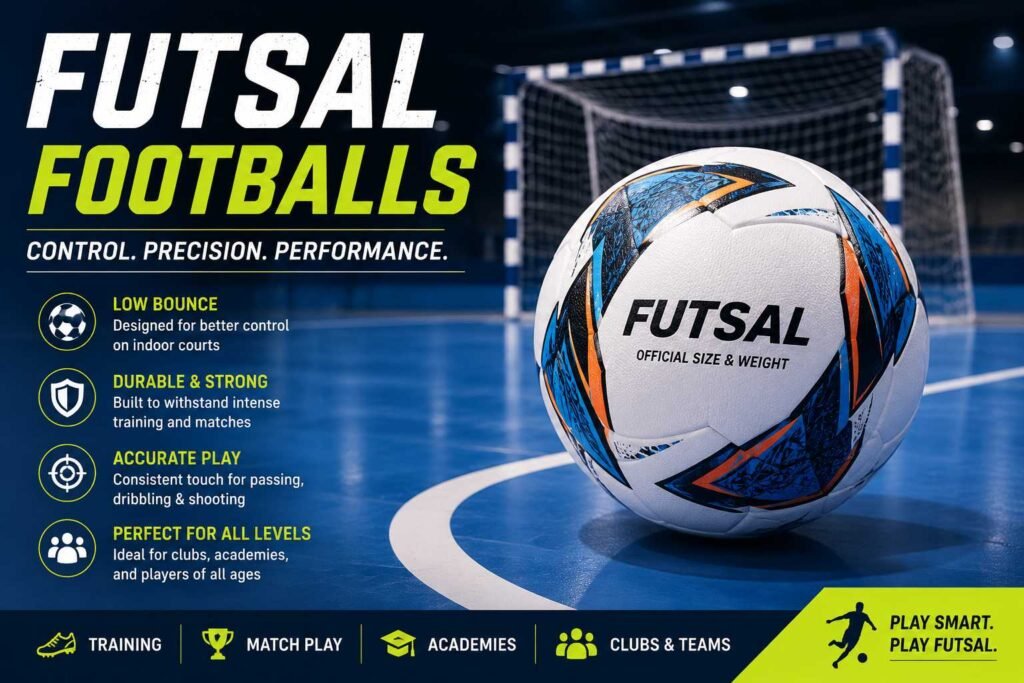
Futsal is a fast, technical form of soccer played primarily on a smaller indoor court. Because the game relies heavily on close control, quick passing, accurate shooting, and rapid changes of direction, the ball used for futsal needs to perform differently from a traditional outdoor soccer ball.
Choosing the right futsal footballs can make a noticeable difference during training, matches, and recreational games. A properly designed futsal ball offers predictable movement, controlled bounce, and a feel that suits the smaller playing surface.
Whether you are a player, coach, parent, school, academy, or club looking for futsal equipment, understanding the important features of a futsal ball can help you make a better choice.
What Are Futsal Footballs?
Futsal footballs are specially designed balls used for the game of futsal. They are generally smaller than standard outdoor soccer balls and are designed with reduced bounce to make them easier to control on a hard indoor court.
Although futsal and outdoor soccer share many similarities, the playing environments are different. Outdoor soccer is usually played across a large grass or artificial-turf field, while futsal takes place on a much smaller, typically hard court.
The ball therefore needs to support close control and quick passing rather than excessive travel and high bounce.
How Is a Futsal Ball Different From a Soccer Ball?
At first glance, a futsal ball may look similar to a regular soccer ball, but there are important differences.
A traditional outdoor soccer ball is designed to travel long distances across a large field. A futsal ball is designed for a smaller playing area where players frequently receive, pass, dribble, and shoot in tight spaces.
Some important differences include:
- Smaller overall size
- Reduced bounce
- Different internal construction
- Strong focus on close control
- Design suited to hard indoor playing surfaces
These characteristics make a futsal ball better suited to the unique demands of the sport.
Why Does a Futsal Ball Have Less Bounce?
Reduced bounce is one of the defining characteristics of a futsal ball.
On a small court, a highly bouncy soccer ball can move unpredictably and make close control more difficult. A lower-bouncing ball stays closer to the playing surface, allowing players to receive passes and maintain possession more easily.
This is especially useful when players are operating in crowded areas where there is very little space between opponents.
The reduced bounce also encourages players to develop better first-touch and ball-control skills.
Choosing the Right Futsal Ball Size
Size is an important consideration when purchasing a futsal ball.
Official futsal competition balls are generally smaller than standard adult outdoor soccer balls. However, exact specifications can vary depending on the governing organization, competition level, and age group.
Before purchasing a ball for an organized competition, check the requirements of the relevant league or organization.
For training and recreational use, your choice may depend more on player age, skill level, playing environment, and personal preference.
1. Consider the Playing Surface
Think about where the ball will be used before purchasing it.
Futsal is commonly played on hard indoor courts, so the ball should be designed for that environment.
Using an ordinary outdoor soccer ball indoors may result in a different playing experience because outdoor balls are designed for larger surfaces and different conditions.
A properly designed futsal ball provides more predictable behavior on a futsal court.
2. Look at the Ball’s Construction
The construction of a futsal ball affects its durability, feel, and performance.
Many futsal balls use machine-stitched, hand-stitched, or thermally bonded panels depending on the model and price range.
The outer material can also influence how the ball feels when players pass, control, or strike it.
For frequent training sessions, look for a ball designed to withstand repeated use while maintaining its shape.
3. Check the Ball’s Weight and Feel
A futsal ball should feel comfortable when controlled with the foot.
Weight and internal construction influence how the ball responds during passing, shooting, and dribbling.
For organized play, always compare the product specifications with the rules of the competition. For casual practice, choose a ball that feels comfortable for the players using it.
A consistent feel can help players develop reliable technique.
4. Choose a Durable Futsal Football
Futsal balls can experience significant wear because they are frequently used on hard surfaces.
If you are buying a ball for an academy, school, club, or regular training program, durability should be a major consideration.
Look for strong construction, quality materials, reliable stitching or bonding, and a design appropriate for indoor play.
A slightly more durable ball may provide better long-term value when it is used frequently.
5. Think About Training vs. Match Use
Not every futsal ball needs to be purchased for competitive matches.
A training ball may be ideal for regular practice sessions because it needs to handle repeated use. A match-quality ball may place greater emphasis on consistency and official specifications.
If you run a club or academy, it may make sense to have separate balls for training and competition.
This can help preserve match balls while allowing players to practice regularly.
Futsal Footballs for Youth Players
Young players can benefit significantly from futsal because the smaller playing environment encourages frequent touches of the ball.
When choosing a futsal ball for children, consider:
- Player age
- Recommended ball size
- Competition requirements
- Court surface
- Ball weight
- Durability
- Skill level
For youth programs, it is particularly important to follow the specifications provided by the relevant league or governing organization.
The right ball can make training more comfortable while helping young players develop their technical skills.
Futsal Balls for Soccer Training
Futsal can also be used as a training method for soccer players.
Because the game involves tight spaces and frequent possession changes, players have opportunities to work on:
- First touch
- Short passing
- Dribbling
- Ball control
- Quick decision-making
- Close-range finishing
- Movement without the ball
A futsal ball can therefore be useful beyond formal futsal matches.
Coaches may incorporate futsal-style drills into soccer training to help players become more comfortable controlling the ball in crowded situations.
Indoor Soccer Ball vs. Futsal Ball
The terms “indoor soccer ball” and “futsal ball” are sometimes used interchangeably, but they do not always refer to exactly the same product.
Indoor soccer can be played under different rules and on different surfaces, depending on the facility and league. Futsal has its own rules and equipment specifications.
If you are purchasing a ball for an official futsal competition, look specifically for a product that meets the competition’s futsal requirements rather than assuming any indoor soccer ball will qualify.
How to Maintain Your Futsal Ball
Proper care can extend the useful life of a futsal ball.
Keep It Properly Inflated
Follow the manufacturer’s recommended inflation range. Avoid overinflating the ball because excessive pressure can affect its feel and construction.
Clean It After Use
Wipe the surface after training, particularly if the court has dust or dirt.
Store It Correctly
Keep the ball in a cool, dry location away from prolonged direct sunlight and extreme temperatures.
Avoid Using It on Unsuitable Surfaces
A ball designed for indoor futsal should not routinely be used on rough outdoor surfaces because this can accelerate wear.
Futsal Footballs for Clubs and Academies
Clubs and academies often need multiple balls for training sessions, matches, and development programs.
When purchasing in larger quantities, consider consistency. Using similar balls across training sessions can give players a more predictable experience.
For organizations, other factors may also matter, including durability, availability, customization options, and bulk purchasing.
Schools and youth programs should also consider whether the selected ball is appropriate for their players’ age groups and playing environment.
How Much Should You Spend on a Futsal Ball?
Futsal balls are available at different price points.
A recreational ball may be suitable for casual games, while a higher-quality training or match ball may provide better construction and consistency.
Instead of choosing solely based on price, consider:
- How often the ball will be used
- Who will use it
- Whether it is for training or competition
- Required specifications
- Expected durability
- Playing surface
For regular club or academy use, durability and consistent performance may provide more value than simply choosing the cheapest available option.
Common Mistakes When Buying Futsal Footballs
There are several mistakes buyers can avoid.
Choosing the wrong size: Always check the recommended specifications before purchasing.
Ignoring the playing surface: A ball should be appropriate for the environment where it will be used.
Buying only based on appearance: Attractive graphics do not necessarily indicate quality or suitability.
Ignoring competition requirements: Official competitions may have specific requirements for ball size, weight, circumference, and construction.
Choosing an unsuitable outdoor ball: A standard outdoor soccer ball may not provide the same controlled response expected from a futsal ball.
Final Thoughts
The right futsal footballs can make training and matches more enjoyable while supporting the technical demands of the game. Because futsal is played in a smaller environment, the ball needs to provide controlled movement, predictable bounce, and a comfortable feel.
When choosing a futsal ball, consider its size, construction, durability, playing surface, intended use, and competition requirements. Players, parents, coaches, schools, and clubs can all benefit from selecting equipment that matches their specific needs.
Whether you are buying one ball for recreational games or several for a soccer academy, investing in suitable futsal equipment can help create a better playing and training experience.
Explore SoccerBallClub for soccer and futsal equipment designed for players, teams, clubs, academies, and training environments.