
Buying a soccer ball for a child sounds simple until you start looking at the different sizes. Size 3, Size 4, and Size 5 balls can look similar at first, but they are made for different stages of the game.
For younger players, choosing the correct ball can make practice more comfortable and easier to enjoy. If you are researching size 3 soccer ball dimensions, you may be wondering exactly how large the ball is, how much it weighs, who should use it, and when a player should move to a larger size.
This guide covers those questions in straightforward terms so you can choose the right ball with confidence.
Understanding Size 3 Soccer Balls
A Size 3 soccer ball is a junior ball made for younger players. It has a smaller circumference than the full-size ball commonly seen in professional and adult soccer.
The reduced size is useful because young children are still developing their coordination and learning how to control a moving ball. A smaller ball can feel easier to manage during dribbling, passing, receiving, and shooting exercises.
Size 3 is particularly common in introductory youth soccer, although the exact ball size required can depend on the local league or soccer organization.
Size 3 Soccer Ball Dimensions Explained
The most important measurement when identifying a soccer ball is its circumference.
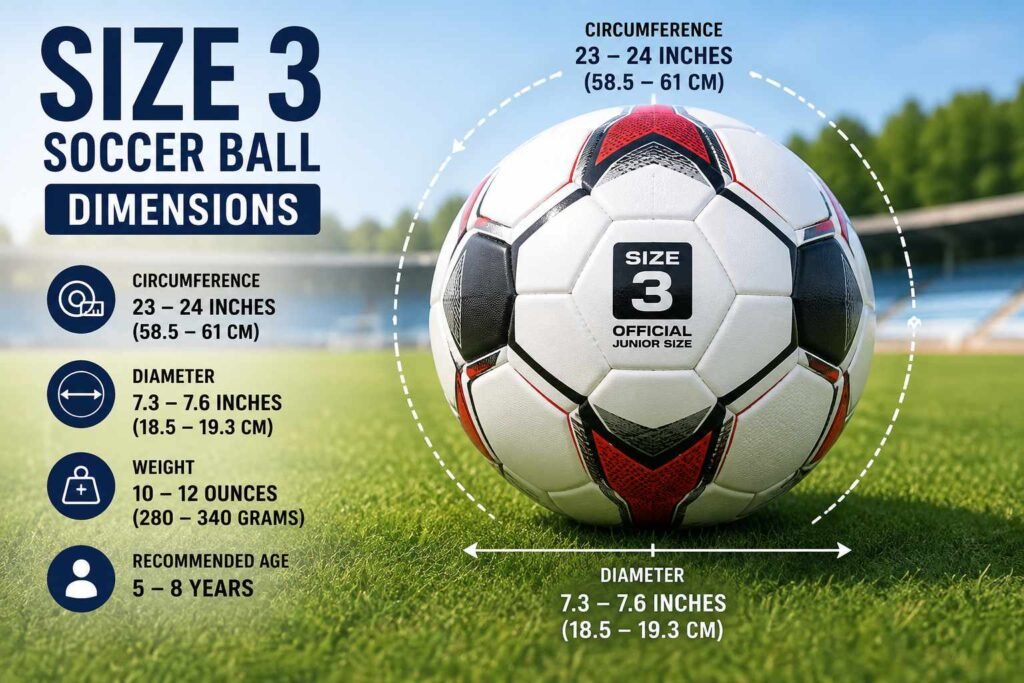
A typical Size 3 soccer ball measures approximately 23 to 24 inches around, equivalent to roughly 58.5 to 61 centimeters.
Its diameter is approximately 7.3 to 7.6 inches.
Because different manufacturers use different materials and construction methods, individual products may have slightly different specifications.
Size 3 Measurement Guide
| Specification | Approximate Measurement |
|---|---|
| Circumference | 23–24 inches |
| Circumference | 58.5–61 cm |
| Diameter | Approximately 7.3–7.6 inches |
| Typical weight | Around 10–12 ounces |
| Ball category | Junior / youth |
These measurements provide a useful reference when shopping, but official competition requirements should always be checked separately.
Why Circumference Matters More Than Diameter
When people search for the dimensions of a soccer ball, they often focus on diameter. However, circumference is normally the more useful measurement when identifying soccer ball sizes.
Circumference measures the distance around the entire ball. This measurement remains a convenient way to distinguish one soccer ball category from another.
For example, a Size 3 ball is smaller around than a Size 4, while a Size 5 is larger again.
If you are comparing products online, look for the listed circumference or official ball size rather than trying to judge the dimensions from a product photograph.
How Large Is a Size 3 Soccer Ball in Real Life?
The numbers can be difficult to visualize, so consider how the ball feels during play.
A Size 3 soccer ball is compact enough for a young player to move comfortably around the field. Its reduced circumference means that children do not have to stretch their feet as much to get around the ball during close-control exercises.
This can be particularly helpful when a child is learning basic footwork.
The ball is still large enough to behave like a conventional soccer ball, allowing children to learn passing, receiving, dribbling, and shooting techniques that they can later transfer to larger equipment.
Size 3 Soccer Ball Weight
Size is not the only physical difference between soccer balls. Weight is another factor worth considering.
A typical Size 3 soccer ball weighs approximately 10 to 12 ounces, although the precise weight varies from one product to another.
The materials used in the outer shell, internal bladder, and panel construction can all influence the final weight.
For a young player, a manageable ball can make repetitive practice more comfortable. Instead of concentrating on handling an oversized ball, the player can spend more time developing technique.
If you are buying a ball for a specific competition, check its official specifications rather than relying on an average measurement.
What Age Group Uses Size 3?
Size 3 is generally associated with younger children, commonly around 5 to 8 years old.
That does not mean every 7-year-old or 8-year-old must use Size 3. Youth soccer programs organize players differently, and some leagues change ball size at different ages.
The safest approach is to consider three things:
- The player’s age group
- The rules of their soccer organization
- The equipment recommended by their coach
This is especially important when purchasing several balls for a team.
Why Children Benefit From the Smaller Size
Learning soccer requires thousands of small interactions with the ball. Children need to become comfortable controlling its movement before advanced techniques start to feel natural.
A Size 3 ball can provide a manageable starting point.
A young player can use it to work on:
- Keeping the ball close while moving
- Changing direction
- Passing to a teammate
- Receiving a moving pass
- Using both feet
- Controlling the first touch
- Shooting toward a target
- Improving general foot coordination
The objective is to build familiarity. Once a child becomes comfortable controlling the ball, increasing the ball size becomes a more natural progression.
Size 3 vs. Size 4: What’s the Difference?
The two sizes are both associated with youth soccer, but they are not identical.
A Size 3 ball generally measures 23–24 inches in circumference. A Size 4 ball is larger at approximately 25–26 inches.
That difference may not sound dramatic, but a young player can notice it immediately.
Size 4 is commonly introduced as players move into older youth divisions. Whether a child should make the switch depends on their soccer program and competition rules.
Size 3 vs. Size 5: A Bigger Jump
Size 5 is the standard full-size soccer ball used by older youth players and adults.
Its circumference is generally around 27–28 inches.
Compared with a Size 3 ball, the difference is substantial. The larger ball requires more reach and can require greater control from the player.
This is why giving a very young child a full-size ball is not always the best way to introduce them to soccer.
Quick Comparison
| Ball | Approximate Circumference | General Use |
| Size 3 | 23–24 in. | Younger players |
| Size 4 | 25–26 in. | Youth players |
| Size 5 | 27–28 in. | Older youth and adults |
These are general categories rather than universal age rules.
Can a Size 3 Ball Be Used at Home?
A Size 3 ball can be an excellent option for home practice when it is appropriate for the child’s age.
You do not need a full soccer field to develop basic skills. A small safe area can be enough for activities such as:
Ball Touches
Have the child alternate touches between their left and right foot while keeping the ball nearby.
Cone Dribbling
Place several cones a short distance apart and encourage the player to weave through them while maintaining control.
Wall Passing
If the playing environment is suitable, controlled passes against a wall can help develop receiving and passing skills.
Target Practice
Create a simple target and ask the player to aim rather than simply kick as hard as possible.
Short, regular sessions can be more beneficial than occasional long practices.
Is Size 3 Suitable for Soccer Training?
For younger players, yes.
A Size 3 ball can be incorporated into technical training because it gives children equipment that matches their physical development.
Coaches may use smaller balls for exercises involving close control, while parents can use them for casual practice.
However, training requirements can differ between clubs and age groups. If the child is preparing for an official match, use the size specified by the competition.
What Should You Check Before Buying?
The number printed on the ball is important, but there are several other factors worth considering.
Ball Material
The outer cover affects the ball’s feel and durability. Consider whether the ball will be used indoors, on grass, artificial turf, or another surface.
Construction
Panel design and manufacturing method can influence how the ball behaves when kicked.
Inflation
A correctly inflated ball will generally perform more consistently than one that is significantly underinflated or overinflated.
Player Experience
A beginner may prioritize comfort and control, while a more experienced youth player may have specific training requirements.
League Rules
For organized soccer, the league’s regulations should be the final authority on ball size.
Common Questions About Size 3 Soccer Balls
What are the standard size 3 soccer ball dimensions?
A typical Size 3 ball has a circumference of about 23–24 inches, or approximately 58.5–61 centimeters.
How wide is a Size 3 soccer ball?
Its approximate diameter is 7.3–7.6 inches, depending on the actual circumference and inflation.
Is Size 3 the smallest regular soccer ball?
No. Smaller novelty and skills-training balls also exist. Size 3 is, however, one of the commonly recognized junior soccer ball sizes.
Is Size 3 suitable for a 6-year-old?
In many youth programs, yes. Size 3 is commonly associated with younger players, including children around six years old. The specific league rules should still be checked.
Should an 8-year-old use Size 3?
It depends on the player’s soccer program. Some organizations continue with Size 3 for younger divisions, while others move players toward Size 4.
Can adults train with a Size 3 ball?
Yes. Adults can use a smaller ball for technical drills, close-control exercises, and certain skill-development activities. It simply is not the standard match ball for adult soccer.
Is Size 3 easier to control?
For many young players, the smaller dimensions can make the ball easier to manage. Control also depends on the player’s experience and technique.
Final Takeaway
Understanding size 3 soccer ball dimensions is useful when shopping for equipment for a young player.
The typical Size 3 soccer ball has a circumference of around 23–24 inches, with an approximate diameter of 7.3–7.6 inches and a typical weight of around 10–12 ounces.
Its smaller format makes it a popular choice for younger soccer players who are learning fundamental skills. It can also be useful for backyard practice and technical training.
Before purchasing, don’t rely on age alone. Check the ball’s specifications and, if the player participates in organized soccer, confirm the requirements of their league or coach.
Choosing equipment that fits the player’s stage of development can help make practice more comfortable, enjoyable, and productive.