
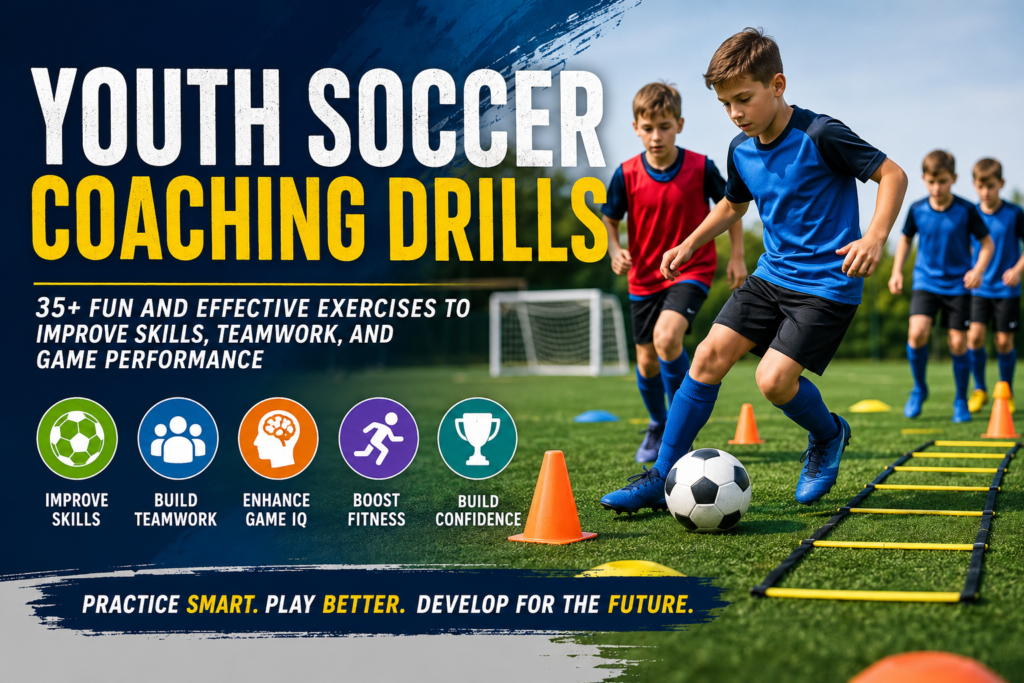
These Youth Soccer Coaching Drills are designed to build technical ability, confidence, and teamwork while keeping every session engaging. By combining skill-focused activities with game-like scenarios, Youth Soccer Coaching Drills help players improve faster and enjoy the learning process.
Introduction (Featured Snippet Ready)
Youth soccer coaching drills are structured practice activities that help young players develop essential soccer skills, improve teamwork, build confidence, and understand game situations. These drills focus on core fundamentals such as dribbling, passing, shooting, ball control, defending, agility, and decision-making while keeping training sessions enjoyable and age-appropriate.
Whether you’re coaching beginners or experienced youth teams, choosing the right exercises can significantly improve player development. Well-designed Youth Soccer Coaching Drills encourage consistent repetition, increase player engagement, and create a positive learning environment where athletes gain both technical ability and tactical awareness.
The most effective coaching sessions combine individual skill work with small-sided games and competitive activities. This balanced approach helps players transfer what they learn in practice to real match situations while maintaining motivation throughout the season.
| Key Benefit | Why It Matters |
| Technical Skills | Improves dribbling, passing, shooting, and ball control |
| Teamwork | Develops communication and cooperation |
| Game Intelligence | Enhances decision-making under pressure |
| Fitness | Builds speed, agility, coordination, and endurance |
| Confidence | Creates a fun environment that encourages continuous improvement |
What Are Youth Soccer Coaching Drills?
Youth Soccer Coaching Drills are structured training exercises designed to help young players develop the technical, physical, tactical, and mental skills required to play soccer effectively. Rather than simply practicing isolated movements, these drills simulate real-game situations, allowing players to learn through repetition, decision-making, and teamwork.
Coaches use age-appropriate activities to teach fundamental skills such as dribbling, passing, shooting, ball control, defending, and movement without the ball. As players progress, drills become more challenging by introducing pressure, limited space, and competitive scenarios that improve game awareness and confidence.
Effective Youth Soccer Coaching Drills should be fun, engaging, and adapted to the players’ age and ability level. Short, high-energy exercises help maintain focus while maximizing touches on the ball, ensuring every player stays actively involved throughout the session.
| Drill Purpose | Player Development |
| Technical Training | Improves dribbling, passing, shooting, and first touch |
| Tactical Awareness | Builds positioning, spacing, and decision-making |
| Physical Development | Enhances speed, agility, balance, and coordination |
| Team Play | Strengthens communication and cooperation |
| Mental Growth | Increases confidence, concentration, and resilience |
When coaches consistently combine these elements, training sessions become more productive, enjoyable, and effective for long-term player development. The next section explores the key benefits these drills provide and why they are essential for every youth soccer program.
Why Youth Soccer Coaching Drills Matter
Consistent practice activities in youth soccer are essential because they transform basic participation into structured skill development. Building on foundational concepts of structured learning, these sessions ensure players develop in a progressive and meaningful way.
Soccer Training Drills play a critical role in bridging the gap between individual technique and real match performance. They allow young athletes to repeat key movements such as passing, dribbling, and shooting under controlled conditions before applying them in competitive situations.
One of the main reasons Soccer Training Drills are so important is their ability to create consistency in learning. When players repeatedly practice the same core skills in varied scenarios, they develop muscle memory, faster reaction times, and better decision-making under pressure.
These drills also support long-term player development by improving both physical and cognitive abilities. Coaches can gradually increase difficulty by adding defenders, reducing space, or limiting touches, which helps simulate real-game intensity.
In addition, structured drills help coaches identify strengths and weaknesses in players more effectively. This allows for targeted feedback and personalized improvement plans that maximize each athlete’s potential.
Ultimately, well-designed training sessions ensure that learning is not random but systematic and measurable. This makes Soccer Training Drills a cornerstone of any successful youth coaching program.
Principles of Effective Youth Soccer Coaching
Effective training environments in youth football are built on clear structure, purposeful activity design, and consistent player engagement. After understanding why structured practice matters, the next step is applying coaching principles that ensure long-term player growth and enjoyment.
Youth Soccer Coaching is most effective when it prioritizes learning through play rather than rigid instruction. Coaches should focus on guiding players with simple cues, allowing them to discover solutions through game-like scenarios instead of constant correction.
Another key principle in Youth Soccer Coaching is age-appropriate progression. Younger players benefit from fun, high-repetition activities, while older groups require more tactical challenges, pressure-based drills, and decision-making tasks that reflect real match conditions.
Consistency in feedback is also essential. Positive reinforcement helps build confidence, while clear, specific instructions ensure players understand what to improve without feeling overwhelmed. Coaches should balance encouragement with technical guidance.
| Coaching Principle | Practical Application |
| Player-Centered Learning | Encourage decision-making and creativity |
| Age Appropriateness | Adjust drill complexity by age group |
| High Engagement | Maximize ball touches and active participation |
| Positive Feedback | Reinforce effort and improvement |
| Game Realism | Use small-sided, match-like scenarios |
In addition, effective coaching requires flexibility. Every team and individual develops at a different pace, so drills should be adaptable based on skill level, confidence, and understanding of the game.
By applying these principles consistently, coaches can create a supportive environment where players enjoy learning while steadily improving their technical and tactical abilities.
How to Structure a Youth Soccer Practice
A well-organized training session ensures that players stay engaged, maximize ball touches, and develop both technical and tactical skills in a logical progression. After understanding core coaching principles, the next step is applying them through structured sessions that support consistent improvement.
Effective Youth Soccer Practice Plans begin with a clear flow that gradually increases intensity. Each phase of the session should serve a specific purpose, from preparing the body to reinforcing game-related skills under pressure.
A typical structure includes a dynamic warm-up, technical drills, skill-based activities, small-sided games, and a controlled cool-down. This progression helps players transition smoothly from basic movement to realistic match scenarios while maintaining focus and energy.
| Session Phase | Objective |
| Dynamic Warm-Up | Prepare muscles, improve mobility, and reduce injury risk |
| Technical Drills | Develop core skills like passing, dribbling, and ball control |
| Skill-Based Activities | Apply techniques in controlled scenarios |
| Small-Sided Games | Improve decision-making and tactical awareness |
| Cool-Down | Support recovery and reflection |
Well-designed Youth Soccer Practice Plans also ensure equal participation. Coaches should avoid long waiting lines and instead design activities that keep all players active with frequent touches on the ball.
Time management is equally important. Short, high-intensity blocks of 10–15 minutes per activity help maintain concentration, especially for younger age groups. Adjusting intensity based on age and skill level ensures that every player is challenged appropriately without being overwhelmed.
Finally, coaches should include reflection time at the end of each session. Brief feedback discussions help players understand what they learned and how to improve in the next practice.
Best Youth Soccer Coaching Drills by Skill
High-quality player development depends on selecting drills that target specific technical and tactical abilities in a progressive way. After learning how to structure an effective session, the next step is choosing skill-focused activities that maximize improvement in real-game performance.
Soccer Training Drills should be organized by core skill categories such as passing, dribbling, shooting, ball control, and defensive awareness. This ensures players build a complete foundation rather than focusing on isolated or repetitive movement patterns without game context.
Each category of Soccer Training Drills should gradually increase in difficulty by adding pressure, reducing space, or introducing opponents. This helps players transfer individual skills into realistic match situations more effectively.
A balanced training approach ensures that no key skill is neglected. Coaches should rotate Soccer Training Drills throughout the week so players are exposed to different challenges that support overall development.
In addition, incorporating small-sided games after technical drills helps reinforce learning by applying skills in dynamic, unpredictable environments. This combination is essential for building confident and adaptable players.
Age-Specific Youth Soccer Coaching Drills
Effective coaching progression depends on adapting training intensity, complexity, and expectations to match the physical and cognitive development of players. After reviewing skill-based training categories, the next step is tailoring activities to age groups for maximum learning impact.
Soccer Drills for Kids should always prioritize enjoyment, repetition, and basic coordination. Younger players benefit most from simple activities that focus on movement, ball familiarity, and fun competition rather than tactical instruction or structured systems.
As players grow, Soccer Drills for Kids gradually evolve into more structured exercises that introduce passing combinations, positional awareness, and controlled pressure. This progression ensures that technical foundations are built before adding tactical complexity.
| Age Group | Training Focus | Drill Style |
| U5–U6 | Movement & fun | Simple ball games, coordination drills |
| U7–U8 | Basic technique | Dribbling, passing, and shooting games |
| U9–U10 | Skill development | Small-sided games, decision-making |
| U11–U12 | Tactical introduction | Positioning, spacing, team play |
| U13–U15 | Competitive training | Pressure drills, match simulation |
| U16–U18 | Advanced performance | Tactical systems, conditioning |
For younger age groups, sessions should be short, highly active, and game-based to maintain attention and motivation. Coaches should avoid overloading players with instructions and instead allow learning through play and repetition.
In older youth categories, drills should become more challenging by introducing constraints such as limited touches, smaller playing areas, and opponent pressure. This helps bridge the gap between training and real match conditions.
Understanding these developmental stages ensures that coaching remains effective and prevents burnout or skill stagnation. Properly designed Soccer Drills for Kids create a structured pathway from basic coordination to advanced tactical awareness.
Common Coaching Mistakes and How to Avoid Them
Even well-planned training sessions can lose effectiveness if common coaching errors are not addressed. After understanding age-specific development stages, it becomes essential to identify mistakes that limit player growth and reduce engagement during practice.
One of the most important Youth Soccer Coaching Tips is avoiding overcomplicated drills. When exercises are too complex, players become confused and spend more time waiting for instructions than actively playing, which reduces learning efficiency.
Another key aspect of Youth Soccer Coaching Tips is ensuring maximum player involvement. Long lines and inactive waiting periods significantly reduce touches on the ball, slowing down technical development and lowering motivation.
Coaches should also avoid delivering constant instructions during play. Instead, brief feedback during breaks is more effective and allows players to learn through experience. This is a core principle in effective Youth Soccer Coaching Tips that supports long-term development.
Additionally, failing to adjust drills based on skill levels can lead to frustration for beginners and boredom for advanced players. Balanced progression ensures every athlete is appropriately challenged and remains motivated throughout the season.
By correcting these common mistakes, training sessions become more efficient, engaging, and development-focused.
Essential Equipment for Youth Soccer Coaching Drills
Well-structured training sessions become significantly more effective when coaches use the right tools to support organization, engagement, and skill development. After identifying common coaching mistakes, the next step is ensuring that every practice environment is properly equipped.
Soccer Coaching Equipment plays a key role in creating organized, high-repetition training sessions where players stay active and engaged. The right equipment allows coaches to design varied drills that improve technical ability, coordination, and decision-making under realistic conditions.
Using essential Soccer Coaching Equipment also helps reduce downtime during sessions by enabling multiple activities to run simultaneously. This increases player involvement and maximizes the number of ball touches per training session.Coaches should ensure that equipment is set up before training begins to maintain session flow and avoid unnecessary delays. Simple organization significantly improves training efficiency and keeps players focused.
High-quality Soccer Coaching Equipment does not need to be expensive, but it must be versatile and suitable for age-appropriate drills. Proper usage helps create a professional training environment that enhances learning outcomes.
How to Measure Player Improvement
Tracking progress is essential for ensuring that training sessions lead to real, measurable improvement over time. After understanding the role of proper coaching tools, the next step is evaluating how effectively players are responding to structured practice environments.
Player Development in youth soccer should be measured through both technical performance and behavioral growth. This includes assessing how well players execute skills under pressure, make decisions during gameplay, and adapt to different match situations.
Consistent observation during drills and small-sided games allows coaches to identify strengths, weaknesses, and progress patterns. This helps ensure that Player Development is not based on guesswork but on clear, observable improvement over time.
| Evaluation Area | What Coaches Should Look For |
| Technical Skills | Passing accuracy, dribbling control, shooting consistency |
| Tactical Awareness | Positioning, spacing, decision-making |
| Physical Growth | Speed, agility, endurance, coordination |
| Mental Attributes | Confidence, focus, resilience |
| Game Application | Ability to transfer skills into match situations |
In addition to observation, simple performance tracking methods such as scoring systems, skill benchmarks, and session feedback forms can provide valuable insight into long-term progress. This structured approach ensures that improvements are measurable rather than subjective.
Regular evaluation also helps coaches adjust training intensity and drill selection to better support each player’s individual needs, strengthening overall Player Development across the team.
Frequently Asked Questions (People Also Ask)
Common questions from coaches often focus on how to design effective sessions that balance structure, enjoyment, and skill development. After understanding how to evaluate player progress, it becomes important to clarify practical concerns that directly impact day-to-day coaching decisions.
These answers help simplify planning for youth soccer coaching drills, ensuring coaches can deliver sessions that are both organized and development-focused. Below are the most frequently asked questions with clear, actionable guidance.
What are the best youth soccer coaching drills?
The best drills are game-based activities that combine technical skill with decision-making. Small-sided games, passing combinations, and dribbling under pressure are highly effective because they replicate real match situations.
How long should a youth soccer practice last?
Training duration depends on age. Younger players (U5–U8) should train 45–60 minutes, while older groups (U9–U18) can train 60–90 minutes with higher intensity and complexity.
How many drills should be included in one practice?
A typical session should include 4–6 focused activities. This allows enough repetition without overwhelming players or reducing engagement.
What equipment is needed for youth soccer drills?
Essential items include soccer balls, cones, bibs, mini goals, agility ladders, and marker discs. These tools support structured and varied training environments.
| Equipment | Purpose |
| Cones | Space organization and movement drills |
| Bibs | Team differentiation in games |
| Mini goals | Finishing and accuracy practice |
| Balls | Core technical development |
How can coaches keep young players engaged during practice?
High activity levels, minimal waiting time, and competitive games are key. Sessions should be fun, fast-paced, and age-appropriate to maintain attention and motivation.
Using well-structured youth soccer coaching drills ensures players stay active while continuously improving their technical and tactical abilities.
Conclusion
Effective player development in youth soccer depends on consistency, structure, and well-designed practice environments. After addressing common coaching questions, it becomes clear that success comes from applying simple, repeatable systems rather than overly complex training methods.
Youth Soccer Coaching Drills provide the foundation for building technical ability, tactical awareness, and confidence in young players. When these drills are organized properly, they create a clear progression from basic skills to match-ready performance, ensuring long-term improvement.
The most effective coaching approach combines technical repetition with game-based learning. This allows players to understand skills in context while staying engaged and motivated throughout every session.
| Key Takeaway | Coaching Impact |
| Consistency matters | Builds long-term skill retention |
| Game-based training | Improves decision-making |
| Age-appropriate drills | Prevents burnout and frustration |
| High engagement sessions | Maximizes learning and participation |
By applying well-structured Youth Soccer Coaching Drills, coaches can create a positive environment where players enjoy learning while steadily improving their abilities. The focus should always remain on development, enjoyment, and gradual progression rather than short-term performance.
Ultimately, effective coaching is about creating experiences that help players grow both on and off the field. With the right drills and structure, every training session becomes an opportunity to build stronger, smarter, and more confident athletes.
Next, coaches can explore advanced training systems and seasonal planning strategies to further enhance long-term player development.