
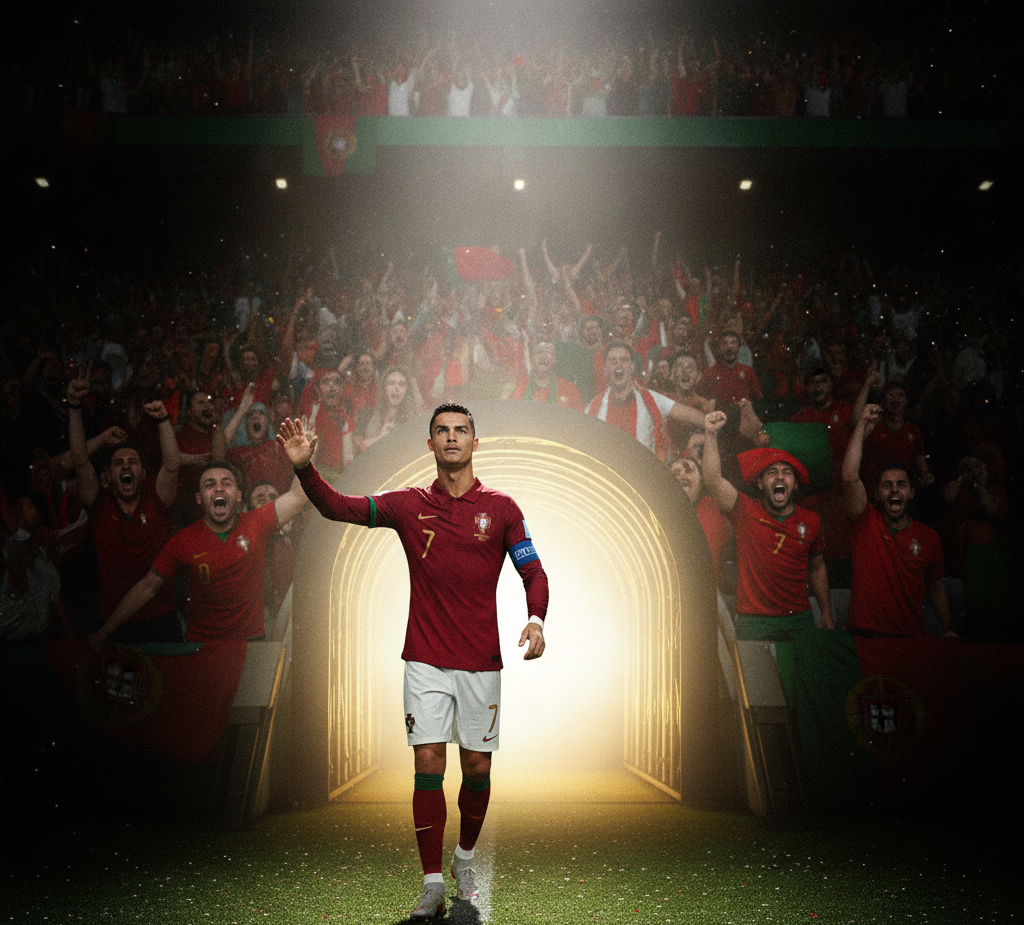
Many articles simply mention Ronaldo’s age and stop there.
The reality is more complex.
Most footballers experience a gradual decline because of accumulated injuries, reduced recovery speed, and lower physical output.
Ronaldo’s career has been unusual because he invested heavily in maintaining his body long before retirement became a topic.
Former teammates, coaches, and fitness experts have repeatedly highlighted his focus on:
- Recovery routines
- Strength training
- Body composition
- Nutrition
- Sleep quality
This does not guarantee World Cup participation, but it explains why analysts continue discussing the possibility.
A typical 41-year-old footballer and Cristiano Ronaldo are not facing the same circumstances.
Looking Back at Ronaldo’s Previous World Cups
Understanding his World Cup history helps explain why 2026 remains such an important topic.
2006 World Cup
A young Ronaldo announced himself on football’s biggest stage.
Portugal reached the semifinals, giving fans a glimpse of his potential.
2010 World Cup
Expectations were much higher.
By this point, Ronaldo had already become one of the world’s best players.
2014 World Cup
Portugal struggled as a team, and injuries affected preparation.
The tournament was disappointing compared to expectations.
2018 World Cup
Many fans remember Ronaldo’s incredible hat-trick against Spain.
That match remains one of the greatest individual World Cup performances of the modern era.
2022 World Cup
The tournament marked a transition period for Portugal.
Younger players began taking on larger responsibilities, raising questions about Ronaldo’s future role.
This progression helps explain why a potential 2026 appearance would be historic.
What Portugal’s Squad Could Look Like in 2026
Another factor often ignored in discussions about Ronaldo is the quality of Portugal’s emerging generation.
Portugal continues producing talented players across Europe.
By 2026, several younger stars will likely be entering their peak years.
This creates two possible outcomes:
Scenario One: Ronaldo Complements the Young Core
In this situation, Ronaldo provides experience, leadership, and finishing ability while younger players handle much of the physical workload.
Many successful national teams have used veteran players in this role.
Scenario Two: Portugal Fully Transitions to a New Era
If younger attackers establish themselves as clear first-choice options, Portugal may prioritize long-term development.
This decision would not diminish Ronaldo’s legacy—it would simply reflect football’s natural cycle.
The Statistics Fans Should Actually Watch
Many supporters focus only on goals.
National team coaches evaluate far more than scoring numbers.
Over the next few years, these indicators may be more important:
Minutes Played
Regular playing time often indicates trust from coaches.
Injury Availability
Consistent availability can be just as important as performance.
Performance Against Strong Opponents
Scoring against weaker teams is useful, but performances against elite opposition carry significant weight.
Physical Output
Modern football tracks running distance, pressing actions, and overall involvement.
These metrics help coaches assess whether a player can still contribute at the highest level.
Can Ronaldo Break Another World Cup Record?
One reason fans remain fascinated by the possibility of a 2026 appearance is the potential for more records.
Throughout his career, Ronaldo has repeatedly extended records related to:
- International goals
- International appearances
- Tournament participation
- Longevity at the highest level
A 2026 appearance would add another remarkable chapter to an already historic career.
Even football supporters who prefer other players recognize that his longevity is extraordinary.
Lessons Young Athletes Can Learn From Ronaldo
The discussion about the 2026 World Cup is not only about football.
It also highlights principles that apply to many careers.
Consistency Beats Motivation
Ronaldo’s success is often linked to habits rather than occasional bursts of motivation.
Adaptation Is Essential
The player who dominated defenders at age 22 is very different from the player competing at age 40.
He changed his game repeatedly to remain effective.
Recovery Is Part of Performance
Many amateur athletes focus only on training.
Elite athletes understand that recovery is equally important.
Long-Term Thinking Creates Opportunities
The reason people still discuss Ronaldo and the 2026 World Cup is because of decisions made throughout his career, not just in recent years.
The Biggest Reason Fans Believe He Can Do It
Most football predictions are based on historical patterns.
History says very few outfield players remain competitive at the highest international level beyond age 40.
The challenge for analysts is that Ronaldo has spent much of his career breaking historical patterns.
When people ask whether he can play in the 2026 World Cup, they are really asking a larger question:
Can one of football’s most disciplined athletes extend his career beyond limits that traditionally ended the careers of others?
That uncertainty is what keeps the debate alive.
Expanded FAQs
Has any outfield player appeared in a World Cup at age 41?
Yes, there have been older World Cup participants, although most were goalkeepers. Outfield players competing at that age remain extremely rare.
Would Ronaldo need to start every match to justify selection?
No. Modern tournament squads often include experienced players who contribute through leadership, rotation, and specific tactical roles.
What is the biggest obstacle between Ronaldo and the 2026 World Cup?
Maintaining elite-level performance while competing against younger players over the next several seasons.
Could Portugal be stronger without relying heavily on Ronaldo?
Possibly. Much depends on how younger attackers develop and how the coaching staff wants to structure the team.
Why is this topic so popular among football fans?
Because it combines two fascinating storylines: the future of one of football’s greatest players and the challenge of competing at an age few elite athletes ever reach.
What is the most realistic prediction today?
The most balanced answer is that a 2026 appearance is possible, but the final decision will depend on form, fitness, squad competition, and Portugal’s tactical plans closer to the tournament.
A More Useful Way to Think About the Question
Instead of asking, “Will Ronaldo play in the 2026 World Cup?” a better question might be:
“What level does Ronaldo need to maintain over the next few years to earn a place in Portugal’s squad?”
That shifts the conversation from speculation to performance.
And ultimately, performance—not reputation—is what determines World Cup selection.
That is exactly what makes the next chapter of Ronaldo’s international career so interesting to follow.