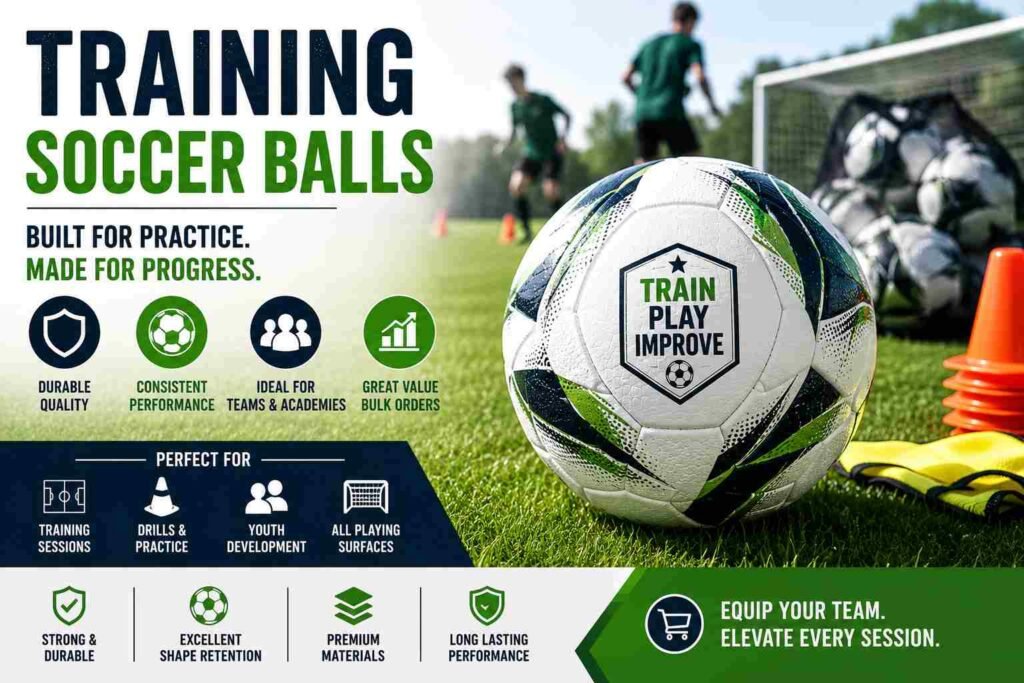
Regular practice is where soccer players develop the skills they use during competitive matches. Passing, dribbling, shooting, receiving, ball control, and decision-making all depend on having reliable equipment available during training.
For this reason, choosing the right training soccer balls is an important decision for soccer clubs, academies, schools, coaches, camps, and recreational programs.
Training balls are used more frequently than many match-focused products. They may be kicked hundreds of times during a single practice, used on different playing surfaces, transported between fields, and handled by players of different ages and skill levels.
A suitable training ball should therefore match the way it will actually be used.
What Are Training Soccer Balls?
Training soccer balls are designed primarily for regular practice and development sessions.
They are commonly used for activities such as:
- Passing drills
- Shooting practice
- Dribbling exercises
- Ball-control sessions
- Small-sided games
- Team practices
- Youth development
- Soccer camps
- Academy training
The ideal training ball depends on the players, age group, training environment, frequency of use, and available budget.
A professional academy may have different requirements from a recreational youth program, even though both organizations need soccer balls for practice.
Why Do Teams Need Dedicated Training Balls?
A soccer club may have several teams training during the same week. If every group depends on a limited number of match balls, equipment can quickly become difficult to manage.
Having a dedicated supply of training soccer balls allows coaches to organize drills without constantly moving equipment from one field to another.
It also means the club can reserve particular balls for competitive use while using separate products for everyday practice.
For organizations with multiple teams, buying training balls in bulk can make equipment planning considerably easier.
Training Soccer Balls for Clubs
Soccer clubs often have players across several age groups.
A single club may operate programs for young children, teenagers, adult players, recreational teams, and competitive squads.
Each group may require a different ball size or product specification.
When purchasing training soccer balls for teams, clubs should consider:
- Player age
- Ball size
- Training frequency
- Playing surface
- Number of teams
- Number of training fields
- Expected equipment usage
- Replacement requirements
- Budget
Planning these factors before ordering can help a club purchase an appropriate quantity instead of simply choosing the cheapest available option.
Choosing the Correct Soccer Ball Size
Ball size is one of the first things to consider when purchasing training equipment.
Different age groups may use different soccer ball sizes, so clubs and academies should confirm the requirements of their particular programs.
Size 5
Size 5 is commonly associated with older youth and adult soccer.
It is widely used for competitive and training environments involving players who are expected to use the standard full-size ball.
Size 4
Size 4 is commonly used for younger players and development programs.
It can provide a smaller option for players who are still developing their technique.
Size 3
Size 3 is designed for younger children and introductory soccer activities.
Because age-group requirements can vary between organizations, always check the relevant league or program specifications before ordering a large quantity.
What Makes a Good Training Soccer Ball?
A training ball needs to handle regular use while providing a consistent experience for players.
Several characteristics are worth considering.
Durability
Training equipment can experience significant wear.
Balls may be repeatedly kicked against goals, passed across different surfaces, used in drills, and transported between practices.
For this reason, durability should be one of the main considerations when selecting training equipment.
Consistent Shape
A soccer ball should maintain its intended shape during normal use.
A well-constructed product can provide a more predictable experience for players during passing, shooting, and receiving drills.
Suitable Surface
The outer surface influences how the ball feels when players interact with it.
The right surface should be selected according to the intended training environment and product specification.
Air Retention
A training ball that frequently loses pressure can become inconvenient for coaches and players.
Buyers should ask about the bladder and internal construction when comparing different products.
Soccer Training Balls for Youth Programs
Youth development programs have unique equipment requirements.
Young players are learning fundamental techniques, so coaches often need several balls available during the same session.
For example, a coach teaching ball-control exercises may want every player to have access to a ball rather than having a small group share one.
This makes quantity particularly important for youth academies.
A youth program should consider the number of players in each session and the number of balls needed for individual and group drills.
The appropriate ball size should also be selected according to the age group.
Training Soccer Balls for Academies
Soccer academies often conduct structured training programs throughout the week.
An academy may have multiple coaches, fields, age groups, and training sessions operating at the same time.
Having a consistent collection of training balls can make equipment management easier.
Academies can also use customized balls featuring their own logo and colors.
This can create a consistent visual identity across training facilities while helping coaches identify academy equipment.
Custom Training Soccer Balls
Training equipment does not have to look generic.
Organizations can explore custom training soccer balls featuring their own branding.
Customization can include:
- Academy logo
- Club crest
- Team colors
- Custom graphics
- Program name
- Tournament branding
- Sponsor information
A customized training ball can be particularly useful for organizations that want their equipment to reflect their brand.
For a large club, custom balls can also help create a consistent identity across different teams and training locations.
Bulk Training Soccer Balls
Organizations that need many balls should consider purchasing in bulk.
Bulk orders can be useful for:
- Soccer clubs
- Youth academies
- Schools
- Colleges
- Soccer camps
- Training centers
- Leagues
- Tournament organizers
- Sports retailers
Before ordering, estimate the number of players and teams that will use the equipment.
It is also worth keeping replacement stock available if the balls will be used heavily throughout the season.
How Many Training Balls Does a Team Need?
There is no single number that works for every team.
A small recreational team may need a relatively limited supply, while a large academy may require hundreds of balls across multiple training groups.
A useful way to estimate requirements is to consider the number of players participating in a typical session.
If a coach frequently runs individual ball-control exercises, more balls may be needed than for drills where players work in larger groups.
Also consider whether several teams train simultaneously.
A club should calculate requirements across its complete program rather than looking at one team in isolation.
Training Balls for Different Playing Surfaces
The surface where training takes place can influence the type of ball an organization should choose.
Soccer programs may train on:
- Natural grass
- Artificial turf
- Indoor surfaces
- School fields
- Community fields
A ball that works well in one environment may experience different levels of wear in another.
Before ordering, explain the intended playing surfaces to the supplier and ask which product specification is appropriate.
Hand-Stitched, Machine-Stitched, or Thermo-Bonded?
Construction is another important consideration when comparing training soccer balls.
Hand-Stitched
Hand-stitched balls are produced by joining panels through manual stitching.
They can be selected when buyers want a traditionally constructed product with an emphasis on craftsmanship and durability.
Machine-Stitched
Machine-stitched balls can be practical for training programs that require a larger quantity of equipment.
They are commonly considered when clubs need functional training products while managing a specific budget.
Thermo-Bonded
Thermo-bonded balls use heat to join the panels.
This construction can provide a different surface and design appearance and is often associated with premium soccer ball products.
There is no single construction method that is perfect for every training program. The decision should be based on the intended application and product requirements.
Training Soccer Balls for US Soccer Clubs
Soccer organizations in the USA operate at many different levels.
There are local recreational programs, competitive youth clubs, school teams, college programs, professional development academies, adult leagues, and soccer camps.
Each organization has different equipment needs.
For US clubs ordering from an international supplier, it is useful to prepare complete product requirements before requesting a quotation.
Include:
- Quantity
- Ball sizes
- Construction preference
- Intended use
- Customization requirements
- Logo files
- Delivery location
- Desired timeline
Clear information can help reduce misunderstandings and make the purchasing process more efficient.
How to Order Training Soccer Balls in Bulk
A bulk order does not have to be complicated when the requirements are organized.
Step 1: Identify Your Players
Determine which age groups will use the balls.
Step 2: Select Ball Sizes
Choose the sizes appropriate for each program.
Step 3: Determine Quantity
Estimate how many balls are needed for each team, field, and training session.
Step 4: Choose Construction
Decide whether hand-stitched, machine-stitched, thermo-bonded, or another option fits your program.
Step 5: Decide on Branding
If customization is required, prepare your club or academy logo and design.
Step 6: Request Product Details
Ask the supplier about materials, minimum order quantity, production time, quality control, and shipping.
Step 7: Review the Design
For customized products, check the artwork carefully before production begins.
Step 8: Confirm the Order
Once the specifications, quantity, design, and delivery arrangements are agreed upon, the order can move into production.
How to Maintain Training Soccer Balls
Even a durable training ball can benefit from proper care.
Coaches and equipment managers should regularly check:
- Air pressure
- Surface condition
- Shape
- Valve condition
- Visible damage
- Dirt and debris
Balls should also be stored appropriately after training.
Keeping equipment organized can make it easier to identify damaged products before the next practice.
Training Soccer Balls vs Match Balls
Training and match balls can serve different purposes.
A training program may prioritize durability, availability, and value because the balls are used repeatedly.
A match-focused product may place greater emphasis on particular performance characteristics and competition requirements.
For many clubs, using separate equipment for training and matches can make financial and operational sense.
The right approach depends on the club’s budget, playing level, league requirements, and training schedule.
What Should You Ask a Supplier?
Before buying training soccer balls in bulk, ask the supplier for clear information.
Useful questions include:
- What sizes are available?
- What construction options are offered?
- Which materials are available?
- What type of bladder is used?
- What is the minimum order quantity?
- Can the balls be customized?
- Can I provide my own logo?
- Is a design proof available?
- How long does production take?
- What quality checks are performed?
- What shipping options are available for the USA?
Getting these details before ordering can help you compare suppliers more effectively.
Why Choose SoccerBallClub for Training Balls?
SoccerBallClub provides soccer ball products for organizations that need training, custom, premium, and other soccer ball options.
Based in Sialkot, the company offers products including training balls, premium balls, thermo-bonded balls, hand-stitched products, and customized soccer balls.
For clubs, academies, teams, retailers, and other organizations, orders can be discussed around the required product type, quantity, design, and specifications.
The right training ball depends on the players and the environment in which it will be used. A clear discussion with the manufacturer can help buyers identify a suitable product before committing to a bulk order.
Final Thoughts
The right training soccer balls can make everyday practice easier for coaches and players.
Whether you manage a youth academy, soccer club, school program, training center, or recreational team, consider the ball size, construction, material, playing surface, quantity, and expected usage before purchasing.
For organizations with multiple teams, bulk purchasing can also simplify equipment planning and help maintain a consistent collection of training balls.
If customization is important, a manufacturer can develop balls featuring your club logo, academy branding, colors, or other artwork.
For US soccer organizations looking for soccer training balls, bulk training soccer balls, custom training balls, or training soccer balls for teams, SoccerBallClub can help you explore options based on your requirements.