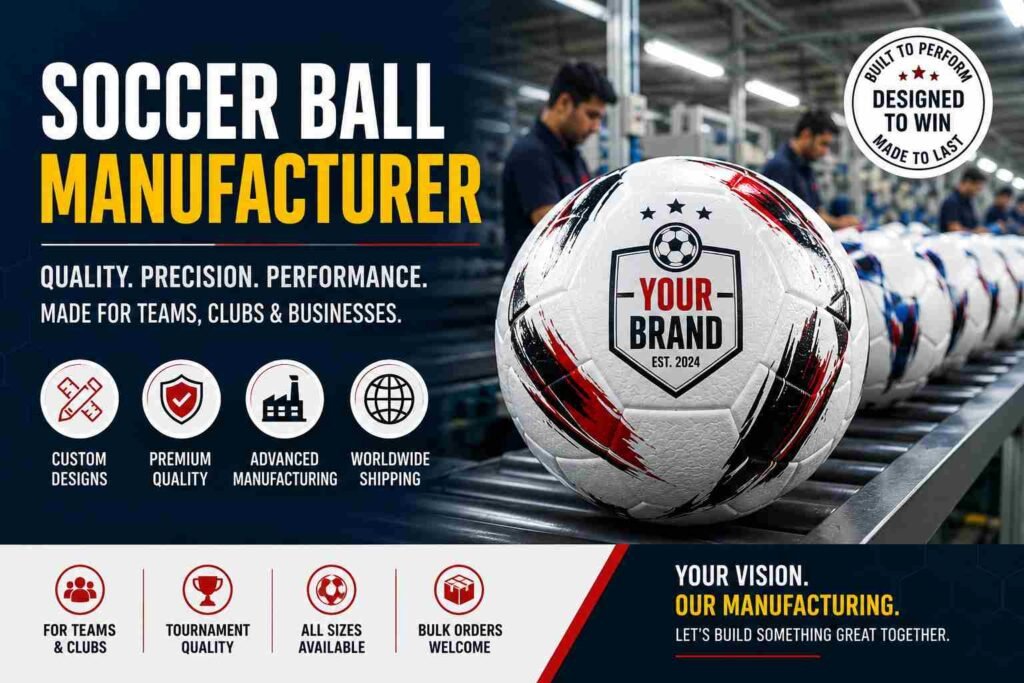
Finding the right soccer ball manufacturer is an important decision for clubs, academies, retailers, distributors, sports brands, schools, and tournament organizers. When a business needs soccer balls in larger quantities, choosing a supplier is about much more than finding a product at a low price.
The manufacturer needs to understand the required ball specifications, production quantity, artwork, materials, construction, packaging, and delivery requirements. For custom orders, even small details can affect the finished product.
A good manufacturing relationship can also make future orders easier. Once a product specification has been established, organizations may be able to reorder the same design or develop new versions for different teams and programs.
What Does a Soccer Ball Manufacturer Do?
A soccer ball manufacturer produces soccer balls according to specific product requirements.
Depending on the company, manufacturing services may include:
- Soccer ball design
- Material selection
- Panel preparation
- Ball construction
- Printing and customization
- Stitching or bonding
- Bladder installation
- Quality inspection
- Packaging
- Bulk production
- International shipping
Some manufacturers focus primarily on standard products, while others specialize in customized and private-label soccer balls.
For a business ordering a large quantity, understanding what the manufacturer can actually produce is essential.
Why Work Directly With a Soccer Ball Manufacturer?
Buying directly from a manufacturer can be useful when an organization needs products in quantity or wants a custom design.
A direct manufacturing relationship can provide more flexibility over product specifications than simply selecting an off-the-shelf ball.
For example, a soccer organization may want to choose:
- Ball size
- Outer material
- Construction method
- Colors
- Graphics
- Logo placement
- Packaging
- Quantity
The exact options depend on the manufacturer’s capabilities and the requirements of the order.
For businesses building their own sports brand, working with a manufacturer can also provide an opportunity to develop products around their own identity.
Custom Soccer Ball Manufacturing
Custom soccer balls are designed around the buyer’s requirements rather than using a completely generic appearance.
A custom project can include a club logo, team colors, company branding, tournament artwork, sponsor information, or an original graphic concept.
This makes customized production suitable for many types of customers.
Soccer Clubs
Clubs can create balls featuring their official colors and crest.
Soccer Academies
Academies can use branded balls during regular training programs.
Sports Retailers
Retailers can develop products for their own customer base or private-label collections.
Tournament Organizers
Events can use specially designed balls carrying tournament branding.
Sports Brands
A sports company can develop a product line with its own visual identity and specifications.
What Materials Are Used in Soccer Balls?
The material used on the outside of a soccer ball can influence its feel, durability, appearance, and playing characteristics.
Modern soccer balls commonly use synthetic materials rather than traditional leather.
Depending on the product, manufacturers may offer different material options and surface finishes.
When discussing a custom order, buyers should ask the manufacturer which material is being proposed and why it is suitable for the intended application.
A training ball designed for frequent practice may have different priorities from a premium ball intended for competitive use.
Soccer Ball Construction Methods
Construction is another important part of manufacturing.
Different soccer balls can be produced using different methods.
Hand-Stitched Soccer Balls
Hand stitching involves manually joining the panels.
This construction method is often associated with craftsmanship and can be selected for products where durability and traditional construction are important considerations.
Machine-Stitched Soccer Balls
Machine stitching is commonly used for products intended for regular training and larger-volume programs.
It can provide an efficient manufacturing process for producing substantial quantities.
Thermally Bonded Soccer Balls
Thermal bonding joins panels using heat rather than traditional stitching.
This construction can provide a clean surface and is used in various premium soccer ball designs.
The appropriate construction depends on the intended use, product requirements, and budget.
How to Choose a Soccer Ball Manufacturer
Not every manufacturer will be suitable for every buyer.
Before placing an order, evaluate several important factors.
Manufacturing Experience
Look for a supplier that understands soccer ball production rather than simply acting as a reseller.
Experience can be particularly important when an order involves custom specifications.
Product Range
Check whether the manufacturer produces the type of soccer balls you actually need.
A company may specialize in training balls, premium balls, custom products, or several categories.
Customization
If you need your own design, confirm that the manufacturer can reproduce your artwork accurately.
Ask about logo printing, colors, panel graphics, packaging, and other customization options.
Quality Control
A manufacturer should have a process for checking finished products before shipment.
Ask how products are inspected and what happens if an issue is identified.
Production Capacity
Large orders require adequate production capacity.
A supplier should be able to explain whether it can handle your required quantity within the expected timeframe.
Communication
Clear communication is especially important for international orders.
Specifications should be confirmed in writing before production begins.
What Should You Ask Before Placing an Order?
Before choosing a soccer ball manufacturer, prepare a list of questions.
What Is the Minimum Order Quantity?
Minimum order quantities can vary according to product type and customization.
If you are a small club or new brand, make sure the required quantity fits your business model.
Can You Produce Custom Designs?
If branding is important, confirm exactly what customization is available.
Can You Provide a Sample?
A sample or design proof can help confirm the appearance and specifications before a larger production run.
What Is the Production Time?
Ask for an estimated production schedule before confirming the order.
What Packaging Options Are Available?
Retail products may require different packaging from bulk training balls.
Do You Ship Internationally?
If you are ordering from the USA or another country, confirm the available shipping arrangements.
Soccer Ball Manufacturer for US Buyers
US buyers have several types of soccer equipment requirements.
A youth club may need hundreds of training balls. A retailer may want a private-label collection. An academy may need custom equipment for different programs.
For these buyers, selecting a manufacturer should begin with the intended use.
If the product is primarily for training, durability and value may be important.
If the product is intended for retail, appearance, packaging, and branding may receive greater attention.
If the balls are being developed for a competitive program, the buyer may have more detailed requirements for construction and performance.
The manufacturer should understand these differences before recommending a product.
Soccer Ball Manufacturing in Sialkot
Sialkot, Pakistan, is well known for its sports manufacturing industry and has a long history of producing sports goods for international markets.
This manufacturing environment gives companies based in the region access to experienced production resources and supply chains.
SoccerBallClub is based in Sialkot and offers soccer ball products including custom orders, training balls, premium products, thermo-bonded balls, and hand-stitched options.
For an international buyer, however, location should be considered alongside other factors such as product quality, communication, customization capability, production capacity, and shipping.
How a Custom Soccer Ball Is Developed
A custom soccer ball project normally begins with an idea.
The buyer provides information about the desired appearance and product specifications.
This may include:
- Logo
- Team name
- Colors
- Artwork
- Ball size
- Construction
- Material
- Quantity
- Packaging
The manufacturer then works from these requirements to prepare the product design.
Before production, the customer should carefully review the artwork.
Check every visible element, including spelling, colors, logo placement, and graphics.
Once the specifications are approved, production can move forward.
Why Artwork Preparation Matters
A soccer ball has a curved surface, which means artwork must be prepared specifically for the product.
A design that looks good on a flat computer screen may require adjustments when applied across multiple ball panels.
This is why communication between the buyer and manufacturer matters.
The manufacturer should understand the artwork requirements and the buyer should review the proposed design before approving production.
Good preparation can reduce avoidable mistakes and make the final product closer to the intended concept.
Bulk Production for Soccer Organizations
Manufacturing becomes particularly valuable when an organization needs a large number of soccer balls.
Instead of buying different products from several suppliers, a club or business can work with one manufacturer to establish a consistent specification.
Bulk production may be suitable for:
- Soccer clubs
- Youth academies
- Schools
- Colleges
- Sports retailers
- Distributors
- Soccer camps
- Tournament organizers
- Private-label brands
Before ordering, calculate your expected demand and consider whether additional stock will be required later.
Private-Label Soccer Ball Manufacturing
Businesses that want to sell soccer balls under their own brand can explore private-label manufacturing.
With a private-label product, the manufacturer produces the soccer ball while the customer sells it using its own branding.
This can be useful for sports retailers and emerging soccer brands that want to develop their own product line.
A private-label project may involve decisions about:
- Product specifications
- Brand identity
- Ball design
- Packaging
- Labels
- Quantity
- Target market
- Pricing strategy
A clear product brief makes the manufacturing process easier to manage.
How to Compare Soccer Ball Manufacturers
Do not compare suppliers based only on their quoted unit price.
Instead, compare the complete offer.
Look at:
Product specification
What exactly are you receiving?
Customization
How much flexibility is available?
Minimum quantity
Does the order requirement fit your needs?
Production
Can the manufacturer produce your quantity within the required timeframe?
Quality
What inspection process is used?
Packaging
Is the packaging appropriate for your intended market?
Shipping
What delivery options are available?
Communication
Can specifications be discussed clearly before production?
A slightly higher unit price may provide better overall value if the product, service, and reliability are stronger.
Common Mistakes When Choosing a Manufacturer
Several mistakes can make a manufacturing project more difficult.
Choosing Only on Price
The cheapest quotation may not provide the product quality or specifications you actually need.
Not Confirming Specifications
Never assume that a supplier understands your requirements without confirming them.
Skipping Artwork Review
A logo, color, or text error can become expensive once production has started.
Ordering Too Much Too Early
New businesses should understand their market before committing to an unnecessarily large inventory.
Ignoring Shipping
International shipping can affect the total landed cost of the order.
Not Planning Reorders
If the first order is successful, having the original specifications available can make future production easier.
A Simple Checklist Before Your First Order
Before contacting a soccer ball manufacturer, prepare the following information:
- Required quantity
- Ball size
- Intended use
- Preferred construction
- Material requirements
- Logo
- Artwork
- Brand colors
- Packaging requirements
- Delivery destination
- Desired delivery timeframe
- Budget range
The more complete your initial brief is, the easier it will be for the manufacturer to understand your project.
Why SoccerBallClub?
SoccerBallClub provides soccer ball manufacturing and customization options for organizations looking for products tailored to their requirements.
The company operates from Sialkot and offers different soccer ball categories, including custom, premium, training, thermo-bonded, and hand-stitched products.
For teams, clubs, academies, retailers, and other organizations, the process can begin by discussing the desired product, quantity, design, and specifications.
The right soccer ball is not necessarily the most expensive one. It is the product that matches the intended use, quality expectations, budget, and branding requirements.
Final Thoughts
Choosing a soccer ball manufacturer is an important step for any organization purchasing soccer balls in quantity.
The best supplier should be able to understand your requirements, explain available options, maintain consistent production standards, and communicate clearly throughout the order process.
Whether you need custom team balls, training equipment, private-label products, tournament balls, or wholesale soccer balls, start with a detailed product specification.
Consider the material, construction, size, quantity, artwork, packaging, quality expectations, production schedule, and shipping requirements before placing your order.
For US clubs, academies, retailers, distributors, and sports brands, working with an experienced international manufacturer can open up more possibilities for customized soccer products.
If you are searching for a custom soccer ball manufacturer, soccer ball supplier, or wholesale soccer ball manufacturer, SoccerBallClub can help you explore production options based on your requirements.