
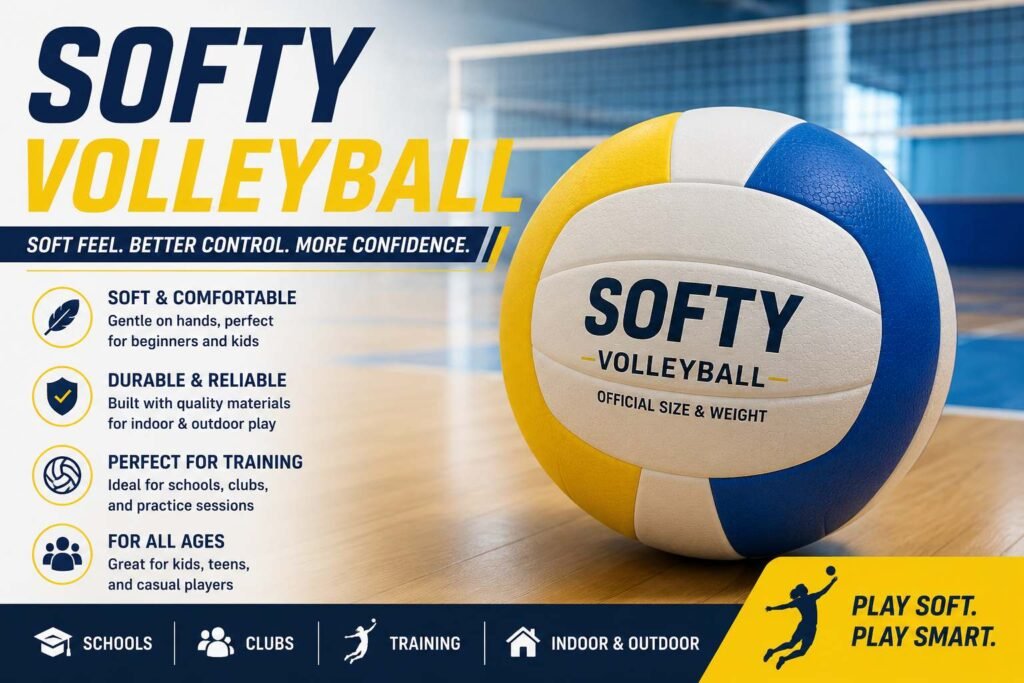
Volleyball is an exciting sport for players of all ages, but beginners and young athletes may need equipment that feels more comfortable and forgiving than a standard competition ball. A softy volleyball can be a useful option for children, beginners, schools, recreational programs, and players who are learning the fundamentals of the game.
Unlike traditional volleyballs designed primarily for competitive play, soft volleyballs are often made with a softer outer surface and cushioning that can make contact more comfortable. This can help new players become more confident when learning passing, serving, setting, and other basic skills.
In this guide, we explain what a softy volleyball is, who can benefit from one, what features to consider, and how to choose the right option for training and recreational play.
What Is a Softy Volleyball?
A softy volleyball is a volleyball designed with a softer feel than a typical hard-surface game ball. Depending on the model, it may feature a cushioned outer layer, soft synthetic material, or lightweight construction.
The softer surface can make ball contact more comfortable, which is particularly useful for beginners and younger players who are still developing their technique.
Soft volleyballs are commonly used for:
- Youth volleyball
- Beginner training
- School physical education
- Recreational games
- Volleyball drills
- Indoor practice
- Casual backyard play
The exact construction and specifications can vary between manufacturers, so buyers should always check the product details before purchasing.
Why Choose a Soft Volleyball?
Learning volleyball requires players to make frequent contact with the ball. Beginners who are not accustomed to passing or receiving a volleyball may find repeated contact uncomfortable.
A softer ball can provide a more approachable introduction to the sport.
For coaches and parents, a soft volleyball can also be useful when teaching basic techniques because players may feel less hesitant about making contact with the ball.
Comfort is not the only benefit. A suitable training ball can also help create a more positive learning environment where players can focus on technique and confidence.
1. Soft Volleyballs Are Great for Beginners
New players need time to develop proper passing and receiving techniques.
A softer volleyball can make early practice sessions more comfortable, allowing beginners to concentrate on positioning, hand placement, movement, and ball control.
Once players become comfortable with basic techniques, they can gradually transition to balls designed for more advanced or competitive play.
2. A Good Choice for Youth Volleyball
Young athletes often have different equipment needs than adult players.
A soft volleyball for kids can be a useful training tool because its softer feel may be more comfortable for developing players.
When choosing a volleyball for children, consider the player’s age, physical development, skill level, and the requirements of the program or league.
For organized youth competitions, always check the equipment specifications provided by the relevant organization.
3. Useful for Volleyball Training
Soft volleyballs can be incorporated into a variety of training activities.
Coaches can use them for introductory drills involving:
- Passing
- Setting
- Serving
- Ball control
- Movement
- Reaction exercises
- Partner drills
- Basic coordination
The goal is to help players develop fundamental skills before progressing to more advanced equipment and competition-level techniques.
4. Consider the Ball’s Weight
Weight is an important consideration when choosing any volleyball.
A ball that is too heavy for a young or inexperienced player may make learning more difficult. A lightweight or appropriately cushioned ball may be easier for some beginners to handle.
However, the ideal weight depends on the specific product and intended use. Always check the manufacturer’s specifications rather than assuming every soft volleyball has the same weight.
For competitive volleyball, use a ball that meets the requirements of the relevant organization.
5. Check the Outer Material
The outer cover affects how a volleyball feels when players make contact with it.
Soft volleyballs may use synthetic leather, foam-based materials, rubberized surfaces, or other constructions designed to provide a softer touch.
If the ball will be used frequently, look for an outer material that balances comfort with durability.
For indoor training, a smooth and comfortable surface can make repeated practice more enjoyable.
6. Think About Indoor and Outdoor Use
Where you plan to use the ball should influence your choice.
Indoor volleyballs are generally designed for smooth court surfaces. Outdoor volleyball equipment may need to withstand different conditions, including rougher surfaces, moisture, dirt, and changing temperatures.
If you are purchasing a soft volleyball for outdoor recreational use, check whether the manufacturer specifically recommends it for outdoor play.
Using a ball only on the surfaces it was designed for can help extend its lifespan.
7. Soft Volleyballs for School Physical Education
Schools can benefit from soft volleyball equipment because students often have different levels of experience.
A class may include complete beginners alongside students who already play volleyball. Softer training balls can provide an approachable option for introductory activities.
Teachers can use them for basic passing, throwing, catching, movement, and coordination exercises before students progress toward standard volleyball techniques.
When purchasing equipment for a school, durability and ease of maintenance should also be considered.
8. Use Soft Volleyballs for Skill Development
A volleyball player needs strong fundamentals before developing advanced skills.
Soft training equipment can be used during early practice to focus on:
Passing
Players learn to position their arms correctly and control the direction of the ball.
Setting
Beginners can practice hand positioning, timing, and movement.
Serving
Players can work on basic serving mechanics and ball contact.
Movement
Volleyball requires constant movement, so drills can combine footwork with ball control.
Developing these fundamentals can help players become more confident before moving to higher-level equipment.
9. Choose a Durable Soft Volleyball
Soft does not necessarily mean fragile.
If a ball will be used regularly by a school, club, academy, or youth program, durability is important.
Look for quality construction, strong seams, reliable panel bonding or stitching, and materials designed for the intended environment.
For casual home use, durability may be less important than comfort and affordability. For frequent training, investing in a better-built ball may provide greater long-term value.
10. Consider the Size of the Volleyball
Volleyballs are available in different sizes and designs depending on their intended purpose.
For youth players, training programs may use equipment that is appropriate for their age and development level.
Before buying a ball for organized competition, check the specific size requirements of the league or governing body.
For recreational play, comfort and ease of handling may be more important than competition specifications.
Softy Volleyball vs. Standard Volleyball
A softy volleyball and a standard volleyball can serve different purposes.
A standard volleyball is generally designed for players who are already comfortable with regular ball contact and may be intended for training or competition.
A soft volleyball places greater emphasis on a comfortable feel, making it suitable for beginners, younger players, recreational activities, and introductory training.
Neither option is automatically better. The right choice depends on the player and the intended use.
How to Choose the Right Softy Volleyball
Before buying a softy volleyball, consider these factors:
Player Age
Younger players may benefit from equipment designed specifically for their developmental stage.
Skill Level
Beginners often need equipment that makes learning more approachable.
Playing Environment
Determine whether the ball will be used indoors, outdoors, at school, or during organized training.
Construction
Check the cover material, seams, panels, and overall build quality.
Comfort
A soft surface can be especially useful when players are learning basic ball-control skills.
Purpose
Decide whether the ball is for casual recreation, school activities, training, or a structured volleyball program.
How to Maintain a Soft Volleyball
Proper care can help your volleyball remain usable for longer.
Clean the surface regularly: Wipe away dirt and dust after use.
Use appropriate inflation: Follow the manufacturer’s recommended pressure rather than overinflating the ball.
Store it properly: Keep it in a dry location away from excessive heat and direct sunlight.
Avoid unsuitable surfaces: If the ball is designed for indoor use, avoid repeatedly using it on rough outdoor surfaces.
Check it regularly: Inspect the cover, seams, and air retention before important training sessions.
Soft Volleyballs for Coaches and Clubs
Coaches can keep several types of volleyballs available for different training activities.
Soft balls can be particularly useful during beginner sessions, youth programs, warm-ups, and introductory drills.
For clubs and academies, purchasing multiple training balls can make group practices more efficient. When buying in bulk, consider consistency in size, construction, and feel so that players have a predictable training experience.
Can Adults Use a Soft Volleyball?
Yes. A soft volleyball is not limited to children.
Adults who are new to volleyball, participating in casual recreation, or recovering confidence with ball contact may also find a softer ball useful.
It can be especially appropriate for relaxed games where competitive specifications are not the primary concern.
For official adult competition, however, players should use a ball that meets the rules of the relevant competition.
Final Thoughts
A softy volleyball can be a practical choice for beginners, children, schools, recreational players, coaches, and training programs. Its softer feel can make learning and practicing volleyball more comfortable while helping new players build confidence.
When choosing one, consider the player’s age, skill level, ball size, weight, construction, playing environment, and intended use. A good soft volleyball should provide an appropriate balance between comfort, durability, and handling.
Whether you are introducing a child to volleyball, organizing a school activity, or looking for a comfortable training ball, choosing the right equipment can make practice more enjoyable.
Explore SoccerBallClub for sports equipment and training products designed to support players, schools, clubs, academies, and recreational programs.