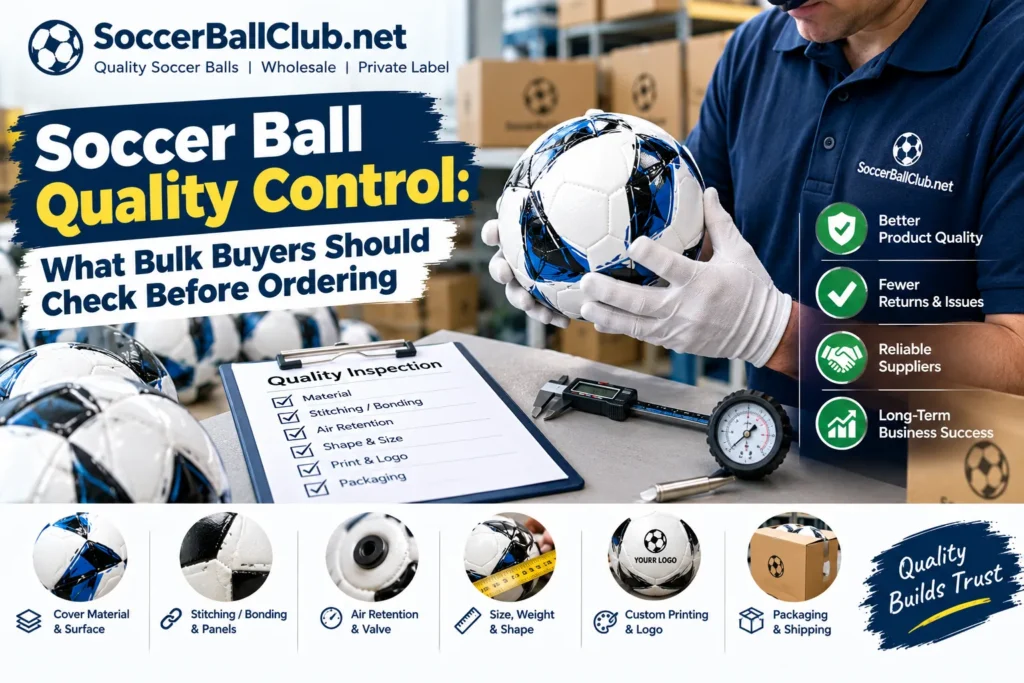
Ordering soccer balls in bulk can help sports retailers, soccer clubs, schools, academies, and distributors manage equipment costs. However, purchasing a large quantity without checking product quality can lead to inconsistent performance, customer complaints, and unnecessary replacement costs.
Whether you are sourcing training balls, match balls, promotional soccer balls, or custom-branded products, quality control should be an important part of your purchasing process.
This guide explains how to evaluate soccer ball quality before placing a bulk order, what to inspect in product samples, and how to communicate quality requirements to a supplier.
Why Soccer Ball Quality Control Matters
Soccer balls may look similar in product photographs, but their construction, materials, shape, and durability can differ significantly. A ball designed for occasional recreational use may not perform like one intended for frequent team training.
For bulk buyers, even a small quality issue can affect an entire shipment. For example, inconsistent air retention can create maintenance problems, while poor printing can make custom-branded balls unsuitable for promotional campaigns.
A clear quality control process helps buyers:
- Identify manufacturing defects before accepting a shipment.
- Compare samples with the approved product specifications.
- Reduce the risk of receiving inconsistent products.
- Protect their brand reputation when selling custom soccer balls.
- Establish measurable expectations with manufacturers and suppliers.
The goal is not simply to find the cheapest soccer ball. It is to purchase a product that meets your intended use, quality requirements, and budget.
1. Inspect the Outer Cover and Surface
The outer cover affects a soccer ball’s appearance, feel, and resistance to wear. Depending on the product, manufacturers may use materials such as TPU, PVC, or PU.
When inspecting a sample, check the following:
- Surface consistency: Look for uneven textures, bubbles, scratches, or visible defects.
- Panel alignment: Confirm that panels fit together evenly.
- Surface finish: Check for peeling, discoloration, or inconsistent coating.
- Material consistency: Compare the sample with the material specified in your quotation or product specification.
- Intended use: Make sure the cover is suitable for the playing surface and frequency of use.
Do not assume that a particular material automatically guarantees better quality. Construction, material grade, manufacturing methods, and intended use all influence the finished product.
If you are buying balls for schools or soccer academies, prioritize practical durability and easy maintenance. If you are sourcing premium match balls, ask for the relevant performance specifications and test documentation.
2. Check Air Retention and Valve Performance
Air retention is an important consideration for soccer balls used regularly in training and matches.
A ball that loses air too quickly may require frequent inflation and create additional work for coaches, equipment managers, and retailers.
Before approving a bulk order, ask the supplier about its air-retention testing procedure. You should also establish how the valve and bladder are inspected during production.
For sample testing:
- Inflate the ball to the pressure recommended by its manufacturer.
- Record the initial pressure using a suitable pressure gauge.
- Keep the ball under consistent conditions during the test.
- Measure the pressure again after a defined period.
- Compare the results with the agreed product specification.
Temperature changes can affect measured pressure, so conduct comparisons under reasonably consistent conditions.
Ask the manufacturer to explain its acceptable pressure-loss limits and provide test results where available. Avoid relying on vague promises such as “excellent air retention” without measurable criteria.
3. Examine Stitching, Bonding, and Panel Construction
Soccer balls may use machine stitching, hand stitching, thermal bonding, or other construction methods. Each method has its own manufacturing characteristics and intended applications.
For stitched balls, examine the seams for loose threads, uneven stitching, and gaps. For bonded balls, look for visible separation, irregular edges, or signs of adhesive failure.
Also check whether the panels remain securely attached after the sample has been used according to its intended purpose.
Questions to ask your supplier include:
- Which construction method is used for this model?
- What quality checks are performed on the seams or bonded panels?
- How are defects identified during production?
- Are the samples made using the same process as the final bulk order?
A sample should represent the actual product you intend to purchase. If the manufacturer supplies a specially prepared sample, request confirmation that the production version will use the same materials and construction specifications.
4. Verify Size, Weight, and Shape
Soccer balls are available in different sizes for children, youth players, and adults. The correct size depends on the intended age group, sport, and applicable competition requirements.
Before ordering, confirm the required size and the supplier’s stated circumference and weight specifications.
Use a measuring tape and suitable scale to check samples. Compare the results with the specifications agreed upon in writing.
You should also inspect the ball’s shape. Place it on a suitable surface and rotate it to look for obvious irregularities. Uneven panel construction or an inconsistent shape may indicate a manufacturing issue.
For orders intended for organized competitions, verify the applicable league or governing-body requirements. Do not assume that every ball marketed as a match ball automatically meets the certification or approval requirements of a particular competition.
5. Test Performance for the Intended Playing Surface
A soccer ball should be evaluated according to where and how it will be used.
For example, balls intended for outdoor grass fields may have different requirements from products designed for indoor play or artificial turf.
When evaluating a sample, consider:
- Bounce consistency.
- Ball response during passing and shooting.
- Grip and touch.
- Surface wear after representative use.
- Resistance to visible damage under normal playing conditions.
Whenever possible, test several samples rather than relying on a single ball. This can help identify differences between individual units.
For bulk purchases, agree on the intended playing surface and use case before choosing a model. This is particularly important for schools, clubs, and academies that use their equipment frequently.
6. Inspect Custom Logos and Printed Designs
Custom soccer balls can help sports brands, retailers, clubs, schools, and businesses create recognizable products. However, branding quality needs to be checked separately from ball construction.
If you are ordering custom soccer balls, examine the logo placement, print sharpness, color consistency, and alignment.
Your inspection checklist should include:
- Correct spelling and logo artwork.
- Accurate brand colors where specified.
- Consistent logo size and placement.
- No visible smudging, peeling, or incomplete printing.
- Agreement between the approved artwork and the finished sample.
Approve a physical sample or a clearly defined production proof before manufacturing begins. Keep the approved artwork and product specifications for comparison during the final inspection.
If you are sourcing private-label soccer balls for resale, branding consistency is particularly important because the product represents your business.
7. Review Packaging and Carton Quality
Packaging protects soccer balls during storage and transportation. It can also affect how easily a shipment is received, counted, and distributed.
Before approving an order, confirm the packaging method, quantity per carton, labeling requirements, and any individual packaging needs.
Check that:
- Cartons are sufficiently protective for the intended shipping method.
- Product quantities match the packing list.
- Carton labels and product descriptions are correct.
- Custom packaging matches the approved design.
- Products arrive without avoidable damage or contamination.
For international orders, clarify who is responsible for inspecting the goods before dispatch and what evidence will be provided if a packaging or product defect is identified.
8. Request a Pre-Shipment Inspection for Bulk Orders
A pre-shipment inspection can help identify problems before goods leave the factory. It is especially useful when ordering large quantities, customized products, or merchandise intended for retail sale.
Depending on the agreement, an inspection may include checking product appearance, dimensions, weight, packaging, logo printing, and selected performance characteristics.
Before production begins, agree on:
- The product specifications.
- The inspection checklist.
- The sample-selection method.
- Acceptable and unacceptable defects.
- The process for reporting and resolving quality issues.
For larger or higher-value orders, consider using an independent inspection service. The appropriate inspection scope depends on order value, risk, product requirements, and your budget.
A supplier’s own inspection report can be useful, but independent verification may provide additional confidence when the order involves significant financial exposure.
9. Create a Written Quality Agreement
Verbal promises can lead to misunderstandings. A written quality agreement makes expectations clearer for both the buyer and supplier.
Your agreement should identify the product model, material, construction method, size, weight range, artwork, packaging, and any required testing or certification.
It should also explain how defects will be documented and what happens if the shipment does not meet the approved requirements.
For example, specify whether the supplier must repair, replace, or otherwise resolve products that fail the agreed inspection criteria. Confirm any relevant costs, deadlines, and responsibilities before production starts.
Keep the quotation, approved sample details, artwork, inspection records, and purchase order together. These documents provide a useful reference if a dispute occurs.
10. Compare Suppliers Beyond the Unit Price
Price matters, but it should not be the only factor when choosing a soccer ball supplier.
A lower quotation may not offer the best overall value if product quality is inconsistent, communication is unreliable, or customization requirements are not followed.
When comparing suppliers, consider:
- Product specifications and sample quality.
- Manufacturing and quality control procedures.
- Customization capabilities.
- Minimum order quantities.
- Production lead times.
- Packaging and shipping arrangements.
- Documentation and responsiveness.
- Written procedures for handling defects.
Request comparable quotations using the same product specifications. This makes it easier to evaluate the actual differences between offers.
You should also confirm the payment terms, delivery responsibilities, and estimated production schedule before committing to a large order.
Final Checklist Before Approving a Bulk Soccer Ball Order
Before confirming your purchase, make sure you have:
- Defined the intended use and playing surface.
- Confirmed the correct ball size and specifications.
- Evaluated representative product samples.
- Checked air retention, shape, seams, and surface finish.
- Approved custom logos and colors where applicable.
- Confirmed packaging and shipment quantities.
- Agreed on inspection procedures and defect criteria.
- Reviewed production timelines and shipping arrangements.
- Documented the final requirements in writing.
Choose Soccer Balls With Confidence
Reliable quality control starts before production and continues through final inspection. By evaluating representative samples, confirming specifications, checking customization, and agreeing on measurable standards, bulk buyers can make more informed purchasing decisions.
Whether you are sourcing equipment for a school, soccer academy, sports retailer, or private-label brand, a structured inspection process can help reduce avoidable problems and improve purchasing confidence.
Looking for a soccer ball supplier for your next bulk order? Explore the available products at SoccerBallClub.net and contact the team to discuss your required sizes, materials, customization options, quantities, and quality specifications before placing an order.