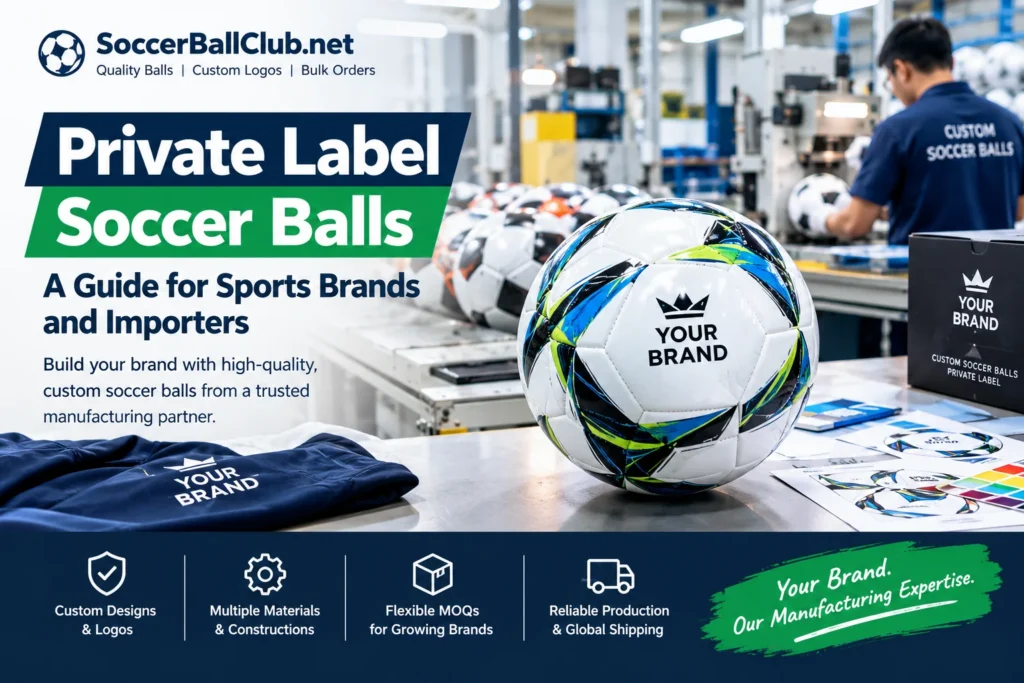
The demand for branded sports equipment creates opportunities for businesses looking to develop their own soccer ball product lines. For sports brands, wholesalers, importers, and retailers, private label soccer balls offer a way to sell products under their own brand names without necessarily operating a manufacturing facility.
However, launching a successful private label soccer ball line requires careful planning. Buyers need to evaluate manufacturers, select suitable materials, develop product designs, understand minimum order quantities, and confirm quality requirements before placing a production order.
In this guide, we explain how private label soccer ball manufacturing works and what businesses should consider when sourcing custom soccer balls for the US market.
What Are Private Label Soccer Balls?
Private label soccer balls are products manufactured for a business that sells them under its own brand name. Depending on the manufacturer’s capabilities, buyers may be able to customize the ball’s graphics, colors, logo, packaging, materials, and other specifications.
For example, a sports retailer in the United States might develop a branded collection of training soccer balls for recreational players. A sports distributor could offer customized products to local clubs, while an established sports brand might introduce a new product line for its customers.
The level of customization depends on the supplier, production methods, order quantity, and budget.
Private label manufacturing can be useful for businesses that want to build brand recognition while working with an experienced soccer ball manufacturer.
Why Businesses Choose Private Label Soccer Balls
1. Build Your Own Sports Brand
Selling products under your own brand can help establish a consistent identity across your product range.
Businesses can choose brand colors, logo placement, packaging styles, and product positioning according to their target audience.
Over time, a consistent product experience and effective marketing may help build customer recognition and repeat purchases.
2. Develop Products for Specific Customers
Different customers have different requirements. A retailer may focus on recreational soccer balls, while a sports academy may need durable training balls for frequent practice.
Private label soccer balls allow businesses to discuss product specifications that suit their intended market.
Depending on the manufacturer’s capabilities, options may include different ball sizes, surface materials, construction methods, graphics, and packaging.
3. Expand Your Product Range
Businesses already selling sportswear, training equipment, or other soccer products may consider adding branded soccer balls to their catalogs.
A private label arrangement can provide access to manufacturing capabilities without requiring the buyer to establish a factory.
Before expanding, businesses should evaluate demand, expected sales volumes, shipping costs, and the investment required for inventory.
4. Create B2B Sales Opportunities
Branded soccer balls can be relevant to sports retailers, local clubs, youth academies, training organizations, and promotional merchandise distributors.
Businesses that establish suitable product specifications and dependable supply arrangements may be able to serve several customer groups with a consistent product line.
How Private Label Soccer Ball Manufacturing Works
Understanding the production process helps buyers communicate their requirements and reduce misunderstandings.
Step 1: Define Your Target Market
Start by identifying the customers you intend to serve.
For example, your target market might include:
- Sports retailers selling soccer equipment.
- Wholesale distributors supplying independent stores.
- Youth soccer academies and training organizations.
- Soccer clubs looking for branded team equipment.
- Online businesses developing their own sports brands.
Your target audience influences the ball specifications, design, pricing strategy, and quantities you should consider.
Step 2: Select the Right Soccer Ball Specifications
Before requesting quotations, prepare a product specification sheet.
Consider the following details:
Ball size: Size 3, size 4, or size 5, depending on the intended players and applicable rules.
Cover material: Discuss available PU, TPU, or other materials with the manufacturer and compare their intended uses.
Construction: Evaluate machine-stitched, hand-stitched, thermo-bonded, or other available construction options.
Bladder: Ask about available bladder materials and their inflation and air-retention characteristics.
Playing surface: Explain whether the product is intended for natural grass, artificial turf, indoor use, or general training.
Performance requirements: Specify the durability, feel, shape retention, and other characteristics important to your customers.
Not every manufacturer offers every option, so confirm which specifications are available before finalizing your design.
Step 3: Develop Your Logo and Design
Branding is a central part of private label manufacturing.
Depending on the supplier’s production capabilities, customization may include printed logos, selected colors, panel graphics, product labels, and branded packaging.
Provide clear artwork files and written instructions covering logo placement, colors, dimensions, and any other requirements.
Before approving production, request a design proof or physical sample when available. Confirm that you have the necessary rights to use the submitted logos and artwork.
Step 4: Request Samples
Samples help buyers assess a product before committing to a larger order.
Review the ball’s surface finish, stitching or bonding, inflation performance, shape, branding quality, and overall construction.
If the product is intended for regular training, test it under realistic playing conditions where possible.
For a new private label range, approval of a representative sample can help establish a reference for subsequent production.
Step 5: Confirm Minimum Order Quantities
Private label manufacturers may require a minimum order quantity, particularly when custom graphics, specialized materials, or branded packaging are involved.
Ask suppliers whether minimum quantities apply per design, size, color, or total order.
You should also request pricing for different order quantities. For example, compare quotations for an initial order and a larger repeat order to understand how unit costs may change.
Do not assume that larger quantities automatically produce better profitability. Consider the amount of capital tied up in inventory and the time required to sell the products.
Step 6: Approve Production and Delivery Terms
Before confirming your order, establish the production schedule, payment terms, quality-control arrangements, packaging details, and shipping responsibilities.
For US importers purchasing from overseas manufacturers, confirm freight charges, customs documentation, applicable duties, and delivery arrangements.
Ask for written confirmation of the final specifications and approved sample so that both parties understand the agreed product requirements.
How to Choose a Private Label Soccer Ball Manufacturer
Finding a suitable manufacturing partner is one of the most important decisions when launching your own soccer ball brand.
Evaluate Manufacturing Experience
Ask about the manufacturer’s experience producing the types of soccer balls you need.
Request product specifications, relevant manufacturing information, and examples of comparable work where available.
A supplier’s ability to explain its production process and answer technical questions can help you assess whether it understands your requirements.
Compare Product Quality
Do not select a supplier based on price alone.
Compare samples, materials, construction, branding quality, and consistency. Ask how the manufacturer checks products during production and before shipment.
If you require particular performance or safety standards, confirm whether the supplier can provide relevant test reports or documentation. Verify any certification claims independently when they are important to your business.
Review Communication and Reliability
A suitable supplier should communicate clearly about quotations, sample development, production schedules, and potential delays.
Before placing a substantial order, establish a clear process for approving artwork, confirming specifications, inspecting goods, and addressing quality issues.
These arrangements can be particularly important when you are building a long-term relationship with an overseas manufacturing partner.
Understand the Total Cost
The factory price is only one part of the total cost of importing private label soccer balls.
Your calculation may need to include:
- Product manufacturing costs.
- Custom logo and artwork costs.
- Packaging and labeling.
- Samples and development charges.
- Freight and insurance.
- Customs duties and applicable taxes.
- Warehousing and domestic delivery.
- Marketing, fulfillment, and selling expenses.
Compare suppliers using the expected landed cost rather than the quoted unit price alone.
How Much Does Private Label Soccer Ball Manufacturing Cost?
The cost depends on product specifications, materials, construction, customization, order quantity, packaging, and shipping arrangements.
A standard training ball with existing graphics may have different production requirements from a fully customized ball with specialized materials and branded packaging.
Instead of relying on a generic price estimate, request a detailed quotation based on your intended product.
For a useful comparison, ask suppliers to quote the same ball size, construction, material, customization requirements, order quantity, and shipping destination.
This makes it easier to compare offers and identify differences in what each supplier includes.
Common Mistakes to Avoid
Choosing the cheapest supplier without evaluating samples: Low initial pricing does not guarantee consistent quality or a suitable product.
Ordering too much inventory too early: Large orders can reduce unit costs in some cases, but unsold inventory can tie up working capital.
Providing unclear artwork: Incorrect logo files, colors, or placement instructions can cause avoidable production issues.
Ignoring shipping and import expenses: Freight, duties, and delivery costs can significantly affect the final cost of the product.
Failing to document specifications: Written requirements and sample approval provide a clearer reference for production and repeat orders.
Making unsupported quality claims: Only advertise certifications, performance ratings, and product features that you can substantiate.
Private Label Soccer Balls for the US Market
Businesses entering the US market should select products according to the needs of their intended customers.
Sports retailers may prioritize attractive designs, competitive pricing, and reliable replenishment. Clubs and academies may focus on consistent specifications and durability for repeated training. Distributors may need dependable production capacity and clear packaging requirements.
If you plan to sell through an online store, prepare accurate product descriptions, original images, shipping information, and transparent return policies.
For wholesale customers, make it easy to request quotations and understand minimum order quantities, customization options, and expected lead times.
Researching your target customers before committing to production can help you develop a product range that fits a real market need.
Work With SoccerBallClub for Your Private Label Project
SoccerBallClub provides a starting point for businesses exploring soccer ball products and manufacturing-related options.
If you are a sports brand, importer, distributor, or retailer interested in developing your own soccer ball line, you can visit SoccerBallClub to review the available products and discuss your requirements with the company.
When requesting information, prepare the desired ball sizes, product specifications, logo artwork, estimated order quantity, packaging preferences, and delivery destination.
Ask for confirmation of available customization services, minimum order quantities, sample options, production timelines, and shipping terms before placing an order.
A clear project brief can make the quotation process more efficient and help determine whether the available manufacturing options match your business needs.
Conclusion
Private label soccer balls offer sports brands, importers, wholesalers, and retailers an opportunity to develop products under their own identities without operating their own manufacturing facilities.
A successful project starts with a clear target market, suitable product specifications, an approved design, and a reliable manufacturing partner.
Compare samples, evaluate total landed costs, confirm minimum order quantities, and document production requirements before committing to a large order.
With careful preparation and realistic demand planning, businesses can develop a private label soccer ball range that supports their long-term product and sales strategy.