
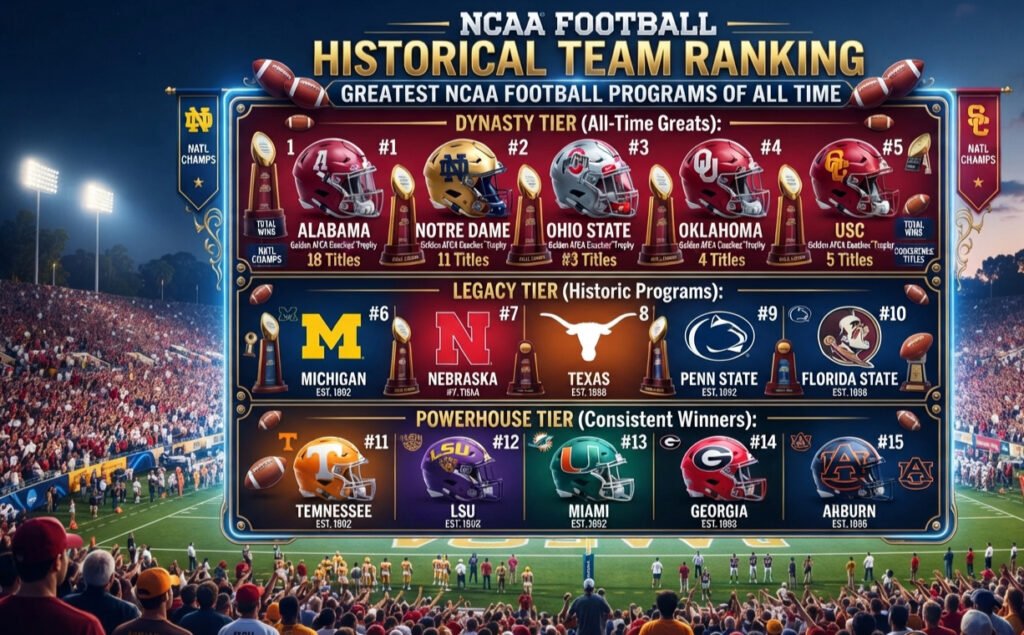
When discussing the NCAA football historical team ranking, passion often collides with statistics. Unlike professional leagues with standardized championships, college football’s fragmented history—spanning the poll era, BCS, and College Football Playoff systems—creates fascinating debates about which programs truly deserve recognition as the greatest of all time.
Whether you’re a die-hard fan researching your alma mater’s legacy or a sports historian seeking objective criteria, understanding how to evaluate decades of performance requires looking beyond simple win-loss records. This comprehensive analysis examines the methodologies, metrics, and legendary programs that define the pinnacle of collegiate athletics.
What Defines Historical Greatness in College Football?
Creating an authoritative NCAA football historical team ranking demands more than tallying victories. True dynasties demonstrate sustained excellence across multiple coaching eras while adapting to evolving game strategies. The most respected ranking systems weigh several critical factors:
National Championships (Claimed and Consensus)
Programs earn prestige through titles recognized by the Associated Press (AP), Coaches Poll, and historical selectors. While some schools claim retroactive championships from early 20th-century mathematical systems, consensus titles carry significantly more weight in historical evaluations.
All-Time Winning Percentage
Consistency matters. Programs like Michigan, Notre Dame, and Ohio State maintain winning percentages above .700 despite competing for over a century, illustrating organizational stability and recruiting dominance across generations.
Bowl Game Success
Postseason performance separates good teams from legendary programs. Rose Bowl appearances, Sugar Bowl victories, and modern New Year’s Six achievements demonstrate a program’s ability to perform under pressure against elite competition.
Heisman Trophy Production
Individual brilliance reflects systemic excellence. Schools producing multiple Heisman winners typically maintain superior talent development pipelines and offensive innovation.
Conference Dominance
Long-term control of power conferences (Big Ten, SEC, Big 12, Pac-12/10, ACC) indicates sustained competitive advantages in resources and coaching.
The Undisputed Elite: Programs That Define the Rankings
While methodologies vary, certain institutions consistently appear at the summit of every NCAA football historical team ranking. These programs have transcended specific eras to become cultural phenomena.
Alabama Crimson Tide
No discussion of historical dominance is complete without Alabama. With 18 claimed national championships (including multiple AP/Coaches Poll era titles) and the highest winning percentage among SEC programs, the Crimson Tide’s resume spans Wallace Wade’s 1920s dynasty to Nick Saban’s modern empire. Their 46 bowl victories and record-setting NFL draft production cement their status as arguably the most accomplished program in history.
Notre Dame Fighting Irish
Despite recent championship droughts, Notre Dame’s independent status and national television contract revolutionized college football exposure. With 11 consensus national titles, seven Heisman winners, and the highest winning percentage among programs with 900+ victories (.729), the Fighting Irish remain the sport’s most recognizable brand. Their 1924 “Four Horsemen” era and 1940s dominance under Frank Leahy established standards for offensive innovation.
Ohio State Buckeyes
As the winningest program in Big Ten history, Ohio State combines quantitative dominance with qualitative achievements. Their eight national championships, seven Heisman winners, and record 10 Rose Bowl victories demonstrate Big Ten supremacy. The Buckeyes’ remarkable consistency—avoiding extended losing streaks since World War I—highlights exceptional administrative stability.
Oklahoma Sooners
Oklahoma’s 47-game winning streak (1953-1957) remains the longest in Division I history, emblematic of Bud Wilkinson’s dynasty. With seven AP national titles and 50 conference championships, the Sooners pioneered the modern passing game under coaches like Barry Switzer and Bob Stoops. Their 899 all-time wins rank among the top ten nationally.
USC Trojans
Representing West Coast football excellence, USC claims 11 national championships and produces NFL talent at unprecedented rates. The Trojans’ 34 Rose Bowl appearances (25 victories) reflect their traditional Pac-12 dominance. From the 1972 “Tailback U” dynasty to Pete Carroll’s 2000s resurgence, USC’s influence on offensive scheming remains profound.
Michigan Wolverines
College football’s winningest program by total victories (998) combines historical prestige with modern relevance. Michigan’s 12 national championships include the 1997 AP title, while their rivalry with Ohio State represents the sport’s most significant annual contest. The Wolverines’ “Three-Yard-and-a-Cloud-of-Dust” era under Bo Schembechler epitomized Big Ten physicality.
Methodology Matters: How Rankings Change by Era
The NCAA football historical team ranking conversation shifts dramatically depending on chronological scope. Pre-1900 programs like Princeton and Yale dominated the sport’s nascent years, claiming 28 and 27 national championships respectively during the “ivy era.” However, modern rankings typically emphasize the AP Poll era (1936-present) when standardized polling created consensus champions.
The Poll Era (1936-1997)
This period favors traditional powers like Notre Dame, Alabama, and Oklahoma, who built dynasties before scholarship limitations and television revenue equalized competition.
The BCS Era (1998-2013)
The Bowl Championship Series created undisputed national champions, benefiting programs like Florida State, Florida, and LSU, who mastered the new selection criteria.
The Playoff Era (2014-Present)
Modern rankings increasingly weigh College Football Playoff appearances, elevating recent dynasties like Clemson and Alabama while penalizing historically great programs (Nebraska, Miami) experiencing contemporary struggles.
Emerging Programs and Historical Context
While traditional powers dominate historical rankings, several programs challenge established hierarchies through recent sustained excellence:
- Clemson Tigers: Two national titles in three years (2016, 2018) propelled Clemson from regional ACC power to national elite, though their overall win total (consecutive 10-win seasons) still trails blue-bloods historically.
- Florida State Seminoles: Bobby Bowden’s dynasty (14 consecutive top-five finishes) and Jimbo Fisher’s 2013 championship established FSU as the winningest program since 1990.
- LSU Tigers: Recent 2019 perfection complements their 2003 and 2007 titles, creating a compelling case for SEC’s second-most accomplished program historically.
Frequently Asked Questions About Historical Rankings
Which college football team has the most national championships?
Princeton claims 28 titles, primarily from the 1800s and early 1900s. Among modern powers, Alabama leads with 18 claimed championships, followed by Notre Dame and USC with 11 each.
How do bowl game victories impact historical rankings?
Bowl victories serve as tiebreakers between programs with similar championship counts. Alabama’s 46 bowl wins and Ohio State’s 10 Rose Bowl victories significantly bolster their historical cases.
Are modern programs disadvantaged in historical rankings?
Somewhat. Programs founded after 1950 face century-long deficits in total wins. However, Florida State and Miami gained “blue-blood” status through concentrated 1980s-2000s dominance despite shorter histories.
What is the most important metric for determining historical greatness?
Consensus national championships carry maximum weight, followed by all-time winning percentage and major bowl victories. The ability to maintain excellence across different coaching regimes indicates systemic program strength.
Conclusion
Determining the definitive NCAA football historical team ranking requires balancing quantitative achievements with cultural impact. While Alabama, Notre Dame, Ohio State, Oklahoma, USC, and Michigan form the sport’s Mount Rushmore, the beauty of college football lies in its evolving narrative.
As NIL deals and conference realignment reshape competitive landscapes, historical rankings serve not as static monuments but as living documents reflecting the sport’s rich tapestry. Whether evaluating leather-helmet legends or playoff-era dynasties, these rankings remind us that greatness in college football is measured not just in trophies, but in the generations of fans who pass down traditions from Saturday to Saturday, season to season, century to century.
For fans researching their team’s place in history, remember that NCAA football historical team ranking debates ultimately celebrate what makes this sport unique: the intersection of regional identity, academic tradition, and athletic excellence that creates lifelong loyalty unlike any other American institution.