
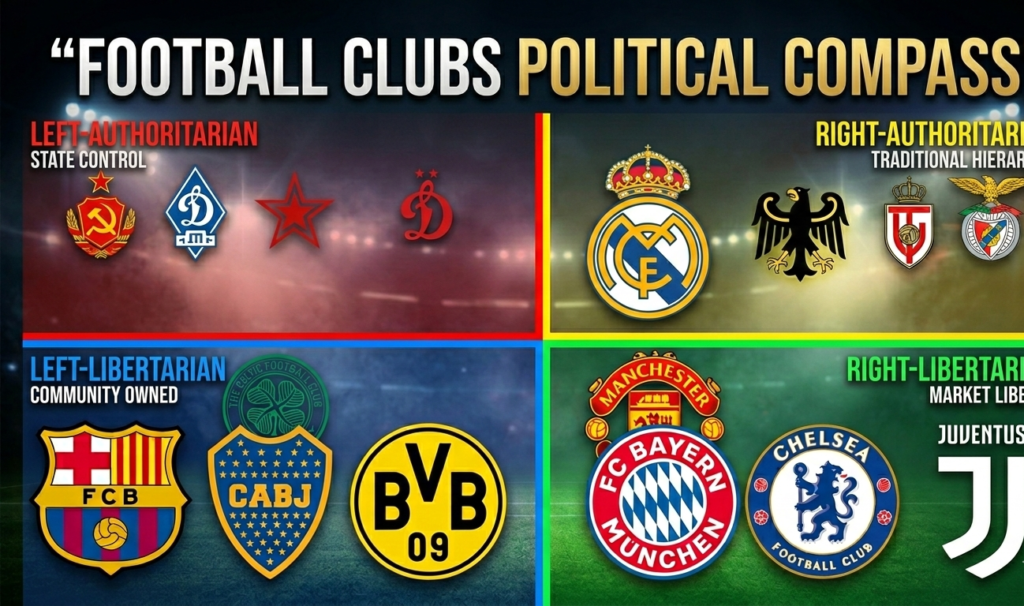
Football is not just a sport; it is a cultural phenomenon that reflects the values, history, and identity of communities worldwide. Beyond the pitch, football clubs can also be examined through a political lens, exploring their historical, social, and ideological affiliations. This is where the concept of the Football Clubs Political Compass comes into play, mapping clubs along political and social axes to understand their leanings, fan culture, and broader societal impact.
In this comprehensive article, we will dive deep into football clubs and their political orientations, examining historical ties, regional influences, fan behaviors, and global relevance. We will also highlight examples from Europe, South America, and beyond.
What is a Football Clubs Political Compass?
A political compass is a tool used to categorize political ideologies along two axes:
Economic Axis (Left ↔ Right)
Left: Emphasis on social equality, community ownership, and redistribution
Right: Emphasis on free markets, private ownership, and capitalism
Social Axis (Authoritarian ↔ Libertarian)
Authoritarian: Structured, traditional, and hierarchical social views
Libertarian: Emphasis on freedom, liberal social values, and personal autonomy
Applying this to football clubs, we analyze:
Club ownership (state-owned, fan-owned, corporate-owned)
Historical affiliations (worker clubs, aristocratic clubs, military ties)
Fan base ideology (ultras, political activism, nationalism)
Regional and cultural influences
This mapping is not absolute but provides a general framework for understanding how clubs interact with politics and society.
Why Football Clubs Have Political Leanings
Football clubs often reflect local communities:
Industrial regions → clubs historically founded by workers or unions lean left
Elite or aristocratic origins → clubs often lean right economically
Urban centers with liberal populations → clubs embrace progressive or libertarian social values
Conservative rural areas → clubs adopt traditionalist or authoritarian tendencies
These influences shape everything from club ownership models to fan culture and stadium chants.
European Football Clubs and Their Political Compass
Europe has a rich football history intertwined with politics. Here are notable examples:
1. FC Barcelona (Spain)
Economic Leaning: Left
Social Orientation: Libertarian
Reasoning:
Known for its Catalan identity and resistance to central Spanish control
Promotes progressive social initiatives
Strong supporter-owned model via “socios”
Fan Culture: Anti-fascist, pro-independence, politically active
2. Real Madrid (Spain)
Economic Leaning: Right
Social Orientation: Authoritarian
Reasoning:
Historically linked with Spanish monarchy and Francoist Spain
Strong hierarchical management
Global corporate ownership style
Fan Culture: Nationalist tendencies, mainstream conservative following
3. Manchester United (England)
Economic Leaning: Right
Social Orientation: Libertarian
Reasoning:
Modern corporate ownership under the Glazer family
International fanbase focused on entertainment
Minimal political activism
Fan Culture: Predominantly apolitical or commercial-focused
4. Liverpool FC (England)
Economic Leaning: Left
Social Orientation: Libertarian
Reasoning:
Originated in working-class dock areas
Emphasis on social solidarity
Fans actively support social causes
Fan Culture: Anti-racism, community-driven initiatives
5. Juventus (Italy)
Economic Leaning: Right
Social Orientation: Authoritarian
Reasoning:
Historically connected with Turin elites
Conservative ownership structure
Emphasis on winning above social activism
Fan Culture: Large commercial appeal, limited political activism
South American Clubs Political Compass
South America’s football clubs have rich political histories reflecting regional struggles:
6. Boca Juniors (Argentina)
Economic Leaning: Left
Social Orientation: Libertarian
Reasoning:
Founded by working-class immigrants
Strong community ties in Buenos Aires’ La Boca neighborhood
Fan Culture: Populist, grassroots activism, politically vocal
7. River Plate (Argentina)
Economic Leaning: Right
Social Orientation: Authoritarian
Reasoning:
Historically associated with wealthier Buenos Aires neighborhoods
Elite cultural and corporate backing
Fan Culture: Conservative fan base, less politically active
8. Flamengo (Brazil)
Economic Leaning: Left
Social Orientation: Libertarian
Reasoning:
Popular in Rio’s working-class suburbs
Fans embrace social inclusion
Fan Culture: Anti-authoritarian, community-driven initiatives
Football Clubs Political Compass in Germany
Germany’s club histories often reflect regional politics:
Bayern Munich: Right-authoritarian
Wealthy southern Bavarian identity
Corporate management, global branding
Borussia Dortmund: Left-libertarian
Industrial Ruhr region
Fan ownership model (50+1 rule)
RB Leipzig: Right-libertarian
Corporate-backed, modern capitalist model
Minimal historical fan activism
How Fan Culture Shapes Club Politics
Fans play a critical role in defining a club’s political identity:
Ultras Movements
Some groups are politically motivated, left or right
Known for chants, banners, and social activism
Community Ownership Models
Socios system (Barcelona, Dortmund) empowers fan-driven decisions
Often linked to left-libertarian ideologies
Commercialization and Globalization
Clubs like Manchester United or PSG focus on corporate expansion
Leads to more right-libertarian orientation (profit-focused, socially neutral)
Political Events and Football Clubs
Throughout history, football clubs have reflected political climates:
Spain: Barcelona vs. Real Madrid became a symbol of Catalan independence vs. Spanish centralism
Italy: Juventus vs. Torino reflected elite vs. working-class struggles
South America: Argentine clubs mirrored socio-economic divides during political turmoil
Football has often served as both a social mirror and protest platform.
Mapping Football Clubs on a Political Compass
Here’s a simplified overview:
| Club | Economic Axis | Social Axis | Fan Base |
|---|---|---|---|
| FC Barcelona | Left | Libertarian | Progressive |
| Real Madrid | Right | Authoritarian | Conservative |
| Liverpool FC | Left | Libertarian | Working-class |
| Manchester United | Right | Libertarian | Commercial |
| Juventus | Right | Authoritarian | Elite |
| Boca Juniors | Left | Libertarian | Grassroots |
| River Plate | Right | Authoritarian | Wealthy |
| Bayern Munich | Right | Authoritarian | Conservative |
| Borussia Dortmund | Left | Libertarian | Industrial |
| Flamengo | Left | Libertarian | Popular |
This compass is not absolute but provides a generalized view of political and social leanings.
Why Understanding the Political Compass of Football Clubs Matters
Fan Engagement: Understanding political leanings helps brands, sponsors, and media tailor campaigns.
Social Awareness: Recognizes clubs as cultural and political symbols.
Historical Insight: Shows how clubs mirror regional and national struggles.
Global Football Perspective: Helps international fans connect with club culture beyond football.
Conclusion
The Football Clubs Political Compass is a fascinating lens to explore football beyond goals and trophies. Clubs like FC Barcelona and Liverpool embrace left-libertarian ideals, reflecting working-class and socially progressive identities. In contrast, Real Madrid, Juventus, and Bayern Munich demonstrate right-authoritarian characteristics with elite ties and conservative fan bases.
By understanding these political leanings, fans, researchers, and marketers gain a deeper insight into how football intersects with society, culture, and ideology. Football is not just about the game—it is a reflection of the world around us.