Finding the right custom soccer ball manufacturer is important for football clubs, academies, schools, sports brands, retailers, and distributors that want soccer balls designed around their own requirements. Custom soccer balls can feature a company logo, club badge, unique colors, special graphics, or other branding elements.
A reliable manufacturer can help businesses move from an initial design concept to a finished product while maintaining consistent quality, suitable materials, and production standards. However, choosing a manufacturing partner requires more than simply comparing prices.
This guide explains what to look for in a custom soccer ball manufacturer, how the customization process works, and what businesses should consider before placing a bulk order.
What Is a Custom Soccer Ball Manufacturer?
A custom soccer ball manufacturer is a company that produces footballs according to a customer’s specifications rather than supplying only standard, ready-made designs.
Depending on the manufacturer, customers may be able to customize several parts of the ball, including:
- Ball colors
- Printed graphics
- Club logos
- Company logos
- Team names
- Branding
- Panel designs
- Surface patterns
- Packaging
- Size and specifications
Customization is particularly useful for organizations that want their footballs to represent a specific club, academy, brand, event, or business.
Why Choose Custom Soccer Balls?
Custom soccer balls provide both practical and promotional benefits.
Build a Stronger Brand Identity
A football featuring a recognizable logo, color scheme, and design can help create a consistent brand identity. Clubs and academies can use customized balls during training sessions, matches, camps, and promotional activities.
Support Football Clubs and Academies
Football clubs and academies often need multiple balls for regular training. Ordering customized soccer balls allows them to use equipment that reflects their identity.
Create Promotional Products
Businesses can use branded soccer balls as promotional products for sporting events, tournaments, sponsorship campaigns, and marketing activities.
Stand Out From Standard Products
Custom designs give buyers greater control over the appearance of their footballs. Instead of using a generic design, organizations can create a product that matches their branding.
What Can You Customize on a Soccer Ball?
The available customization options depend on the manufacturer and production method.
Colors and Graphics
Customers can select colors and graphic patterns that match their club or company branding.
For example, a football club might choose its traditional team colors, while a sports retailer may develop a distinctive design for its own brand.
Logos and Branding
Logos are one of the most common customization requirements. A manufacturer may print or apply a customer’s logo to the ball as part of the production process.
Before production begins, the manufacturer normally needs a high-quality version of the logo or artwork.
Ball Size
Soccer balls are available in different sizes for different age groups and playing requirements.
Common sizes include:
- Size 5 for standard adult and youth football
- Size 4 for many younger players
- Size 3 for younger children
Businesses should specify the required size before production.
Packaging
For branded products, customization may also extend to packaging. Businesses can request branded boxes, labels, bags, or other packaging depending on the manufacturer’s capabilities and order quantity.
How Does the Custom Soccer Ball Manufacturing Process Work?
A professional manufacturer normally follows several stages from design to final production.
Step 1: Share Your Requirements
The buyer provides information about the desired ball, including size, colors, design, logo, quantity, materials, and intended use.
The more specific the requirements are, the easier it is for the manufacturer to prepare an accurate proposal.
Step 2: Approve the Design
The manufacturer may create a digital design or artwork showing how the finished soccer ball is expected to look.
Customers should carefully review the logo placement, colors, graphics, and other details before approving the design.
Step 3: Develop a Sample
For many custom orders, a sample may be produced before large-scale manufacturing begins.
A sample gives the buyer an opportunity to check the appearance and specifications before committing to the full production order.
Step 4: Begin Production
After the design and sample are approved, the manufacturer can begin bulk production.
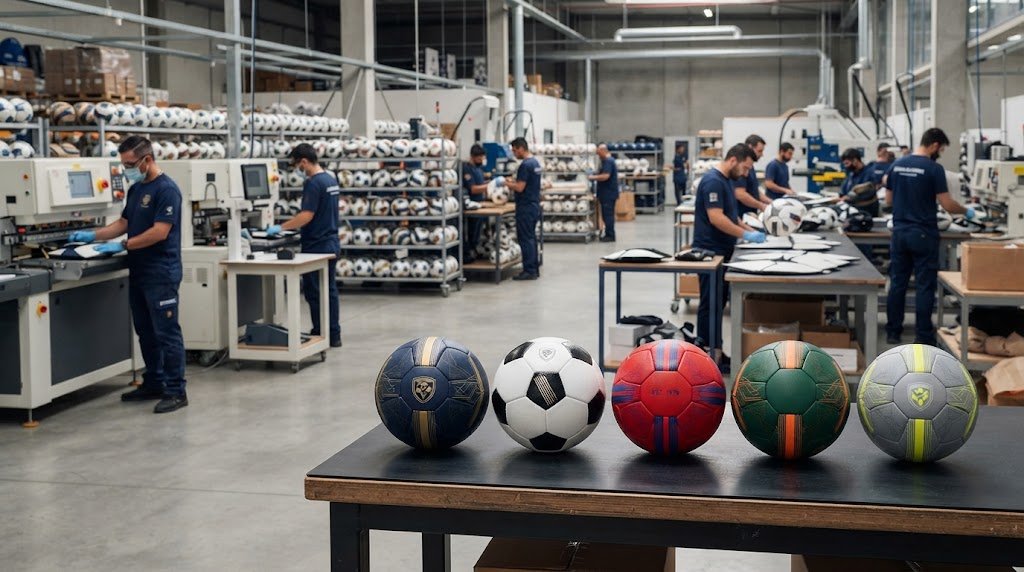
The manufacturing process may include material preparation, panel cutting, printing, stitching or bonding, bladder installation, shaping, inflation, and quality inspection.
Step 5: Quality Control
Quality control is an important part of soccer ball manufacturing. Finished products should be inspected for issues such as:
- Incorrect printing
- Poor stitching
- Surface defects
- Incorrect inflation
- Shape irregularities
- Logo placement problems
- Material defects
The exact quality-control process varies between manufacturers.
Step 6: Packaging and Shipping
After inspection, the finished soccer balls are packaged and prepared for delivery according to the buyer’s requirements.
How to Choose the Right Custom Soccer Ball Manufacturer
Choosing a manufacturer requires careful consideration, especially for large B2B orders.
Check Manufacturing Experience
Look for a manufacturer with experience producing soccer balls for businesses, clubs, academies, retailers, or distributors.
Experience can be particularly valuable when an order involves complex customization or large quantities.
Review Product Quality
Ask about the materials, construction method, production standards, and quality-control procedures used for the soccer balls.
If possible, request a sample before placing a large order.
Ask About Minimum Order Quantity
Manufacturers may have different minimum order quantities for custom products.
If you are ordering for a football club or small academy, ask about the minimum quantity before proceeding.
Compare Customization Options
Not every supplier offers the same customization services. Confirm whether the manufacturer can provide the exact logo, colors, artwork, ball size, construction, and packaging you require.
Consider Production Capacity
For wholesalers and distributors, production capacity is an important factor. A supplier should be able to handle your required quantity within an agreed production schedule.
Evaluate Communication
Clear communication can prevent mistakes during customization. A good supplier should be able to explain specifications, artwork requirements, production timelines, samples, packaging, and shipping arrangements.
Custom Soccer Balls for Football Clubs
Football clubs can use customized balls for training, matches, youth programs, tournaments, and promotional activities.
A club can incorporate its:
- Club logo
- Team colors
- Club name
- Sponsor branding
- Special event graphics
Ordering directly from a manufacturer can also allow clubs to discuss specifications and quantities based on their specific needs.
Custom Soccer Balls for Academies and Schools
Football academies and schools often need soccer balls in larger quantities because players use them regularly during training.
Custom balls can help academies maintain a consistent visual identity while providing equipment for different training groups.
For younger players, organizations should select an appropriate ball size based on the age group and training requirements.
Custom Soccer Balls for Sports Brands and Retailers
Sports brands and retailers may work with manufacturers to develop private-label or branded soccer balls.
In this type of arrangement, the manufacturer produces footballs according to the brand’s specifications, allowing the business to sell products under its own branding.
This can involve customized:
- Ball designs
- Logos
- Colors
- Packaging
- Product specifications
- Labels
For businesses planning to sell customized footballs commercially, it is important to discuss production quantities, packaging, quality requirements, and intellectual-property permissions before manufacturing begins.
Wholesale Custom Soccer Balls
Businesses ordering customized footballs in larger quantities should look for a manufacturer that supports wholesale production.
Wholesale orders may provide better per-unit pricing because production costs can be distributed across a larger quantity. However, the final price depends on factors such as materials, construction, customization, order quantity, packaging, and shipping.
Instead of choosing a supplier based only on the lowest quoted price, buyers should compare the complete offer.
Questions to Ask a Custom Soccer Ball Manufacturer
Before placing an order, consider asking the manufacturer:
- What is your minimum order quantity?
- What soccer ball sizes do you produce?
- What customization options are available?
- Can you add our logo and branding?
- Can we approve a sample before bulk production?
- What materials and construction methods do you use?
- What is the expected production time?
- How do you perform quality control?
- What packaging options are available?
- What are your shipping options?
- Can you provide product specifications before production?
- What are the payment terms?
Getting clear answers to these questions can make the purchasing process easier and reduce misunderstandings.
Custom Soccer Ball Manufacturer vs. General Sports Supplier
There is an important difference between buying standard footballs from a general sports supplier and working directly with a custom soccer ball manufacturer.
A general supplier may offer ready-made products from different brands. A manufacturer, on the other hand, may provide greater control over product design, customization, specifications, packaging, and production quantities.
For organizations that need a unique branded football, working directly with a manufacturer may be more suitable than purchasing standard products.
What Affects the Cost of Custom Soccer Balls?
The price of a customized soccer ball can vary considerably.
Important factors include:
Order Quantity
Larger orders can affect the per-unit production cost.
Materials
Different materials and construction methods have different production costs.
Customization
Complex artwork, multiple colors, special printing, or additional branding can affect the overall price.
Construction Method
Different soccer ball construction methods can influence both performance and manufacturing cost.
Packaging
Customized packaging can add to the total production cost.
Shipping
International shipping costs depend on factors such as destination, order size, shipping method, and delivery requirements.
For an accurate quotation, buyers should provide complete product specifications and order quantities to the manufacturer.
Tips for Ordering Custom Soccer Balls
Before confirming a bulk order, follow a structured process.
First, define exactly what you need. Decide on the ball size, design, colors, logo, construction, quantity, and packaging.
Next, request a quotation and ask about the minimum order quantity.
After that, review the design carefully and request a sample when appropriate.
Once the sample meets your requirements, confirm the final specifications in writing.
Finally, make sure production, inspection, packaging, and shipping arrangements are clearly agreed upon before the order begins.
Conclusion
Choosing the right custom soccer ball manufacturer can make a significant difference for football clubs, academies, schools, sports brands, retailers, and distributors.
A suitable manufacturing partner should be able to provide the required customization, consistent product quality, appropriate production capacity, clear communication, and reliable order fulfillment.
Whether you need a small batch of branded footballs for a football academy or a large wholesale order for a sports business, clearly defining your requirements and evaluating manufacturers carefully can help create a smoother purchasing process.
For businesses looking for customized soccer balls, the next step is to prepare your design requirements, determine the required quantity, and contact a manufacturer for a detailed quotation and production information.