
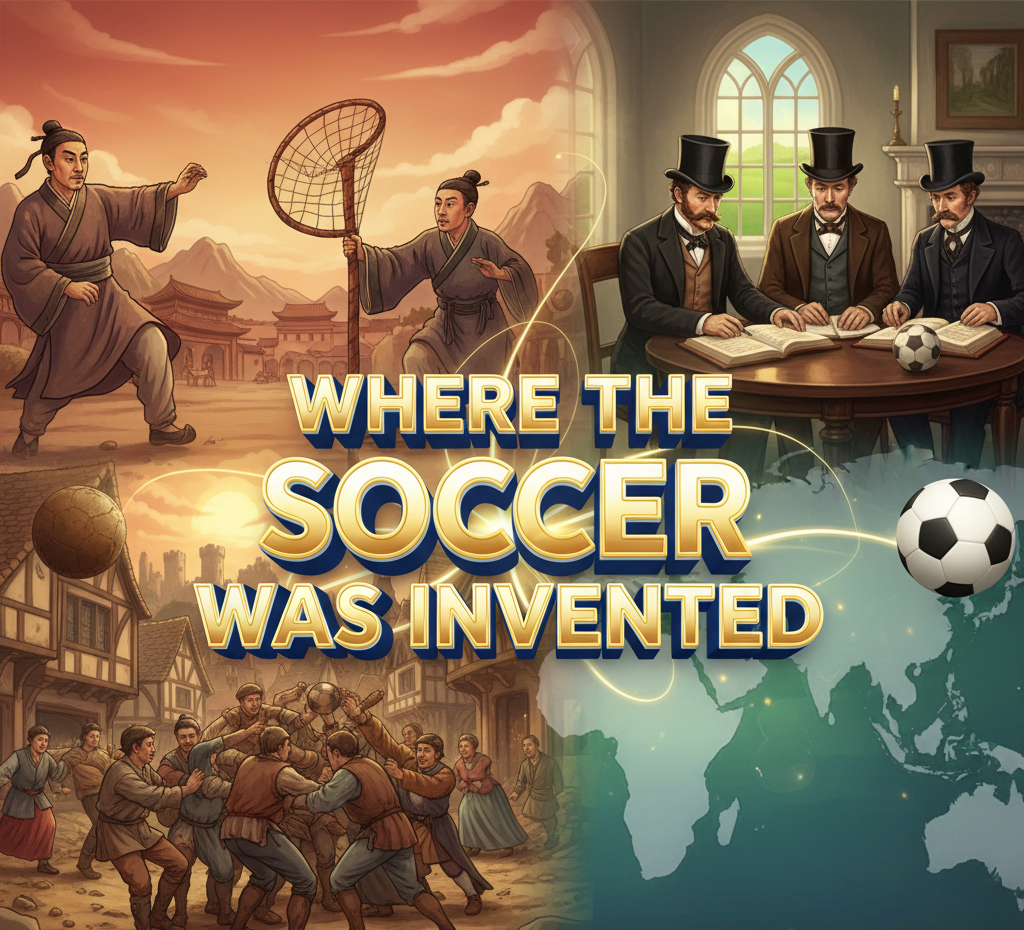
Soccer, known as football in most parts of the world, captivates billions of fans every week. From packed stadiums to dusty neighborhood pitches, the game brings people together like nothing else. Yet many wonder: where the soccer was invented exactly?
The honest answer is that it didn’t spring up in one place on a single day. Ancient kicking games existed for thousands of years, but the modern sport with clear rules and global appeal took shape in 19th-century England.
Where the soccer was invented is a story of gradual evolution. Early versions appeared in ancient China, while rough folk games thrived in Britain. The real breakthrough came in 1863 when English clubs standardized the rules. This guide walks you through the full journey in an easy-to-follow way.
Table of Contents
- Ancient Kicking Games: The Earliest Traces
- Cuju in Ancient China: The Oldest Known Form
- Medieval and Folk Football in Britain
- The Birth of Modern Soccer in England
- The Historic 1863 Meeting That Changed Everything
- How Soccer Spread Across the Globe
- Recent Debates: Scotland’s Claim to Early Fields
- Benefits of Knowing Where the Soccer Was Invented
- Frequently Asked Questions
- Conclusion
Ancient Kicking Games: The Earliest Traces
Humans have kicked balls for fun, fitness, and even military training since ancient times. These early games looked quite different from today’s matches, but they shared the basic idea of controlling a ball with your feet.
Records show similar activities in ancient Greece and Rome. In Rome, the game Harpastum involved carrying and kicking a small ball. Greek Episkyros also mixed kicking with handling.
These weren’t organized team sports with fixed rules. They often served training purposes or entertainment during festivals. Still, they prove that the concept of foot-based ball games is incredibly old.
The question of where the soccer was invented starts here, but these versions were far from the structured 90-minute matches we enjoy today.
Cuju in Ancient China: The Oldest Known Form
Many historians and FIFA itself recognize ancient China as home to the earliest documented kicking game.
During the Han Dynasty (around 206 BC to 220 AD), people played Cuju (also spelled Tsu Chu or Cu Ju), meaning “kick ball.” Players kicked a leather ball stuffed with feathers or hair through a small hole in a silk cloth or between bamboo poles raised high off the ground.
- It began as military training to keep soldiers fit and improve coordination.
- Later, it became popular entertainment, even played in imperial courts.
- Teams could vary in size, and skill with feet was highly valued.
FIFA has officially acknowledged Cuju as the oldest form of football with written records. Former FIFA president Sepp Blatter once highlighted China’s contribution during events in Beijing.
However, Cuju differed from modern soccer in important ways — no large rectangular pitch, no 11-player teams, and goals were small elevated openings rather than full nets. It shows the idea existed early, but it wasn’t yet the global sport we know.
While China gave us the oldest evidence, the full development of soccer happened elsewhere.
Medieval and Folk Football in Britain
By the 12th century, Britain saw the rise of “mob football” or folk football. These chaotic games happened during holidays like Shrovetide between neighboring villages.
Hundreds of people joined in, with almost no rules. You could kick, punch, or carry the ball. Goals might be miles apart, and matches could turn rough, sometimes causing injuries or damage to property.
Kings and local leaders tried banning these games several times because they distracted men from practicing archery for war. Despite the bans, the tradition continued in England, Scotland, and other parts of the British Isles.
These rowdy games mixed Roman influences with local customs. They kept the spirit of kicking a ball alive through the Middle Ages, setting the stage for more organized play later on.
The Birth of Modern Soccer in England
So, where the soccer was invented in its recognizable modern form? The credit largely goes to England in the mid-1800s.
During the Industrial Revolution, public schools such as Eton, Harrow, and Rugby developed their own versions of football. Some schools allowed handling the ball (which later became rugby), while others emphasized kicking.
As young men left school and moved to cities, they wanted to keep playing. Different clubs had different rules, making matches confusing when teams met.
Clubs in and around London started pushing for unity. This led to the creation of the Football Association (FA) in 1863 — the first official governing body for the sport.
England didn’t invent kicking a ball, but they invented the standardized rules that turned scattered games into the beautiful game we love worldwide.
The Historic 1863 Meeting That Changed Everything
On October 26, 1863, representatives from 11 London clubs and schools gathered at the Freemasons’ Tavern in Great Queen Street.
After heated debates, they agreed on key rules that separated “association football” from rugby:
- No handling the ball with hands (except the goalkeeper, added later).
- No “hacking” or kicking opponents’ shins.
- A defined pitch size and goal setup.
- Teams playing with consistent laws.
These early laws formed the foundation of today’s game. Further refinements came over the years, including the introduction of the crossbar, penalties, and throw-ins.
The Football Association’s work made fair, organized competition possible. Soon, leagues formed, and the FA Cup — the world’s oldest national football competition — began in 1871.
This 1863 moment in London is widely accepted as the true birth of modern soccer.
How Soccer Spread Across the Globe
With clear rules in place, British sailors, traders, teachers, and soldiers carried the game wherever they went.
- Late 1800s: It reached South America (Argentina in 1867), Europe, and beyond.
- 1904: FIFA formed in Paris with seven founding members.
- 1930: The first World Cup took place in Uruguay.
Today, FIFA has 211 member associations. The sport thrives from professional leagues in Europe to passionate street games in South America, Africa, and Asia.
Its simple requirements — a ball and open space — make it accessible to everyone, rich or poor.
Recent Debates: Scotland’s Claim to Early Fields
Most accounts credit England, but new archaeological findings add nuance. In 2025, researchers identified what may be a 17th-century soccer field near Anwoth Church in southwest Scotland.
Some historians argue this shows organized play happened in Scotland earlier than previously thought, challenging the strict “England only” narrative.
While exciting, these discoveries don’t change the fact that the standardized rules and governing body emerged in England in 1863. They simply highlight how folk games evolved across the British Isles.
Benefits of Knowing Where the Soccer Was Invented
Understanding the history adds real value:
- Deeper Appreciation: You see how a simple idea evolved into a global phenomenon.
- Cultural Insight: It connects ancient China, medieval Britain, and today’s World Cup.
- Inspiration for Players: Kids learn that the game rewards skill and teamwork, not just strength.
- Global Unity: Soccer’s story shows how one sport can cross borders and bring people together.
- Better Context for Rules: Knowing why hands are banned or why 11 players per team exist makes the game more meaningful.
The rich history reminds us that soccer belongs to the entire world, even if its modern rules started in one place.
Frequently Asked Questions
Where the soccer was invented exactly? Modern soccer with standardized rules was invented in England in 1863. Earlier kicking games existed in ancient China (Cuju) and other cultures.
Did China invent soccer? China had the oldest recorded form called Cuju over 2,000 years ago, recognized by FIFA. However, it differed significantly from today’s game.
Why is England credited with inventing soccer? English clubs created the Football Association and wrote the first unified laws in 1863, separating it from rugby and making organized play possible.
When was the first official soccer match played? Organized matches under FA rules began shortly after 1863. The first international match was England vs Scotland in 1872.
How did the word “soccer” come about? It originated in England as slang for “association football” (assoc + er). The term helped distinguish it from rugby (“rugger”).
Is there any single person who invented soccer? No single inventor exists. Ebenezer Morley is often called the “father” of the FA for pushing for unified rules.
Conclusion
Asking where the soccer was invented takes us on an amazing journey — from ancient Chinese Cuju fields used for military training, through chaotic medieval British villages, to the orderly 1863 meeting in a London tavern.
England gave the world the rules, structure, and governing body that allowed soccer to become the planet’s most popular sport. Yet its roots draw from many cultures, making it truly universal.
Next time you watch a match, kick a ball with friends, or cheer for your favorite team, remember this long and fascinating story. The beautiful game connects us to history while creating new moments of joy every day.
Whether you’re in England, China, Pakistan, or anywhere else, you’re part of a tradition that has evolved for over two thousand years — and it keeps getting better.