
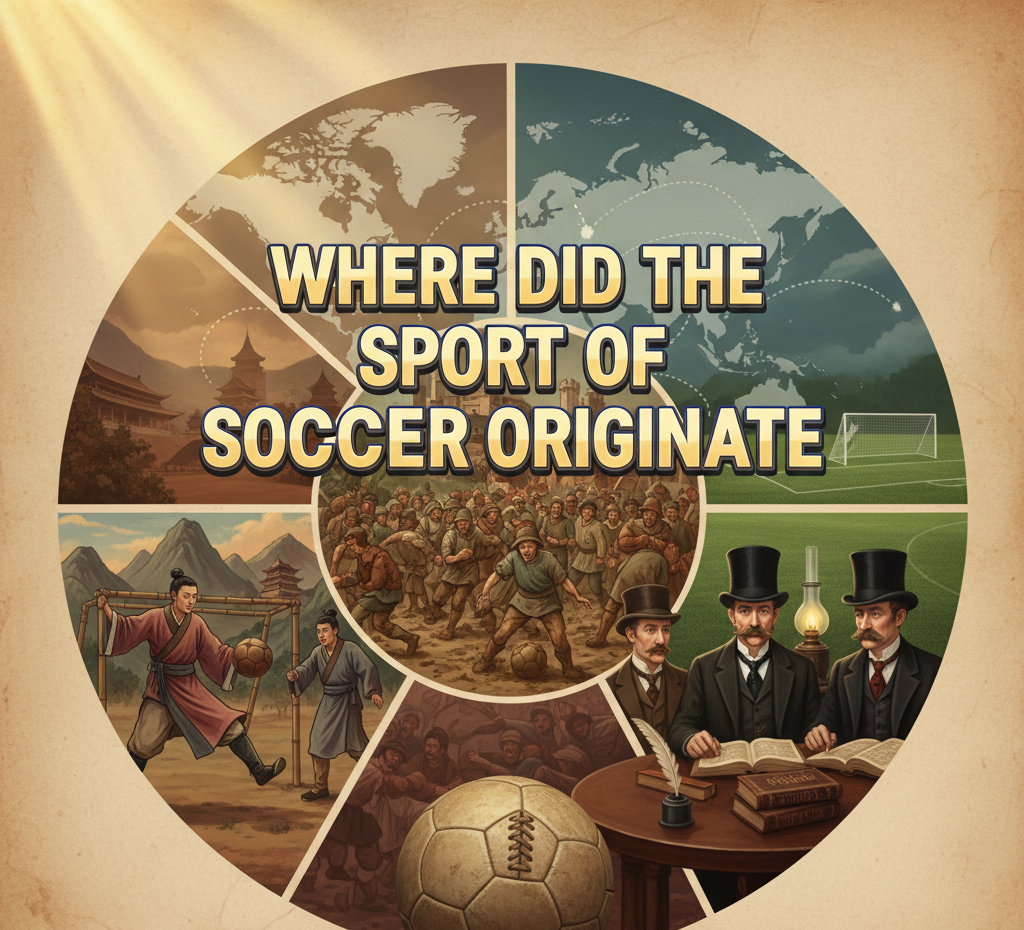
Have you ever watched a thrilling soccer match and wondered how this beautiful game actually started? Millions of fans around the world play or follow soccer (or football, as most call it), but its roots stretch back thousands of years across different continents.
Where did the sport of soccer originate? The answer is fascinating and spans multiple cultures. While ancient kicking games existed long before, the modern version we love today took shape in 19th-century England.
This guide explores the full story in simple terms. You’ll discover early versions of the game, how rules changed, and why England gets credit for standardizing soccer. Whether you’re a curious fan or a parent explaining the game to kids, you’ll find useful insights here.
Table of Contents
- Ancient Roots: Early Kicking Games Around the World
- Soccer in Ancient China: The Oldest Evidence
- Medieval Football in Britain: Rough and Rowdy Beginnings
- The Birth of Modern Soccer in England
- How the Rules Were Standardized in 1863
- The Spread of Soccer Worldwide
- Why We Call It Soccer in Some Places
- Benefits of Understanding Soccer’s History
- Frequently Asked Questions
- Conclusion
Ancient Roots: Early Kicking Games Around the World
People have been kicking balls for fun and training since ancient times. These early games looked nothing like today’s soccer, but they planted the seeds.
Versions appeared in ancient Greece (Episkyros), Rome (Harpastum), and even Mesoamerican cultures. Players often used their hands and feet, and games could get quite physical.
These activities served different purposes — military training, religious rituals, or simple entertainment. Yet the core idea of moving a ball toward a goal existed long ago.
The real question “where did the sport of soccer originate” leads us to look beyond one single place. No single country invented it overnight. Instead, it evolved gradually through cultural exchanges.
Soccer in Ancient China: The Oldest Evidence
Many historians and even FIFA point to ancient China as home to the earliest documented kicking game.
Around the 3rd to 2nd century BC during the Han Dynasty, people played Cuju (or Tsu Chu). Players kicked a leather ball stuffed with feathers or hair through a small opening in a silk net or bamboo poles. It was often used for military fitness training but also became popular entertainment.
- Balls were round and lightweight compared to earlier stone versions.
- Games emphasized skill and accuracy rather than brute force.
- Both men and women sometimes participated in later periods.
Cuju had rules, teams, and even referees in some descriptions. While it differed from modern soccer (no full pitch or 11 players), it represents the oldest clear evidence of a foot-based ball game.
Similar games like Kemari in Japan focused more on keeping the ball in the air without using hands. These Asian versions show how the concept of kicking spread across cultures.
Many experts agree that while China gave us the earliest kicking game, it was not yet the soccer we recognize today.
Medieval Football in Britain: Rough and Rowdy Beginnings
Fast forward to medieval England. By the 12th century, “mob football” or “folk football” became common during festivals like Shrovetide.
Hundreds of players from neighboring villages would compete. There were few rules — you could kick, punch, or even carry the ball. Goals might be miles apart, and matches could last all day.
These games were chaotic and sometimes violent. Injuries and even deaths occurred. Local authorities tried to ban them multiple times because they distracted from archery practice or caused property damage.
The Romans likely brought early ball games to Britain, which mixed with local traditions. By the 1300s–1400s, written records mention “football” in England.
In Scotland and other parts of Britain, similar rough games developed. This period shows how soccer-like activities became part of community life, even if they were far from organized sport.
The Birth of Modern Soccer in England
So, where did the sport of soccer originate in its recognizable form? Most credit goes to England in the 1800s.
During the Industrial Revolution, public schools like Eton, Harrow, and Rugby developed their own versions of football. Some allowed handling the ball (leading to rugby), while others focused more on kicking.
Students and workers in cities started forming clubs. The game needed consistency so people from different backgrounds could play together fairly.
In 1863, representatives from London clubs met at the Freemasons’ Tavern. They created The Football Association (FA) — the first governing body for the sport.
This meeting marked a turning point. They separated “association football” (kicking only, no hands) from rugby football.
How the Rules Were Standardized in 1863
The original 1863 laws of the game laid the foundation for modern soccer. Key early decisions included:
- No handling the ball (except by the goalkeeper later).
- Bans on “hacking” (kicking opponents’ shins).
- Introduction of a defined pitch size and goal markings.
- Teams of 11 players (standardized later).
The Cambridge Rules from university students heavily influenced these laws. Over time, further refinements added throw-ins, penalties, and the crossbar.
The 1863 FA meeting is widely seen as the birth of organized soccer. England didn’t invent kicking a ball, but they created the standardized rules, structure, and governing body that allowed the sport to grow globally.
The Spread of Soccer Worldwide
Once rules were set, soccer spread rapidly through British traders, sailors, and soldiers.
- 1870s–1880s: Reached Europe and South America.
- 1904: FIFA formed in Paris to oversee international play.
- 1930: First World Cup in Uruguay.
Today, over 4 billion people follow the sport. Professional leagues exist on every continent, and the game unites cultures like few others can.
From street games in Brazil to youth academies in Europe and local pitches in Islamabad, soccer’s simple equipment needs — just a ball and space — make it accessible everywhere.
Why We Call It Soccer in Some Places
The term “soccer” actually started in England as slang for “association football.” Students added “-er” to words, turning “assoc” into “soccer” to distinguish it from “rugger” (rugby).
In Britain, “football” became the common name. In countries like the United States, Canada, and Australia — where other “football” codes existed — “soccer” stuck to avoid confusion.
So the word “soccer” is thoroughly British in origin, even if many now associate it with American English.
Benefits of Understanding Soccer’s History
Knowing where did the sport of soccer originate adds depth to your enjoyment of the game:
- Appreciation for Simplicity: The sport’s ancient roots show why it remains so accessible — no fancy gear required.
- Cultural Connection: You see how different civilizations contributed ideas that evolved into one global game.
- Respect for Rules: The 1863 standardization prevented chaos and made fair competition possible.
- Inspiration for Players: Learning the history motivates kids and adults to value teamwork and skill over violence.
- Global Perspective: It reminds us soccer belongs to the world, not just one country.
Understanding this rich backstory makes watching or playing the game even more meaningful.
Frequently Asked Questions
Where did the sport of soccer originate exactly? Ancient kicking games started in China over 2,000 years ago, but modern soccer with standardized rules originated in England in 1863 through the Football Association.
Did China invent soccer? China had the earliest documented form called Cuju, but it was quite different. England formalized the version we play today.
Why is it called soccer in some countries? The word comes from “association football” in 19th-century England. It helps distinguish the sport where other types of football exist.
When were the first official soccer rules written? The Football Association created the first set of laws in December 1863 in London.
How did soccer spread from England? British people carried the game abroad through trade, military, and schools in the late 1800s and early 1900s.
Is soccer older than other major sports? Its ancient roots are among the oldest ball games, though organized team sports like cricket or baseball developed later in their modern forms.
Conclusion
The question “where did the sport of soccer originate“ doesn’t have one simple answer. Its story begins with ancient Chinese Cuju for fitness and fun, travels through rough medieval English fields, and reaches its modern form in 1863 London when rules brought order to chaos.
England gave soccer its structure, laws, and global framework, while earlier cultures contributed the joy of kicking a ball. That combination created the world’s most popular sport — one that continues to evolve while keeping its beautiful simplicity.
Next time you watch a match or kick a ball with friends, remember this long journey. Soccer connects us to history and to each other across borders and centuries. Whether you’re in England, China, Pakistan, or anywhere else, you’re part of a tradition thousands of years in the making.
The beautiful game keeps growing, but its heart remains the same: skill, teamwork, and the simple thrill of play.