
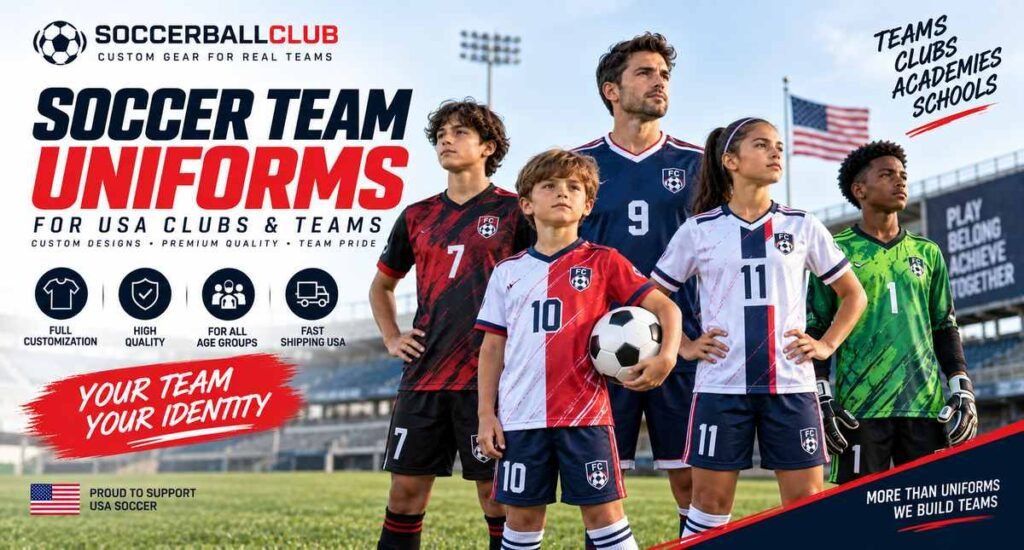
A soccer team’s uniform is one of the first things people notice when players step onto the field. A well-designed uniform creates a recognizable team identity, helps players look organized, and gives clubs an opportunity to showcase their colors and branding.
For soccer clubs, youth organizations, schools, academies, and recreational teams across the United States, choosing the right soccer team uniforms involves more than selecting an attractive jersey. Teams also need to consider comfort, sizing, materials, customization, durability, and the requirements of their league or tournament.
This guide explains what to consider when choosing soccer uniforms and how to create a professional team look.
What Are Soccer Team Uniforms?
Soccer team uniforms are coordinated sportswear designed for players representing the same club, school, academy, or organization.
A traditional soccer uniform can include:
- Soccer jersey
- Soccer shorts
- Soccer socks
- Club logo
- Player number
- Player name
- Sponsor branding
- Team colors
Some clubs also use matching training shirts, warm-up jackets, pants, and travel apparel to create a complete teamwear collection.
Why Are Soccer Team Uniforms Important?
A team uniform serves several practical and branding purposes.
Create Team Identity
Every soccer club has its own personality. Team colors, logos, and uniform designs can communicate that identity whenever players compete.
A recognizable uniform can also make the club easier to identify in photographs, tournaments, social media posts, and community events.
Encourage Team Unity
Matching uniforms can create a stronger sense of belonging among players. Everyone wears the same colors and represents the same organization.
This can be especially meaningful for youth players who are joining a team for the first time.
Provide a Professional Appearance
A coordinated uniform can make a team look organized and prepared.
Even recreational teams can create a professional appearance by using matching jerseys, shorts, socks, and consistent branding.
What Should Be Included in a Soccer Uniform?
The exact requirements vary depending on the team and league, but a complete match uniform usually contains several key components.
Soccer Jersey
The jersey is the most visible part of the uniform. It typically includes the club crest and player number.
Many teams also add player names and sponsor logos.
Soccer Shorts
Soccer shorts should provide enough flexibility for running, kicking, turning, and other movements.
Matching shorts can use the same colors and design elements as the jersey.
Soccer Socks
Soccer socks complete the uniform and provide a consistent appearance.
Teams should select a color that works well with the jersey and shorts.
Custom vs. Standard Soccer Team Uniforms
Teams generally have two main options: standard uniforms or customized teamwear.
Standard uniforms use existing designs and are often available in predetermined colors and sizes.
Custom uniforms allow teams to select their own:
- Colors
- Patterns
- Logos
- Numbers
- Player names
- Sponsor placement
- Design details
For established clubs and organizations that want a unique identity, customized uniforms can provide more flexibility.
How to Choose the Right Soccer Uniform Design
A good uniform design should be attractive, practical, and consistent with the club’s identity.
Start With Your Club Colors
Your team colors should be the foundation of the design.
If your club already has official branding, use the same colors in your uniforms whenever possible.
Common soccer color combinations include:
- Black and red
- Navy and white
- Blue and gold
- Red and white
- Green and white
- Black and yellow
The best combination is the one that fits your club’s identity and remains easy to recognize.
Choose a Simple Pattern
A uniform does not need an overly complicated design to look professional.
Popular options include:
- Solid-color uniforms
- Striped designs
- Gradient patterns
- Geometric graphics
- Abstract patterns
- Minimalist designs
A clean design can help logos, names, and numbers remain easy to read.
Choosing the Right Soccer Jersey Material
Players can spend several hours each week practicing and competing, so comfort should be an important consideration.
When evaluating soccer team uniforms, look for sportswear materials that provide:
Breathability
Soccer is a high-intensity sport. Breathable material can help make a jersey more comfortable during active play.
Lightweight Construction
A lightweight jersey can allow players to move naturally without unnecessary bulk.
Flexibility
Soccer requires constant movement. Uniforms should allow players to run, stretch, turn, and kick comfortably.
Durability
Team uniforms may be washed repeatedly during a season. Durable construction can help them remain usable over time.
Soccer Team Uniforms for Youth Players
Youth soccer teams have different needs compared with adult teams.
Children grow quickly, so sizing is particularly important.
When ordering youth uniforms, consider:
- Youth-specific sizing
- Player measurements
- Comfortable fit
- Room for movement
- Fabric quality
- Expected growth
- Replacement requirements
Do not rely only on age when choosing a size. Players of the same age can have significantly different heights and body shapes.
Soccer Uniforms for Clubs and Academies
Soccer clubs and academies may have several teams operating under one organization.
A consistent uniform strategy can help connect different age groups to the same club identity.
For example, a soccer academy might use the same logo and core colors for:
- U8 teams
- U10 teams
- U12 teams
- U14 teams
- U16 teams
- U18 teams
Each team can have a slightly different design while maintaining the same overall branding.
Home and Away Soccer Uniforms
Competitive teams may need both home and away uniforms.
The purpose of an away uniform is to provide a contrasting color combination when the opposing team’s uniform is too similar.
For example:
Home Uniform: Navy jersey, navy shorts, white accents
Away Uniform: White jersey, white shorts, navy accents
Having two designs can make it easier for teams to meet league requirements and avoid color conflicts.
Custom Soccer Uniforms With Player Names and Numbers
Personalization is one of the most useful features of customized teamwear.
Player numbers make it easier to identify players during games, while names provide an additional level of personalization.
Before production, the team manager should verify:
- Player name spelling
- Jersey number
- Size
- Team name
- Club logo
- Sponsor information
A final proof should be reviewed carefully before the order is approved.
Soccer Team Uniforms With Sponsor Logos
Sponsors can provide valuable support to soccer clubs and youth organizations.
If a team has sponsors, their logos can potentially be incorporated into the uniform design.
Common sponsor locations include:
- Front of jersey
- Back of jersey
- Sleeves
- Lower jersey area
Sponsor graphics should be positioned carefully so they do not interfere with the club logo or player numbers.
How to Order Soccer Team Uniforms
Planning your order in advance can reduce mistakes and delays.
Step 1: Determine Your Team Requirements
Decide whether you need jerseys only or complete uniforms including shorts and socks.
Step 2: Collect Player Information
Create a list containing:
- Player names
- Jersey numbers
- Jersey sizes
- Shorts sizes
- Required quantities
Step 3: Finalize the Design
Confirm your colors, logo, patterns, names, numbers, and sponsor details.
Step 4: Check the Size Chart
Compare player measurements with the supplier’s official sizing information.
Step 5: Review the Design Proof
Check every personalized detail before production.
Step 6: Confirm Production and Shipping
Make sure the estimated timeline works with your league season, tournament, or first scheduled match.
How Many Soccer Uniforms Does a Team Need?
A team should order enough uniforms for its complete roster.
Depending on the organization, you may also need uniforms for:
- Substitute players
- Goalkeepers
- New players
- Replacement needs
- Additional tournament requirements
Ordering a few extra uniforms can be useful when players join during the season.
However, the final quantity should be based on the team’s expected roster and budget.
How to Maintain Soccer Team Uniforms
Team uniforms can last longer when they are properly maintained.
Players and parents should follow the manufacturer’s washing instructions.
After training or matches, uniforms should be removed from sports bags and cleaned according to the recommended care instructions.
Avoid harsh washing methods or excessive heat when the manufacturer’s instructions advise against them.
Proper care can help preserve the fabric, colors, numbers, logos, and other customized elements.
What Makes a Good Soccer Team Uniform?
A good team uniform should combine several important qualities.
Professional Design
The uniform should reflect the team’s identity and look organized.
Comfortable Fit
Players should be able to move freely during matches and training.
Durable Construction
The uniform should be suitable for regular use throughout the season.
Clear Identification
Player names and numbers should be easy to read.
Consistent Branding
Colors, logos, and other design elements should work together.
Appropriate Sizing
Every player should have a size that allows comfortable movement without being excessively loose or restrictive.
Soccer Team Uniforms for USA Teams
The American soccer market includes teams at many different levels. From local youth leagues to competitive clubs and soccer academies, each organization can have different uniform requirements.
Soccer team uniforms can be designed for:
- Youth soccer clubs
- Competitive soccer teams
- School teams
- Soccer academies
- Recreational leagues
- Community teams
- Tournament teams
- Adult soccer clubs
Teams can customize their uniforms according to their age group, club branding, competition level, and budget.
Tips for Creating a Professional Soccer Team Look
A professional appearance does not require an overly complicated uniform.
Follow these basic principles:
- Choose two or three coordinated colors.
- Use a high-quality club logo.
- Keep player numbers easy to read.
- Make sure names are spelled correctly.
- Select comfortable sportswear material.
- Use matching shorts and socks.
- Consider a separate away uniform if necessary.
- Review the final design before production.
- Order early enough for the start of the season.
- Keep branding consistent across teamwear.
These simple decisions can create a uniform that looks polished and represents the club effectively.
Final Thoughts
Choosing the right soccer team uniforms is an important decision for clubs, academies, schools, and youth organizations. A good uniform combines team identity with comfort, durability, practical sizing, and personalization.
Whether you are preparing for a new season, creating a uniform for a new club, or replacing an existing kit, start by defining your colors, logo, player requirements, and design preferences.
Then compare customization options, materials, sizing, production time, and overall value before placing your order.
A well-designed soccer uniform can become an important part of your team’s identity—representing your players and club every time they step onto the field.