
Introduction
The Premier League schedule is one of the most anticipated football calendars in the world. Every year, millions of fans eagerly wait for the fixture list to see when their favourite clubs will face rivals, title contenders, and newly promoted teams. The schedule shapes the entire season, influencing championship races, European qualification battles, and relegation fights.
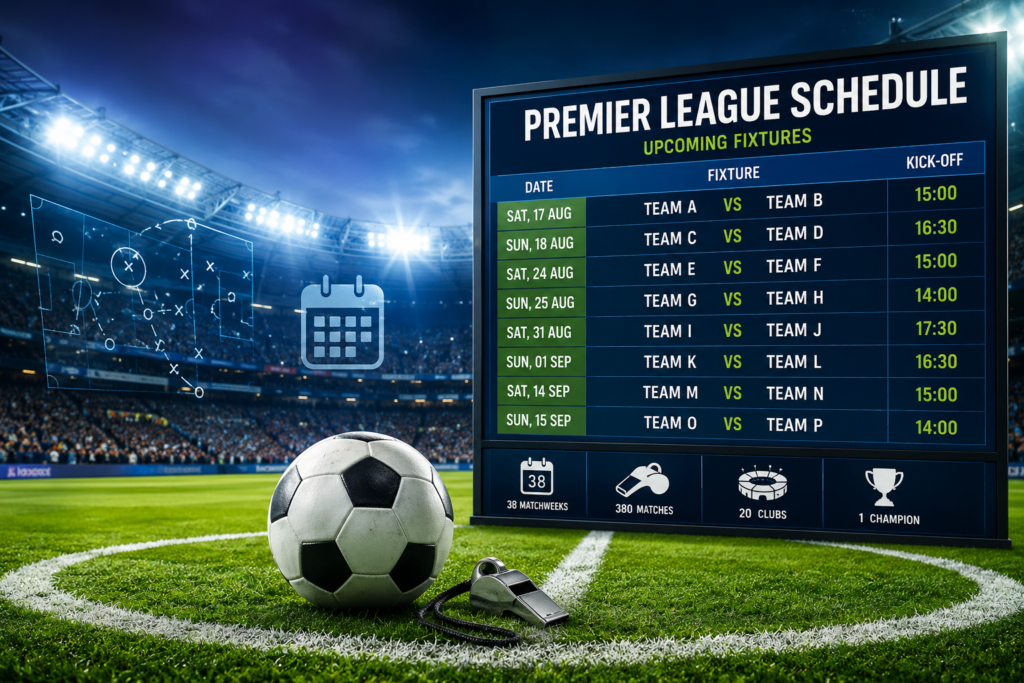
England’s Premier League is regarded as the most competitive domestic football competition, featuring 20 clubs that compete over 38 matches. From the opening weekend in August to the dramatic final day in May, every fixture can have a major impact on the league table.
Whether you’re a lifelong supporter or a new football fan, understanding how the Premier League schedule works helps you follow the competition more effectively. This guide explains everything you need to know, including fixture creation, key matchdays, scheduling changes, international breaks, holiday football, and tips for following the season.
What Is the Premier League Schedule?
The Premier League schedule is the official list of fixtures that determines when and where every league match will be played throughout the season.
Each club plays:
- 19 home matches
- 19 away matches
- Total of 38 league games
With 20 clubs participating, the league produces 380 matches every season.
The fixture list is usually released several weeks before the new season begins, allowing clubs, broadcasters, players, and supporters to prepare.
How the Premier League Schedule Is Created
Many people assume fixtures are randomly selected, but the process is far more complex.
The schedule is generated using advanced computer software while following numerous rules.
Important factors include:
- Stadium availability
- Local police recommendations
- Travel considerations
- Television broadcasting requirements
- European competitions
- International match calendar
- Club requests
- Derby scheduling
For example:
- Liverpool and Everton usually do not play home matches on the same weekend.
- Manchester United and Manchester City often alternate home fixtures.
- London clubs receive scheduling adjustments to reduce policing challenges.
After the initial schedule is generated, it undergoes several reviews before being officially released.
When Does the Premier League Season Start?
The Premier League season typically begins in August.
The opening weekend immediately attracts worldwide attention as clubs unveil:
- New signings
- New managers
- Tactical changes
- Updated squads
- Title ambitions
The season generally concludes in May, with all final-day fixtures kicking off simultaneously to maintain sporting fairness.
Understanding Matchweeks
The Premier League season consists of 38 matchweeks.
Each matchweek usually contains:
- Friday night football
- Saturday fixtures
- Sunday matches
- Monday Night Football
Occasionally, matches are played on:
- Tuesday
- Wednesday
- Thursday
These additional fixtures often occur because of:
- European competitions
- Fixture congestion
- Weather postponements
- Cup competitions
Premier League Schedule During Christmas
One of the league’s unique traditions is its festive football calendar.
Unlike many European leagues, the Premier League continues during Christmas and New Year.
Fans enjoy matches on:
- Boxing Day
- Late December
- New Year’s period
The festive schedule often plays a significant role in deciding the title race because clubs must play multiple matches within a short period.
Squad depth becomes especially important during this demanding period.
International Breaks
Throughout the season, the Premier League pauses for FIFA international windows.
During these breaks, players represent their national teams in:
- World Cup qualifiers
- European Championship qualifiers
- Nations League matches
- International friendlies
Managers often hope their players return healthy and injury-free before domestic football resumes.
Midweek Fixtures
While weekends remain the primary matchdays, the Premier League also schedules midweek matches.
Reasons include:
Fixture congestion
Clubs competing in Europe require flexible scheduling.
Weather postponements
Snow, storms, or unsafe conditions occasionally delay matches.
Cup competitions
FA Cup and EFL Cup fixtures can require league games to be rearranged.
Television and Schedule Changes
The original fixture list rarely remains unchanged.
Broadcasters select matches for live television throughout the season.
As a result:
- Kick-off times change
- Match dates move
- Weekend fixtures become evening matches
- Saturday games move to Sunday
Fans planning stadium visits should regularly check updated fixture announcements.
Biggest Fixtures Every Season
Every Premier League schedule includes several blockbuster encounters.
Some of the most anticipated fixtures include:
Manchester United vs Liverpool
England’s biggest football rivalry consistently attracts global audiences.
Arsenal vs Tottenham Hotspur
The North London Derby is famous for its intensity and passionate atmosphere.
Manchester City vs Liverpool
In recent years, this fixture has frequently influenced the title race.
Chelsea vs Arsenal
A major London rivalry featuring two successful clubs.
Manchester Derby
Manchester United and Manchester City battle for city supremacy.
These matches often become season-defining moments.
Newly Promoted Teams
Each season introduces three promoted clubs from the Championship.
Their schedules usually feature:
- Opening-day excitement
- First home Premier League match
- Meetings with top-six clubs
- Relegation six-pointers
Supporters closely monitor these fixtures as survival often depends on strong performances against direct rivals.
Double Gameweeks
A double gameweek occurs when a club plays twice within one Premier League scoring period.
These happen because postponed fixtures are rearranged.
Fantasy Premier League managers pay close attention to double gameweeks because they offer additional scoring opportunities.
Blank Gameweeks
Blank gameweeks occur when clubs do not play due to:
- FA Cup progression
- Weather postponements
- Fixture rearrangements
Fantasy football players often plan transfers weeks in advance to prepare for these schedule changes.
Final Day Drama
One of football’s greatest traditions is the Premier League’s final matchday.
Every match kicks off simultaneously.
This ensures no club gains an unfair advantage by knowing another team’s result before playing.
The final day often determines:
- Champions
- Champions League qualification
- Europa League places
- Relegation
Some of the league’s most unforgettable moments have occurred during the closing day of the season.
How Fans Follow the Premier League Schedule
Modern supporters have numerous ways to stay updated.
Popular options include:
- Official Premier League website
- Club websites
- Mobile apps
- Google Calendar integration
- Sports television channels
- Football news websites
- Social media updates
Many fans also subscribe to fixture alerts so they never miss a match.
Why the Schedule Matters
The order of fixtures can influence a club’s entire season.
Factors include:
Tough opening fixtures
A difficult start may increase pressure on managers.
Easier run of games
A favourable schedule can build momentum.
European commitments
Clubs playing in Europe often face demanding travel.
Injury management
Busy periods require squad rotation.
Title race
Late-season fixtures often decide the championship.
Managers regularly analyse fixture difficulty months in advance.
Home and Away Balance
The fixture list aims to distribute home and away matches fairly.
Although every team eventually plays:
- 19 home games
- 19 away games
The sequence varies.
Some clubs may experience:
- Three consecutive away matches
- Several home fixtures in succession
This balance becomes an important consideration for supporters planning travel.
Impact on Fantasy Premier League
Millions of managers study the Premier League schedule before selecting players.
Key scheduling considerations include:
- Easy fixture runs
- Double gameweeks
- Blank gameweeks
- Home advantage
- Rotation risk
- Derby matches
Fixture analysis often influences captain selections and transfer decisions.
Premier League Schedule and Broadcasting
Television coverage has transformed modern scheduling.
Broadcasters select matches based on:
- Club popularity
- League position
- Rivalries
- European qualification battles
- Relegation fights
This creates football almost every day during busy periods, giving supporters continuous entertainment.
Tips for Following the Premier League Schedule
To stay informed throughout the season:
- Save the official fixture calendar.
- Enable mobile notifications.
- Follow your club’s social media accounts.
- Watch for television schedule updates.
- Monitor international breaks.
- Keep track of postponed matches.
- Plan around festive fixtures.
- Check kickoff times regularly.
Frequently Asked Questions
How many matches are in the Premier League season?
There are 380 matches played across the season.
How many games does each team play?
Each club plays 38 league matches.
Why do fixture dates change?
Television broadcasting, cup competitions, weather conditions, and European tournaments often require adjustments.
When are Premier League fixtures announced?
The full schedule is usually published several weeks before the new season begins during the summer.
Are all final-day matches played at the same time?
Yes. Every final-day fixture kicks off simultaneously to preserve competitive integrity.
Why is Boxing Day football so popular?
The Premier League is one of the few major leagues that continues during the Christmas holidays, making Boxing Day fixtures a long-standing tradition.
Conclusion
The Premier League schedule is far more than a list of football matches. It is the framework that shapes one of the world’s most exciting sporting competitions. Every fixture influences title ambitions, European qualification, relegation battles, and unforgettable rivalries.
Understanding how the schedule is created, why fixtures change, and which periods are most demanding allows fans to enjoy the season on a deeper level. Whether you’re following your favourite club, planning stadium visits, or managing a Fantasy Premier League team, keeping up with the Premier League schedule ensures you never miss the biggest moments of England’s top-flight football.