
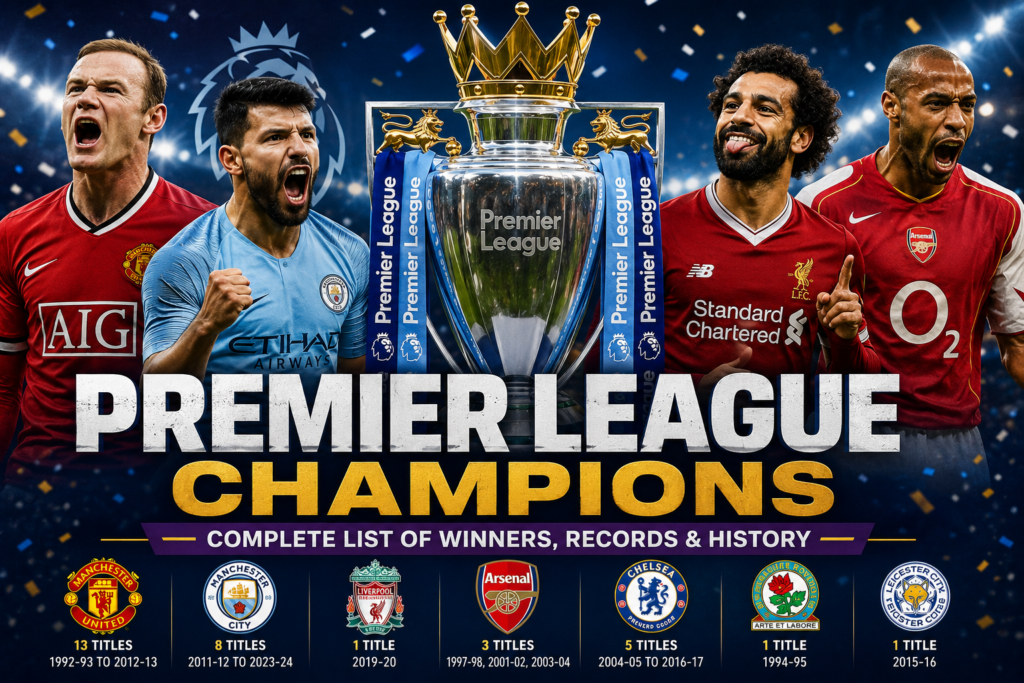
The Premier League is widely regarded as one of the most competitive and exciting football leagues in the world. Since its launch in 1992, it has featured some of football’s greatest clubs, legendary managers, and unforgettable title races. Winning the Premier League is considered one of the highest achievements in English football because it requires consistency, tactical excellence, and squad depth across a demanding 38-match season.
Premier League champions are the club that finishes at the top of the Premier League table after all league matches have been played. Teams earn three points for a win, one point for a draw, and no points for a defeat. If two or more clubs finish with the same number of points, goal difference and then goals scored determine the champion.
From Manchester United’s dominance under Sir Alex Ferguson to Arsenal’s famous unbeaten “Invincibles” season, Leicester City’s remarkable 2015–16 triumph, and Manchester City’s record-breaking campaigns under Pep Guardiola, the Premier League has produced countless memorable champions.
In this guide, you’ll learn how the Premier League champion is decided, explore the complete history of title winners, discover the most successful clubs and managers, review championship records, and relive some of the greatest title races in football history.
What Is the Premier League?
The Premier League is the highest level of professional football in England. Formed in 1992, it replaced the old Football League First Division and introduced a new commercial structure that transformed English football into one of the world’s most watched sporting competitions.
Today, the league consists of 20 clubs, with each team playing 38 matches during the season—one home match and one away match against every other club. The season usually runs from August to May.
Because of its global popularity, the Premier League attracts elite players, world-class managers, and millions of viewers from around the world.
League Format
The competition follows a simple league format.
Each club plays:
- 19 home matches
- 19 away matches
At the end of the season:
- The club with the most points wins the Premier League title.
- The top clubs qualify for European competitions.
- The bottom three clubs are relegated to the Championship.
This structure rewards consistency rather than knockout success, making the title one of the hardest to win in club football.
How the Points System Works
The Premier League uses a straightforward points system:
- Win = 3 points
- Draw = 1 point
- Loss = 0 points
If two teams finish level on points, the following tie-breakers apply:
- Goal difference
- Goals scored
- Additional competition rules if required
Because every point matters, even a single draw or defeat can determine the outcome of the title race.
How Is the Premier League Champion Decided?
Winning the Premier League requires sustained excellence across an entire season rather than success in a single final. Clubs must consistently perform against opponents of varying strengths while managing injuries, fixture congestion, and squad rotation.
Consistency Over 38 Matches
Championship-winning teams rarely rely on individual brilliance alone. Instead, they succeed by maintaining high performance levels from the opening weekend to the final match.
Successful champions typically demonstrate:
- Strong defensive organization
- Clinical finishing
- Squad depth
- Tactical flexibility
- Excellent home form
- Consistent away performances
These qualities allow clubs to collect points even during difficult periods.
Goal Difference Can Decide the Title
Goal difference has played a decisive role in Premier League history.
It is calculated by subtracting goals conceded from goals scored. A higher goal difference reflects both attacking efficiency and defensive strength.
As a result, top clubs continue attacking even when comfortably ahead because every goal could become important at the end of the season.
Why Squad Depth Matters
Modern football schedules are demanding.
Teams compete in:
- Domestic league matches
- Domestic cup competitions
- European tournaments
- International breaks
Championship-winning clubs usually possess strong squads capable of maintaining performance levels despite injuries and fixture congestion. Rotating players without reducing quality is often a key factor in winning the league.
Complete List of Premier League Champions by Season
Every Premier League season has added another chapter to English football history. Some clubs have established long periods of dominance, while others have produced unforgettable underdog stories.
Below is the structure you can use in your article for a season-by-season winners table:
| Season | Champion | Manager | Runner-up |
|---|---|---|---|
| 1992–93 | Manchester United | Sir Alex Ferguson | Aston Villa |
| 1993–94 | Manchester United | Sir Alex Ferguson | Blackburn Rovers |
| 1994–95 | Blackburn Rovers | Kenny Dalglish | Manchester United |
| … | … | … | … |
After the table, highlight notable championship seasons such as:
- Manchester United winning the inaugural Premier League title.
- Arsenal completing the 2003–04 season unbeaten.
- Chelsea setting new defensive standards under José Mourinho.
- Leicester City’s extraordinary 2015–16 title victory against overwhelming odds.
- Manchester City’s 100-point campaign, setting a new benchmark for excellence.
- Liverpool ending a 30-year wait for the English league title with a dominant 2019–20 season.
These landmark campaigns illustrate the evolution of the Premier League and why it remains one of the most competitive football leagues in the world.
Most Successful Premier League Champions
Winning the Premier League once is a remarkable achievement, but maintaining success over multiple seasons requires exceptional leadership, tactical consistency, financial planning, and squad depth. Since the league began in 1992, only a handful of clubs have established themselves as regular champions.
Manchester United
Manchester United remains the most successful club in the Premier League era, winning 13 league titles under the legendary manager Sir Alex Ferguson. Between 1992 and 2013, the club dominated English football with a winning culture built on attacking football, youth development, and strong leadership.
Several iconic players contributed to this success, including Ryan Giggs, Paul Scholes, Roy Keane, Cristiano Ronaldo, Wayne Rooney, Rio Ferdinand, and Nemanja Vidić. Ferguson’s ability to rebuild winning teams over two decades remains one of the greatest achievements in football history.
Manchester City
Manchester City has become the dominant force of the modern Premier League era. Under Pep Guardiola, the club introduced a possession-based style combined with tactical flexibility and relentless consistency.
City has broken numerous Premier League records, including:
- Most points in a single season (100)
- Most consecutive league wins
- Highest goals scored in several championship campaigns
- Multiple consecutive Premier League titles
The club’s success has been built on intelligent recruitment, world-class coaching, and exceptional squad depth.
Liverpool
Liverpool is one of England’s most historic football clubs. After decades of success before the Premier League era, the club finally captured its first Premier League title in the 2019–20 season under Jürgen Klopp.
Liverpool’s championship campaign was built on:
- High-intensity pressing
- Solid defensive organization
- Clinical attacking football
- Outstanding teamwork
The title ended a 30-year wait for England’s top-flight championship and became one of the club’s greatest modern achievements.
Arsenal
Arsenal’s most famous Premier League triumph came during the 2003–04 season when the club completed the entire league campaign unbeaten. Nicknamed the “Invincibles,” Arsenal won the title without losing a single league match.
Managed by Arsène Wenger, the team combined technical quality, attacking creativity, and defensive resilience. This achievement remains unmatched in the Premier League era.
Chelsea
Chelsea emerged as a dominant force after winning the league under José Mourinho in 2004–05. The club became known for its disciplined defending, tactical organization, and consistent performances.
Chelsea has won multiple Premier League titles with different managers, demonstrating the club’s ability to compete successfully across different eras.
Other Premier League Champions
Although several clubs have dominated the competition, a few other teams have enjoyed memorable title-winning seasons.
Blackburn Rovers
Blackburn Rovers won the 1994–95 Premier League title under Kenny Dalglish. Led by striker Alan Shearer, the club produced one of the greatest achievements in English football history.
Leicester City
Leicester City’s 2015–16 Premier League victory is widely regarded as one of the biggest surprises in sports history. Starting the season as outsiders, Claudio Ranieri’s team overcame the odds through teamwork, disciplined defending, and consistent performances.
Their title remains one of football’s greatest underdog stories.
Greatest Premier League Title-Winning Teams
Some champions stand out not only because they lifted the trophy but because they changed the way football was played.
Arsenal’s Invincibles (2003–04)
Arsenal completed all 38 league matches without suffering a single defeat.
Key achievements:
- Undefeated season
- Attractive attacking football
- Strong defensive record
- Historic place in football history
The “Invincibles” remain one of the most celebrated teams in world football.
Manchester United’s Treble Era
Manchester United’s 1998–99 season is remembered as one of the greatest campaigns ever by an English club. The team won the Premier League, FA Cup, and UEFA Champions League in the same season, completing a historic treble.
Their resilience, dramatic late victories, and never-give-up attitude defined an unforgettable era.
Manchester City’s 100-Point Season
During the 2017–18 campaign, Manchester City became the first Premier League club to reach 100 points in a single season.
The team also set records for:
- Most wins
- Most goals
- Largest points total
- Highest goal difference
Their attacking football and tactical innovation set new standards for excellence.
Leicester City’s Fairytale Triumph
Leicester City’s championship success demonstrated that teamwork, belief, and smart management can overcome financial disadvantages.
Despite competing against wealthier clubs, Leicester remained consistent throughout the season and secured one of football’s most inspirational league titles.
Liverpool’s Historic Championship
Liverpool dominated the 2019–20 season with aggressive pressing, disciplined defending, and clinical finishing. Their consistency allowed them to secure the title with several matches remaining, ending one of the longest waits for an English league championship.
Premier League Championship Records
The Premier League has produced numerous records that highlight the quality of its greatest champions.
Most Premier League Titles
Manchester United leads the Premier League era with the highest number of championships, while Manchester City continues to close the gap through sustained modern success.
Highest Points Total
Manchester City’s 100-point season remains one of the greatest achievements in English football history and set a benchmark for future champions.
Longest Winning Streak
Several title-winning teams have enjoyed remarkable winning runs that transformed close title races into dominant championship campaigns.
Largest Goal Difference
Championship-winning clubs often combine prolific attacking football with strong defensive organization, resulting in impressive goal differences that reflect their overall quality.
Earliest Title Victory
Some teams have secured the championship several weeks before the season ended, demonstrating complete dominance over their rivals.
Consecutive Championships
Winning one Premier League title is difficult, but defending it is even harder. Only a few clubs have managed to win consecutive championships, proving their ability to maintain elite performance levels over multiple seasons.
Legendary Managers Behind Premier League Success
Behind every great Premier League champion is a manager capable of building a winning culture. While talented players are essential, successful managers create tactical systems, motivate squads, develop young talent, and make crucial decisions throughout a long season.
Sir Alex Ferguson
Sir Alex Ferguson is widely regarded as the greatest manager in Premier League history. During his remarkable career at Manchester United, he won 13 Premier League titles, establishing a level of consistency that remains unmatched.
His success was built on several key principles:
- Trusting young players from the club’s academy.
- Continuously rebuilding successful squads.
- Maintaining high standards of discipline.
- Adapting tactics to different opponents.
- Inspiring players to perform under pressure.
Ferguson’s influence extended beyond trophies, helping shape the modern Premier League.
Pep Guardiola
Pep Guardiola transformed English football with his possession-based philosophy and tactical innovation at Manchester City. Under his leadership, City achieved multiple league titles while breaking numerous Premier League records.
His teams are known for:
- High ball possession
- Intelligent pressing
- Positional play
- Quick passing combinations
- Squad rotation
- Consistent attacking football
Guardiola’s methods have influenced coaches around the world.
Arsène Wenger
Arsène Wenger revolutionized Arsenal through modern coaching methods, improved sports science, and an attractive attacking style.
His greatest achievement remains the famous Invincibles season, when Arsenal completed the 2003–04 Premier League campaign without losing a single match.
José Mourinho
José Mourinho guided Chelsea to several Premier League titles using outstanding defensive organization, tactical discipline, and a winning mentality. His teams were difficult to break down and consistently delivered results against the league’s strongest opponents.
Claudio Ranieri
Claudio Ranieri will always be remembered for leading Leicester City to one of football’s greatest underdog triumphs in the 2015–16 season. His calm leadership, simple tactical approach, and strong team spirit helped Leicester achieve the impossible.
Memorable Premier League Title Races
Some Premier League seasons are remembered not only for the champions but also for the dramatic battles that lasted until the final weeks—or even the final minutes—of the campaign.
Manchester City vs. Manchester United (2011–12)
The 2011–12 season produced one of the most dramatic endings in football history. Manchester City secured the title on goal difference after Sergio Agüero scored a stoppage-time winner against Queens Park Rangers on the final day. The unforgettable “93:20” moment remains one of the league’s defining memories.
Leicester City’s Miracle Season
Leicester City started the 2015–16 campaign as outsiders, but their consistent performances, disciplined defending, and effective counterattacking football helped them finish ahead of traditional title contenders. Their success proved that teamwork and belief can overcome financial differences.
Manchester City vs. Liverpool
Recent seasons have featured intense competition between Manchester City and Liverpool. Both clubs regularly earned more than 90 points, producing one of the highest-quality rivalries in Premier League history. Small margins often determined the destination of the trophy.
Why Winning the Premier League Matters
Becoming Premier League champions brings far more than a trophy. It represents the highest level of domestic success in English football and provides significant sporting, financial, and commercial benefits.
Sporting Prestige
Winning the title confirms that a club has been the most consistent team over an entire season, outperforming every other club in one of the world’s strongest football leagues.
UEFA Champions League Qualification
Premier League champions automatically qualify for the following season’s UEFA Champions League, giving them the opportunity to compete against Europe’s elite clubs.
Financial Rewards
League champions benefit from increased prize money, higher broadcasting revenue, sponsorship opportunities, and global commercial growth. Success on the pitch often leads to stronger financial performance off it.
Global Recognition
Premier League champions receive worldwide attention, attracting new supporters, commercial partnerships, and elite players. Winning the league strengthens a club’s reputation for years to come.
Frequently Asked Questions
Who has won the most Premier League titles?
Manchester United has won the most Premier League titles since the competition began in 1992, with 13 championships under Sir Alex Ferguson.
Which club won the first Premier League?
Manchester United became the inaugural Premier League champions by winning the 1992–93 season.
How is the Premier League champion decided?
The champion is the club that finishes first in the league table after 38 matches. Teams earn three points for a win and one point for a draw. If clubs finish level on points, goal difference and then goals scored determine the winner.
Has any team gone unbeaten and won the Premier League?
Yes. Arsenal completed the entire 2003–04 Premier League season without losing a match, earning the famous nickname “The Invincibles.”
Which team recorded the highest points total in a title-winning season?
Manchester City became the first Premier League club to finish a season with 100 points during the 2017–18 campaign.
Conclusion
The history of Premier League champions is filled with legendary clubs, iconic players, visionary managers, and unforgettable moments. Since the league’s formation in 1992, each championship-winning team has earned its place through consistency, determination, and excellence across a demanding 38-match season.
From Manchester United’s dominance under Sir Alex Ferguson to Arsenal’s unbeaten Invincibles, Chelsea’s defensive masterclasses, Leicester City’s fairytale triumph, Liverpool’s long-awaited return to the summit, and Manchester City’s record-breaking achievements under Pep Guardiola, every era has contributed to the Premier League’s rich legacy.
Beyond lifting the trophy, becoming Premier League champions reflects outstanding teamwork, tactical intelligence, resilience, and the ability to perform under pressure throughout an entire season. These qualities are what separate champions from the rest of the competition.
As new seasons unfold, fresh challengers emerge, records are broken, and memorable title races continue to captivate football fans around the world. The story of the Premier League is still being written, and every campaign offers the possibility of another historic champion.
Key Takeaways
- The Premier League is England’s top professional football competition.
- Champions are determined by points accumulated over 38 league matches.
- Goal difference and goals scored are used as tie-breakers.
- Manchester United is the most successful club in the Premier League era.
- Arsenal’s Invincibles remain the only unbeaten champions of the Premier League era.
- Leicester City’s 2015–16 triumph is one of football’s greatest underdog stories.
- Winning the Premier League brings prestige, financial rewards, and qualification for Europe’s top club competition.
Call to Action
If you enjoyed this guide, bookmark it for future reference and revisit it each season to follow the latest champions, updated records, and historic milestones. Share it with fellow football fans who want to explore the complete history of Premier League champions and celebrate the greatest achievements in English football.