
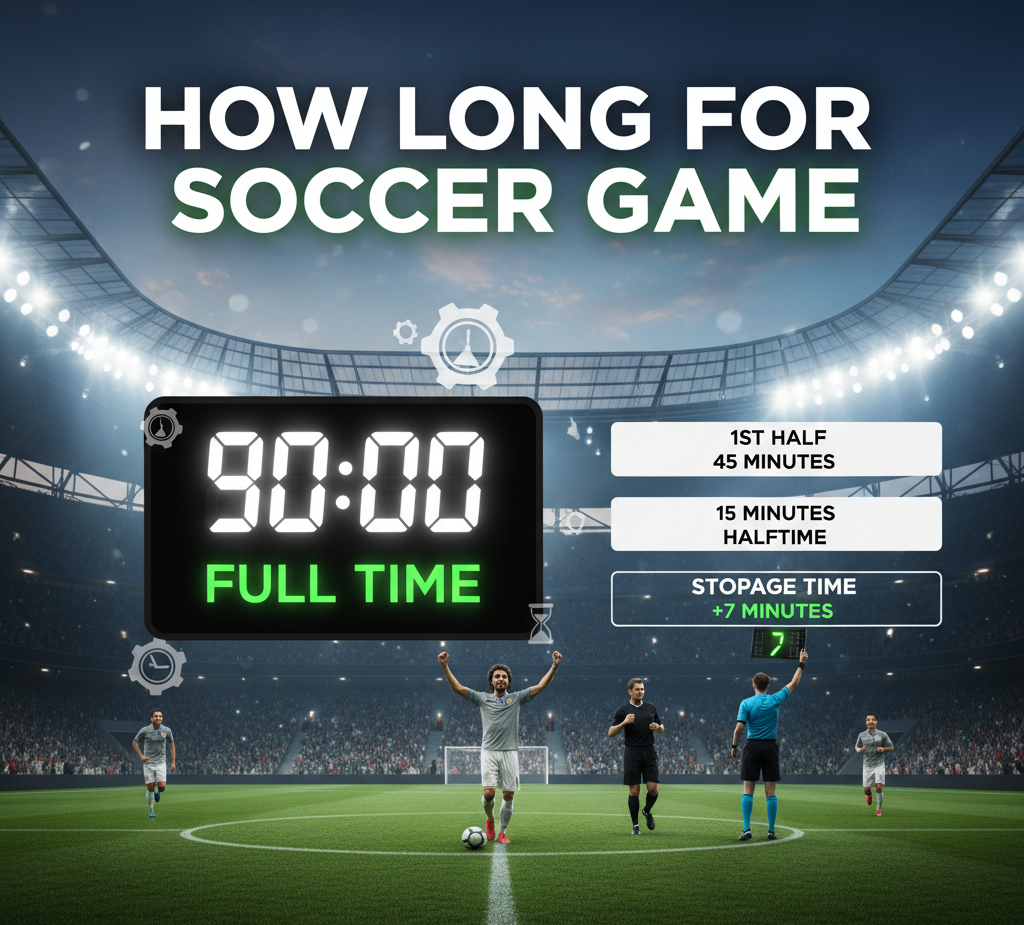
If you’ve ever wondered how long for a soccer game, you’re not alone. It’s one of the most common questions new fans ask, and even experienced supporters sometimes get confused about the exact timing.
A standard professional soccer game lasts 90 minutes of actual playing time, split into two 45-minute halves. But that’s not the full story. With stoppage time, halftime, and possible extra time in knockout matches, the total duration can stretch much longer.
In this guide, we’ll break down exactly how long for a soccer game in different situations, why the clock works the way it does, and what to expect when you watch or attend a match.
The Basic Structure: How Long for a Soccer Game in Regulation Time
The core of any soccer game is straightforward. According to the official Laws of the Game set by FIFA and IFAB, a normal match consists of two halves of 45 minutes each.
That gives you 90 minutes of pure playing time. The referee blows the whistle to start each half, and the clock runs continuously — except when the referee stops it for serious injuries, substitutions, or other significant delays.
Between the two halves, there is a 15-minute halftime break. During this time, players rest, coaches give tactical instructions, and fans grab snacks or use the bathroom.
So, for a typical league match without extra time, you’re looking at roughly 105 to 120 minutes from the first whistle to the final whistle. That includes the 90 minutes of play plus the 15-minute halftime.
Stoppage Time: Why Soccer Games Often Run Longer
One of the biggest reasons people get surprised by how long for a soccer game is stoppage time, also called added time or injury time.
The referee adds extra minutes at the end of each half to make up for time lost during the match. Common reasons include:
- Player substitutions
- Injuries and medical treatment on the pitch
- Time-wasting by players (especially when a team is winning)
- VAR reviews
- Goal celebrations
- Serious fouls or red cards
In modern football, stoppage time has become more accurate and often longer. You’ll frequently see 4–8 minutes added in the first half and 6–12 minutes in the second half. Some big matches have even seen over 15 minutes of added time.
This is why many fans say a soccer game feels closer to two hours long in total.
How Long for a Soccer Game in Different Competitions
The basic 90-minute format stays mostly the same, but certain situations change how long for a soccer game:
League and Group Stage Matches
- Regular 90 minutes + stoppage time
- No extra time unless it’s a cup final or knockout stage
- Most matches finish between 1 hour 55 minutes and 2 hours 10 minutes
Knockout Matches (Cup Games, Play-offs, World Cup)
If the score is tied after 90 minutes, the game goes to extra time:
- Two periods of 15 minutes each (30 minutes total)
- Another short break between extra time periods
- More stoppage time added
If it’s still level after extra time, the match is decided by penalty shootout, which usually takes 10–20 minutes.
Youth and Amateur Soccer
Lower age groups often play shorter matches:
- Under-12s: Often 2 × 25 or 30 minutes
- High school games: Sometimes 2 × 40 minutes
- Amateur adult leagues: Usually still 2 × 45 minutes
Women’s Soccer
Professional women’s matches follow the exact same rules as men’s — 90 minutes plus stoppage time.
Why Soccer Doesn’t Have a Running Clock Like Other Sports
Unlike basketball or American football, soccer uses a stopped clock only for major interruptions. The referee keeps the official time on the pitch, and the fourth official displays the minimum added minutes on a board.
This system encourages continuous play and makes the game more fluid. It also adds drama — teams know they have to keep pushing even when the clock seems to be running out.
Many new fans are surprised by how long for a soccer game because they expect it to end exactly at 90 minutes like a timed sport.
What Affects How Long for a Soccer Game in Practice
Several factors can make one soccer game feel much longer or shorter than another:
- Referee style — Some referees are stricter with time-wasting and add more stoppage time.
- Weather conditions — Hot weather or heavy rain can lead to more breaks.
- Scoreline — Teams leading often slow the game down, increasing added time.
- VAR usage — Video reviews can add several minutes.
- Number of substitutions — Each team now gets up to five substitutions, which takes time.
On average, a Premier League or Champions League match lasts about 1 hour 58 minutes to 2 hours 10 minutes from start to finish.
Tips for Watching or Attending a Soccer Game
If you want to plan your time better when wondering how long for a soccer game, keep these tips in mind:
- Arrive at the stadium at least 45–60 minutes before kick-off for the full experience.
- Plan for at least 2 hours 15 minutes total if you’re going to a match in person (including travel and exit time).
- For TV viewing, add buffer time for pre-match and post-match analysis.
- Bring snacks and drinks if you’re watching at home — the game can easily stretch past two hours.
- Check the referee’s name beforehand — some are known for longer added time.
Understanding how long for a soccer game helps you enjoy it more without constantly checking your watch.
Benefits of Knowing Soccer Match Duration
- Better plan your schedule around matches
- Avoid frustration when games run long
- Appreciate the flow and drama of stoppage time
- Explain the rules clearly to new fans or children
- Make smarter bets or fantasy football decisions
Frequently Asked Questions (FAQ) about How Long for a Soccer Game
How long for a soccer game in total? A normal match lasts about 105–120 minutes including 90 minutes of play, 15-minute halftime, and stoppage time.
Does soccer have extra time in every game? No. Extra time only happens in knockout competitions when the score is tied after 90 minutes.
How much stoppage time is usually added? Typically 4–8 minutes in the first half and 6–12 minutes in the second half, though it can be more.
How long is halftime in soccer? Halftime is always 15 minutes.
How long for a soccer game with penalties? Add another 10–20 minutes for the penalty shootout after extra time.
Do youth soccer games last the same time as professional ones? No. Younger age groups usually play shorter halves, sometimes as little as 25–30 minutes per half.
Is women’s soccer the same length as men’s? Yes, professional women’s matches are also 90 minutes plus stoppage time.
Conclusion: Understanding How Long for a Soccer Game Makes It More Enjoyable
Now you know exactly how long for a soccer game — 90 minutes of action, plus halftime, stoppage time, and possibly extra time in big knockout matches. While the clock says 90 minutes, the full experience usually takes around two hours or slightly more.
The beauty of soccer lies in this flow. The lack of constant stoppages creates tension and excitement that other timed sports sometimes miss. Once you understand the timing, you’ll enjoy matches even more because you’ll know what to expect.
Whether you’re watching your first game or you’ve followed soccer for years, remembering that how long for a soccer game is flexible helps you relax and appreciate every moment on the pitch.
Next time someone asks you how long a soccer match lasts, you’ll have the full answer ready — and maybe even impress them with your knowledge of stoppage time and extra periods.
Enjoy the beautiful game, and don’t forget to factor in those extra minutes!