
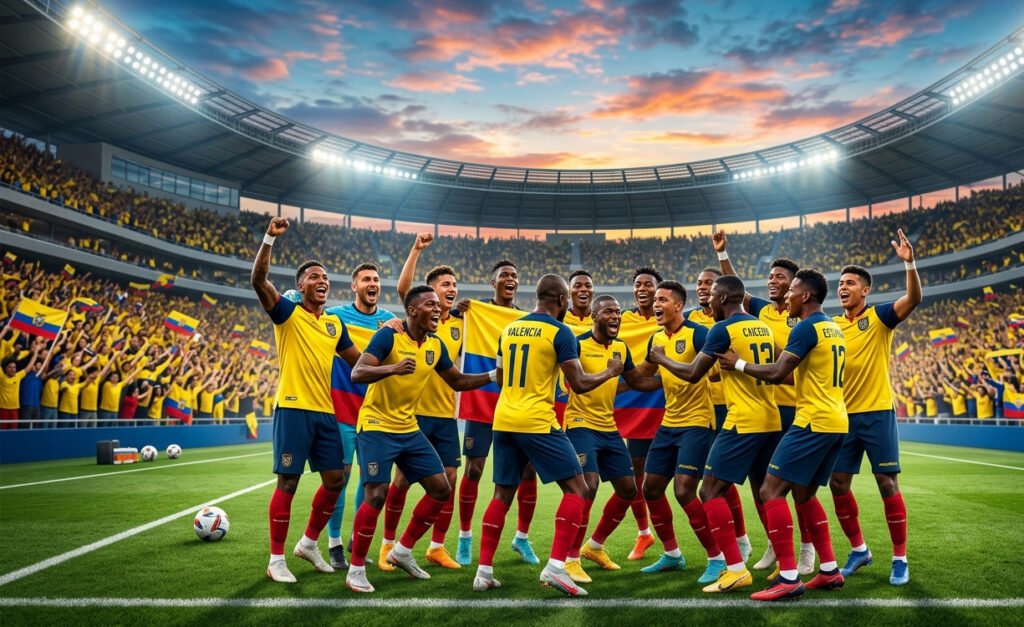
The Ecuador national football team has transformed into one of South America’s most competitive football nations. Known for its energetic style of play, physically gifted players, and impressive performances in international tournaments, Ecuador has steadily earned respect on the global stage. While the country may not have the long football history of Brazil or Argentina, it has consistently challenged South America’s traditional giants and produced world-class talent.
Representing Ecuador in international competitions, the national team is managed by the Ecuadorian Football Federation (FEF) and competes in tournaments organized by FIFA and CONMEBOL. Over the last two decades, Ecuador has qualified for multiple FIFA World Cups and Copa América tournaments, demonstrating significant progress in international football.
In this guide, you’ll learn everything about the Ecuador national football team, including its history, achievements, famous players, FIFA ranking, playing style, and future ambitions.
History of the Ecuador National Football Team
Football arrived in Ecuador during the late 19th century through British influence. The Ecuadorian Football Federation was established in 1925, and the national team played its first official international match in 1938.
For many decades, Ecuador struggled to compete with South American powerhouses such as Brazil, Argentina, and Uruguay. Limited infrastructure, fewer professional clubs, and inconsistent youth development made international success difficult.
However, the situation began to change during the 1990s. Investments in football development, improved domestic competitions, and stronger youth academies helped produce a new generation of talented players.
The breakthrough came in 2002, when Ecuador qualified for its first FIFA World Cup. Since then, the national team has become a regular contender in World Cup qualification and one of South America’s rising football nations.
Nickname and Team Identity
The Ecuador national football team is popularly known as “La Tri,” referring to the country’s three national colors:
- Yellow
- Blue
- Red
These colors are proudly displayed on the team’s home jersey, with yellow serving as the primary color.
Ecuador is recognized for:
- High-intensity football
- Fast counterattacks
- Strong athleticism
- Excellent defensive organization
- Developing young talent
Their home matches are often played at high altitude in Quito, giving them a unique advantage over visiting teams.
Ecuador in FIFA World Cup History
One of Ecuador’s greatest achievements has been its consistent qualification for the FIFA World Cup.
FIFA World Cup Appearances
| Year | Result |
|---|---|
| 2002 | Group Stage |
| 2006 | Round of 16 |
| 2014 | Group Stage |
| 2022 | Group Stage |
Best World Cup Performance
The team’s finest World Cup campaign came in 2006 in Germany.
Ecuador won two group-stage matches and advanced to the Round of 16 for the first time. Although they lost to England, the tournament proved Ecuador could compete with elite football nations.
Several Ecuadorian players gained international recognition after their impressive performances.
Copa América Performances
The Copa América is South America’s oldest international football tournament.
Although Ecuador has yet to win the competition, the team has produced several memorable performances.
Best Copa América Finish
The team’s best finish remains Fourth Place, achieved twice:
- 1959
- 1993
In recent tournaments, Ecuador has consistently qualified and frequently reached the knockout stages, showing gradual improvement.
FIFA World Ranking
The Ecuador national football team has experienced significant growth in the FIFA rankings over the past two decades.
Its ranking has improved thanks to:
- Successful World Cup qualification campaigns
- Strong performances against top South American teams
- Victories in international friendlies
- Development of young European-based players
Ecuador is now widely considered one of CONMEBOL’s strongest emerging football nations.
Home Stadium
Although Ecuador has played in several stadiums, the most iconic home venue is:
Estadio Rodrigo Paz Delgado
Located in Quito, the stadium sits more than 2,800 meters (9,200 feet) above sea level.
The altitude often creates difficult playing conditions for visiting teams, making Quito one of the toughest away venues in international football.
Playing Style
Modern Ecuadorian football combines athleticism with technical ability.
Key characteristics include:
Fast Counterattacks
Ecuador transitions quickly from defense to attack using pace on the wings.
High Pressing
The team frequently presses opponents high up the pitch to force turnovers.
Physical Strength
Ecuadorian players are known for stamina, strength, and speed, allowing them to compete intensely throughout the match.
Defensive Discipline
Recent coaches have emphasized organized defending while remaining dangerous on the counterattack.
Famous Ecuador National Football Team Players
Over the years, Ecuador has produced several outstanding footballers who have represented top clubs around the world.
Antonio Valencia
One of Ecuador’s greatest footballers, Antonio Valencia enjoyed a successful career in the English Premier League.
Achievements include:
- Multiple Premier League titles
- UEFA Europa League winner
- Long-time national team captain
His leadership and versatility made him an Ecuadorian football icon.
Enner Valencia
Enner Valencia is Ecuador’s all-time leading international goalscorer.
Known for:
- Clinical finishing
- Intelligent movement
- Leadership
- World Cup goals
He has represented Ecuador in multiple FIFA World Cups.
Moisés Caicedo
Moisés Caicedo is regarded as one of the world’s top young midfielders.
Strengths include:
- Ball-winning ability
- Passing range
- Defensive intelligence
- Work rate
He represents the exciting future of Ecuadorian football.
Piero Hincapié
Hincapié has emerged as one of South America’s finest young defenders.
His qualities include:
- Composure under pressure
- Strong tackling
- Excellent positioning
- Ability to play out from the back
Current Squad Strength
The current Ecuador squad blends experienced leaders with exciting young talent.
Strengths include:
- Athletic midfield
- Young defenders
- Dangerous attackers
- European-based professionals
- Excellent team chemistry
Many players now compete in Europe’s top leagues, helping raise the national team’s overall quality.
Youth Development
One reason behind Ecuador’s recent success is its investment in youth development.
Several academies consistently produce talented footballers who later move to Europe.
The country has also enjoyed success in youth international competitions, proving that future generations remain promising.
Youth development focuses on:
- Technical ability
- Tactical awareness
- Physical conditioning
- Professional coaching
- International exposure
Major Achievements
Although Ecuador has not yet won a major international trophy, the team has achieved numerous milestones.
Key Achievements
- Qualified for four FIFA World Cups
- Reached the Round of 16 in 2006
- Regular Copa América participant
- Produced internationally recognized football stars
- Established itself among South America’s strongest teams
- Developed one of the continent’s best young generations
Biggest Rivals
Ecuador regularly competes against South America’s traditional football powers.
Major rivalries include:
- Peru
- Colombia
- Chile
- Brazil
- Argentina
Matches against neighboring countries are often highly competitive due to regional pride and World Cup qualification stakes.
Future of the Ecuador National Football Team
The future appears bright for Ecuadorian football.
A strong youth pipeline, experienced coaching staff, and increasing numbers of players in Europe’s elite leagues suggest continued progress.
The team’s primary goals include:
- Qualifying consistently for future FIFA World Cups
- Advancing beyond the Round of 16
- Competing for a Copa América title
- Developing the next generation of international stars
If current trends continue, Ecuador could become one of South America’s most successful football nations over the next decade.
Conclusion
The Ecuador national football team has evolved from an underdog into one of South America’s most exciting international sides. With multiple FIFA World Cup appearances, talented players competing at Europe’s highest levels, and a strong commitment to youth development, Ecuador continues to strengthen its position in world football.
While major international trophies remain a future ambition, the team’s steady improvement, disciplined playing style, and emerging generation of stars suggest that its greatest achievements may still lie ahead. Football fans around the world can expect La Tri to remain a formidable force in international competitions for years to come.