A soccer club with several teams can go through a surprising number of soccer balls during a season. Training sessions, camps, tournaments, school programs, and everyday practice all require equipment that is ready when players step onto the field.
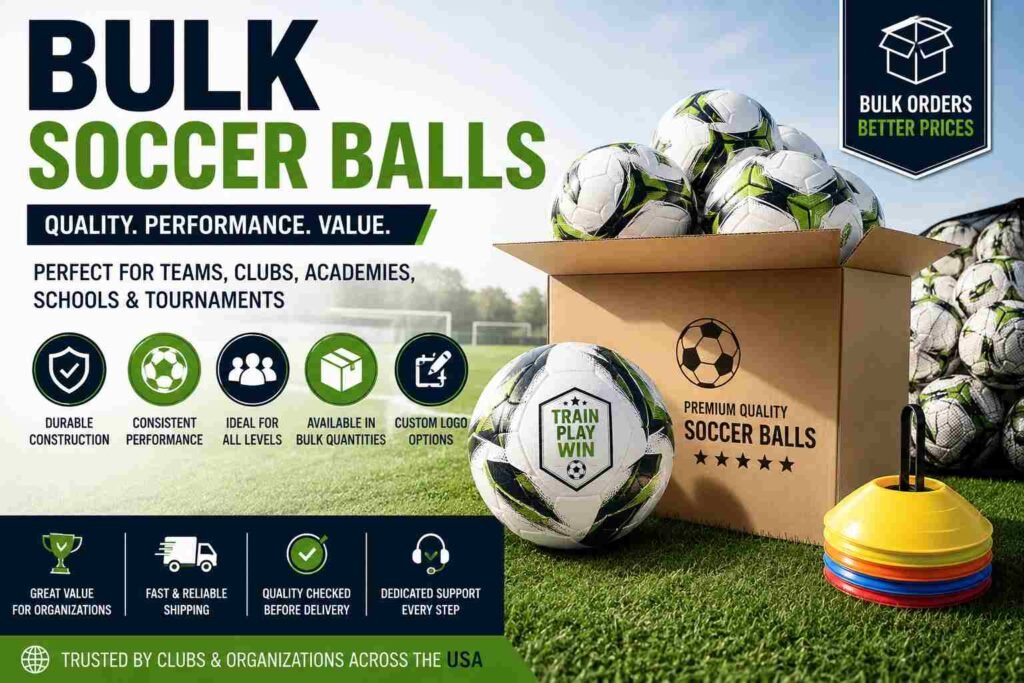
For organizations that need a large quantity, purchasing bulk soccer balls can be more practical than repeatedly buying individual balls. Bulk purchasing allows teams and businesses to plan their equipment needs, select suitable specifications, and work toward a consistent inventory.
However, buying in quantity should not mean choosing a product without considering how it will be used. Ball size, construction, material, playing surface, quantity, customization, shipping, and overall product quality can all influence the final decision.
This guide explains what US soccer organizations should consider when purchasing soccer balls in bulk.
What Are Bulk Soccer Balls?
Bulk soccer balls are soccer balls purchased in a larger quantity for organizational, commercial, training, or event purposes.
The buyer may be a soccer club, academy, school, retailer, distributor, league, tournament organizer, or sports business.
A bulk order might contain standard training balls, premium products, customized team balls, youth-sized balls, or a combination of different products.
The appropriate quantity depends on the buyer’s requirements.
For example, a small soccer academy may need several dozen balls for its training groups, while a distributor may order a much larger quantity for resale.
Who Buys Soccer Balls in Bulk?
Bulk purchasing is useful for many different types of organizations.
Soccer Clubs
Clubs with multiple teams often need equipment for several fields and age groups.
Soccer Academies
Academies can require large quantities because players train frequently and several groups may operate at the same time.
Schools
Schools may need soccer balls for physical education classes, school teams, recreational activities, and seasonal programs.
Tournament Organizers
Large events can require many balls for matches, warm-ups, training areas, and other activities.
Retailers
Sports retailers can purchase products in bulk and sell them individually to customers.
Distributors
Distributors may source soccer balls in larger quantities and supply local clubs, stores, academies, or other organizations.
Soccer Camps
Seasonal camps can require additional equipment because many players may participate simultaneously.
Why Buy Soccer Balls in Bulk?
There are several practical reasons for ordering soccer balls in quantity.
Easier Equipment Planning
Instead of purchasing a few balls every time equipment becomes unavailable, organizations can plan their requirements in advance.
Consistent Products
Buying from the same supplier can help maintain a consistent product specification across the organization’s equipment.
Suitable for Multiple Teams
A club can distribute a planned quantity to each team, training group, or field.
Customization Opportunities
Larger orders can also provide an opportunity to add custom branding, team colors, logos, or other artwork where the manufacturer’s options allow it.
Replacement Stock
Organizations can keep additional balls available for normal wear, loss, or damage during the season.
How Many Bulk Soccer Balls Should You Buy?
There is no universal quantity that works for every organization.
The right number depends on how many teams you operate, how often they train, how many players participate, and how many fields are being used.
A club should consider:
- Number of teams
- Number of players
- Number of training fields
- Weekly training sessions
- Tournament schedule
- Soccer camp requirements
- Expected equipment wear
- Replacement stock
- Storage capacity
A club with ten teams will naturally have different requirements from a small recreational program.
Rather than choosing a quantity based only on a supplier’s minimum order, calculate your expected usage first.
Choosing the Right Soccer Ball Size
Buying a large quantity of the wrong size can create an unnecessary expense.
Different age groups may use different soccer ball sizes, so organizations should confirm their requirements before ordering.
Size 5 Soccer Balls
Size 5 is commonly associated with older youth and adult soccer programs.
It is widely used for standard full-size training and competitive environments.
Size 4 Soccer Balls
Size 4 is commonly used for younger player development programs.
It offers a smaller option for players who are still developing their technique.
Size 3 Soccer Balls
Size 3 is commonly associated with younger children and introductory soccer activities.
Age-group requirements can vary, so clubs should always check the specifications of their league or program before placing a large order.
Bulk Soccer Balls for Teams
Teams that train regularly can benefit from having enough balls available for every session.
A coach may want players to work in pairs, small groups, or individually. Each type of exercise can require a different amount of equipment.
If there are not enough balls, players may spend valuable practice time waiting for equipment.
For this reason, bulk soccer balls for teams can be particularly useful for clubs with frequent training schedules.
A team should consider both its current needs and the amount of replacement equipment likely to be required during the season.
Bulk Soccer Balls for Clubs
A soccer club may manage several teams under one organization.
Instead of allowing each team to purchase equipment independently, the club can centralize purchasing and establish consistent specifications.
This can make inventory management easier.
For example, a club could choose a particular training ball model and distribute it across its youth and adult programs.
The club can then maintain replacement stock and reorder the same specification when needed.
Centralized purchasing may also make it easier to manage branding and product quality.
Custom Bulk Soccer Balls
Bulk purchasing and customization can work particularly well together.
An organization ordering a significant quantity may want its soccer balls to feature a recognizable design.
Custom options may include:
- Club logo
- Academy name
- Team colors
- Custom graphics
- Tournament branding
- Sponsor information
- Special event designs
A custom product can help distinguish one organization’s equipment from another’s.
For businesses, customized soccer balls can also be developed as branded merchandise or private-label products.
Bulk Training Soccer Balls
Training equipment usually experiences more frequent use than balls reserved for special matches.
A training ball may be used repeatedly during passing exercises, shooting drills, small-sided games, and technical sessions.
Because of this, buyers should consider durability and value when selecting bulk training soccer balls.
A product intended for daily practice should be chosen according to its expected environment rather than simply based on its appearance.
Construction Options for Bulk Orders
Soccer balls can be manufactured using different construction techniques.
The appropriate option depends on the intended use and product requirements.
Hand-Stitched
Hand-stitched soccer balls are produced by manually joining the panels.
They can be considered when buyers want a traditional construction approach and particular durability characteristics.
Machine-Stitched
Machine stitching can be suitable for organizations that need larger quantities of practical training equipment.
It can provide an efficient production method for bulk orders.
Thermo-Bonded
Thermo-bonded soccer balls use heat to join the panels.
This method can produce a clean surface and is often used for premium product designs.
When placing a bulk order, ask the manufacturer which construction is appropriate for your intended application.
Choosing the Right Material
The outer material affects the feel, appearance, and durability of a soccer ball.
Modern soccer balls commonly use synthetic materials, with different options available for different product categories.
A training ball intended for frequent use may have different material requirements from a premium match-oriented ball.
Before ordering, ask the supplier for the complete material specification instead of evaluating a ball only from photographs.
Bulk Soccer Balls for US Buyers
US buyers sourcing soccer balls internationally should think about more than the unit price.
The final purchasing decision may involve:
- Product cost
- Customization
- Minimum order quantity
- Production time
- Packaging
- Shipping
- Import-related costs
- Delivery schedule
- Quality requirements
A low quoted price does not necessarily mean a lower total cost.
For international orders, buyers should understand the complete purchasing arrangement before confirming production.
How to Find a Reliable Bulk Soccer Ball Supplier
Choosing a supplier is one of the most important parts of a bulk order.
Before committing to a manufacturer, investigate its products and production capabilities.
Look for information about:
Product Range
Does the supplier offer the type of balls you actually need?
Customization
Can the manufacturer produce your logo, colors, and artwork?
Manufacturing Capability
Can the company handle your required quantity?
Quality Control
Does the supplier have a process for inspecting finished products?
Communication
Can product specifications be clearly discussed and confirmed?
Shipping
Does the supplier provide delivery options suitable for your destination?
These factors can be more important than simply finding the lowest quotation.
Questions to Ask Before Ordering in Bulk
Before placing your order, ask the supplier:
What is the minimum order quantity?
Different products and custom designs may have different requirements.
What sizes are available?
Confirm which sizes can be produced and whether they are suitable for your age groups.
Which construction methods are available?
Ask whether the supplier offers hand-stitched, machine-stitched, thermo-bonded, or other options.
Can the balls be customized?
If branding is important, confirm the available customization options.
Can I review the design before production?
A design proof can help prevent errors in logos, colors, and artwork.
What is the production schedule?
Ask how long manufacturing is expected to take before placing the order.
How are finished products inspected?
Understanding the quality-checking process can help buyers evaluate suppliers.
What shipping options are available?
For US buyers, confirm how the finished products will be delivered.
How Bulk Soccer Ball Orders Are Produced
A bulk order normally starts with product selection.
The buyer decides on the ball size, construction, material, design, and quantity.
For a custom order, artwork is then prepared and reviewed.
Once the product specification is approved, the manufacturer begins production.
During production, the components are assembled according to the selected construction method. Finished products can then be inspected and prepared for shipment.
The exact manufacturing process varies depending on the product.
For this reason, buyers should request detailed specifications from the manufacturer before confirming a large order.
Bulk Soccer Balls for Tournaments
Tournament organizers often have a temporary but significant demand for soccer balls.
An event may have several fields operating at the same time, which can increase the number of balls required.
Tournament organizers should consider:
- Number of fields
- Number of matches
- Warm-up requirements
- Ball replacement
- Age groups
- Tournament branding
- Delivery deadline
Custom tournament balls can also be created for special events.
A tournament logo or event design can turn the ball into a promotional product as well as functional equipment.
Bulk Soccer Balls for Retailers
Retailers have a different objective.
They need products that customers are willing to purchase.
A retailer should therefore evaluate:
- Product quality
- Retail packaging
- Design
- Size options
- Target customer
- Wholesale price
- Shipping cost
- Reorder availability
A store serving competitive players may want premium products, while a general sporting-goods business may need a range of products across different price points.
Understanding the target customer before ordering can help prevent excess inventory.
Why Sialkot Is a Major Soccer Ball Manufacturing Location
Sialkot, Pakistan, is an established sports manufacturing center with a long history of producing sporting goods for international markets.
The region has developed a strong manufacturing ecosystem around sports products.
SoccerBallClub operates from Sialkot and offers custom, training, premium, thermo-bonded, and hand-stitched soccer ball products.
For US buyers, however, the manufacturing location should be only one part of the supplier evaluation.
Product quality, specifications, customization, communication, production capacity, and shipping should all be considered before placing a large order.
Why Choose SoccerBallClub for Bulk Soccer Balls?
SoccerBallClub provides soccer ball products for organizations that need standard, custom, training, premium, and bulk solutions.
The company works from Sialkot and offers different soccer ball categories for teams, clubs, academies, retailers, and other organizations.
For a bulk project, buyers can discuss their requirements around:
- Quantity
- Ball size
- Product type
- Construction
- Custom design
- Branding
- Packaging
- Delivery
Providing these details at the beginning can make it easier to identify a suitable product.
Common Bulk Buying Mistakes
Ordering Without Calculating Demand
Buying too few balls can create shortages, while purchasing far more than needed can tie up money and storage space.
Selecting Only by Price
The cheapest option may not provide the product quality or durability required.
Ignoring Ball Size
Always confirm age-group requirements before ordering.
Not Checking Custom Artwork
Logo and design mistakes can become difficult to correct after production.
Forgetting Replacement Stock
Regular training can result in normal wear and occasional losses.
Not Considering Delivery Time
International production and shipping require planning, especially before tournaments or seasonal programs.
Final Thoughts
Buying bulk soccer balls can simplify equipment management for US clubs, academies, schools, retailers, leagues, tournaments, and soccer businesses.
The key is to plan the purchase around actual requirements.
Before ordering, consider the number of players, teams, fields, age groups, training sessions, playing surfaces, ball sizes, construction, materials, and expected replacement needs.
If customization is important, prepare your logo and artwork before discussing production with the manufacturer.
For international buyers, also consider production time, packaging, shipping, and the complete cost of receiving the products.
A well-planned bulk order can give an organization a reliable supply of soccer balls while maintaining consistent product specifications.
If you are looking for bulk soccer balls, bulk training soccer balls, soccer balls for teams, or customized soccer balls in larger quantities, SoccerBallClub can discuss your requirements and available manufacturing options.