
Table of Contents
- Introduction
- The Very First Game: November 6, 1869
- From Soccer and Rugby to Something New
- Walter Camp: The Father of American Football
- Key Rule Changes That Shaped the Game
- The Rise of Professional Football
- How American Football Evolved Into the Modern Game
- Lessons and Benefits for Fans and Players Today
- Frequently Asked Questions (FAQ)
- Conclusion: Why the Invention Still Matters
Introduction
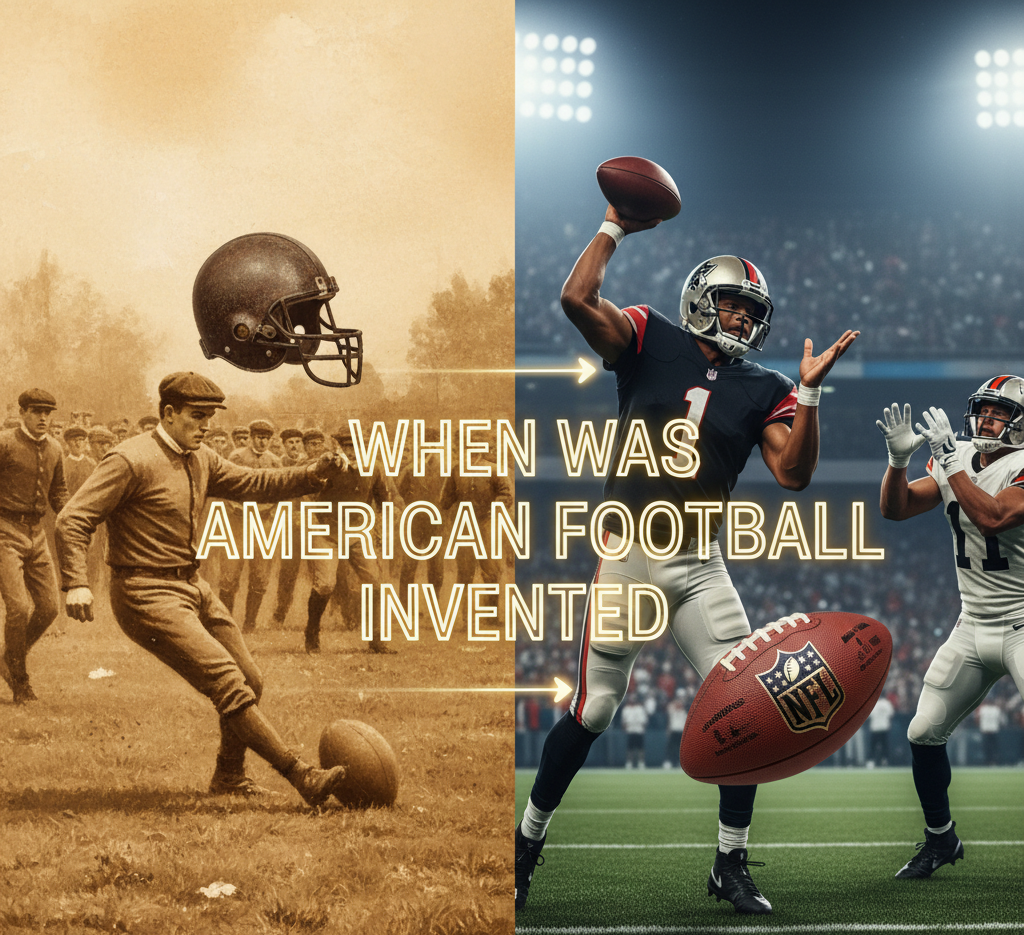
If you’ve ever wondered when was American football invented, you’re not alone. It’s a question that takes us back to dusty college fields in the 1800s, wild games with dozens of players, and one man who changed everything.
American football didn’t pop up overnight. It grew out of soccer and rugby, slowly turning into the strategic, high-energy sport we love today. The first game happened in 1869, but the version we recognize—with downs, forward passes, and 11 players per side—took shape in the 1880s thanks to Walter Camp.
In this guide, we’ll walk through the full story with clear timelines, fun facts, and real insights. Whether you’re a casual fan, a history buff, or a parent explaining the game to kids, you’ll find everything you need to understand how American football was born and why it became America’s favorite pastime.
The Very First Game: November 6, 1869
Most historians point to November 6, 1869, as the birthdate of American football. On that crisp fall day in New Brunswick, New Jersey, Rutgers University took on Princeton (then called the College of New Jersey).
It wasn’t exactly the football we watch on Sundays. Each team had 25 players. They used a round ball, and you couldn’t really carry it—you kicked or batted it toward the opponent’s goal. Rutgers won 6–4 in a chaotic but exciting match.
This game followed rules loosely based on the new London Football Association (soccer) rules. A week later, they played a rematch under Princeton’s slightly different rules. These early contests were more like massive soccer-rugby hybrids than modern gridiron action.
The 1869 Rutgers-Princeton game is widely accepted as the first intercollegiate American football game.
From Soccer and Rugby to Something New
American football didn’t start in a vacuum. Students at East Coast colleges had been playing various “foot-ball” games since the early 1800s, often rough and with few rules. Some versions looked like soccer; others allowed more carrying and tackling.
By the 1870s, the sport was splitting. Harvard preferred rugby-style play after facing Canadian teams. In 1875, Harvard and Yale played under “concessionary rules” that mixed elements.
A big meeting in 1876 helped standardize things, but the game was still messy—large teams, constant scrums, and plenty of injuries.
- Soccer influence: Kicking a round ball, no hands initially
- Rugby influence: Running with the ball, tackling, oval-shaped ball later
This mix created the foundation, but it needed someone to organize the chaos.
Walter Camp: The Father of American Football
Enter Walter Camp, the man most responsible for inventing modern American football. Born in 1859 in Connecticut, Camp played for Yale and later became a coach and rules maker.
People call him the “Father of American Football” for good reason. Starting in 1880, he pushed through major changes that separated the sport from rugby forever.
Camp introduced the line of scrimmage, the snap from center to quarterback, and the system of downs (you get four tries to gain 10 yards or lose the ball). He also helped set teams at 11 players each and created the quarterback position.
One important sentence: Without Walter Camp’s vision in the 1880s, American football might never have become the strategic, stop-start game millions enjoy today.
His ideas made the sport safer, more organized, and coach-friendly. Plays could now be planned instead of turning into one big pile-up.
Key Rule Changes That Shaped the Game
The transformation happened gradually. Here are the biggest milestones:
- 1880: Reduced to 11 players per side, line of scrimmage replaces the rugby scrum, snap introduced.
- 1883: Scoring system standardized (touchdowns, field goals, safeties).
- 1906: Forward pass legalized (after deadly 1905 season with many injuries).
- Later tweaks: Neutral zone, ball shape and size defined, more protections for players.
These changes turned a free-for-all into a game of strategy, timing, and athletic skill. The forward pass, in particular, opened up the field and made the sport more exciting to watch.
Bullet points of early differences from rugby:
- No endless scrums—clean restarts with the snap
- Possession controlled by downs instead of continuous play
- Emphasis on yards gained and field position
By the early 1900s, college football was booming, drawing huge crowds.
The Rise of Professional Football
College football came first, but the pro game followed quickly. The first known professional player was William “Pudge” Heffelfinger, who got paid $500 in 1892 to play for the Allegheny Athletic Association against Pittsburgh.
That November 12, 1892, game is often called the birth certificate of pro football.
In 1920, team owners met in Canton, Ohio, and formed the American Professional Football Association (APFA). It renamed to the National Football League (NFL) in 1922. Legends like Jim Thorpe helped give it credibility.
The NFL grew slowly at first but exploded in popularity after World War II, especially with television. Today, the Super Bowl is one of the biggest events in American culture.
How American Football Evolved Into the Modern Game
From the 1930s onward, innovations kept coming: better helmets, two-platoon systems, specialized positions, and complex playbooks. The 1958 NFL Championship (the “Greatest Game Ever Played”) helped boost national interest.
By the 1960s and 1970s, stars like Joe Namath and the AFL-NFL merger created the modern Super Bowl era. Rules continued evolving for safety and excitement—things like instant replay, stricter concussion protocols, and targeting penalties.
Numbered list of modern features rooted in early invention:
- 11 players on offense and defense
- Four downs to make 10 yards
- Forward pass as a key weapon
- Structured scoring and timing
- Emphasis on strategy and coaching
The game that started in 1869 now features billion-dollar franchises, global fans, and incredible athleticism.
Lessons and Benefits for Fans and Players Today
Understanding when was American football invented helps us appreciate the sport more. Here are some practical takeaways:
- For players: Focus on fundamentals like blocking, tackling technique, and reading plays. Camp’s emphasis on strategy still wins games.
- For coaches: Build disciplined systems—American football rewards preparation.
- For fans: Learn the rules to enjoy the chess-like battles between plays. It makes watching way more fun.
- Health tip: Always prioritize safety gear and proper training to avoid injuries that plagued early football.
Benefits include: Building teamwork, discipline, resilience, and strategic thinking that translate to life off the field.
Frequently Asked Questions (FAQ)
When was American football invented exactly? The first game was on November 6, 1869, but Walter Camp shaped the modern rules starting in 1880.
Who invented American football? No single person, but Walter Camp is called the “Father of American Football” for his rule changes.
How is American football different from rugby and soccer? It uses downs, a line of scrimmage, forward passes, and has more structured stops in play.
When did the NFL start? The league formed in 1920 as the APFA and became the NFL in 1922.
Is American football still changing? Yes—safety rules, replay technology, and pace-of-play adjustments continue to evolve.
Conclusion
So, when was American football invented? It began with a simple college matchup in 1869 and truly took shape through Walter Camp’s innovations in the 1880s. What started as a chaotic mix of soccer and rugby became a uniquely American sport full of strategy, athleticism, and drama.
Today, millions play and watch because of those early pioneers who dared to change the rules. The invention story reminds us that great things often evolve step by step.
Next time you see a perfect spiral or a game-winning drive, remember the long journey from that 1869 Rutgers-Princeton clash. Football’s past makes its present even more thrilling.
What’s your favorite era or moment in football history? Share in the comments!