
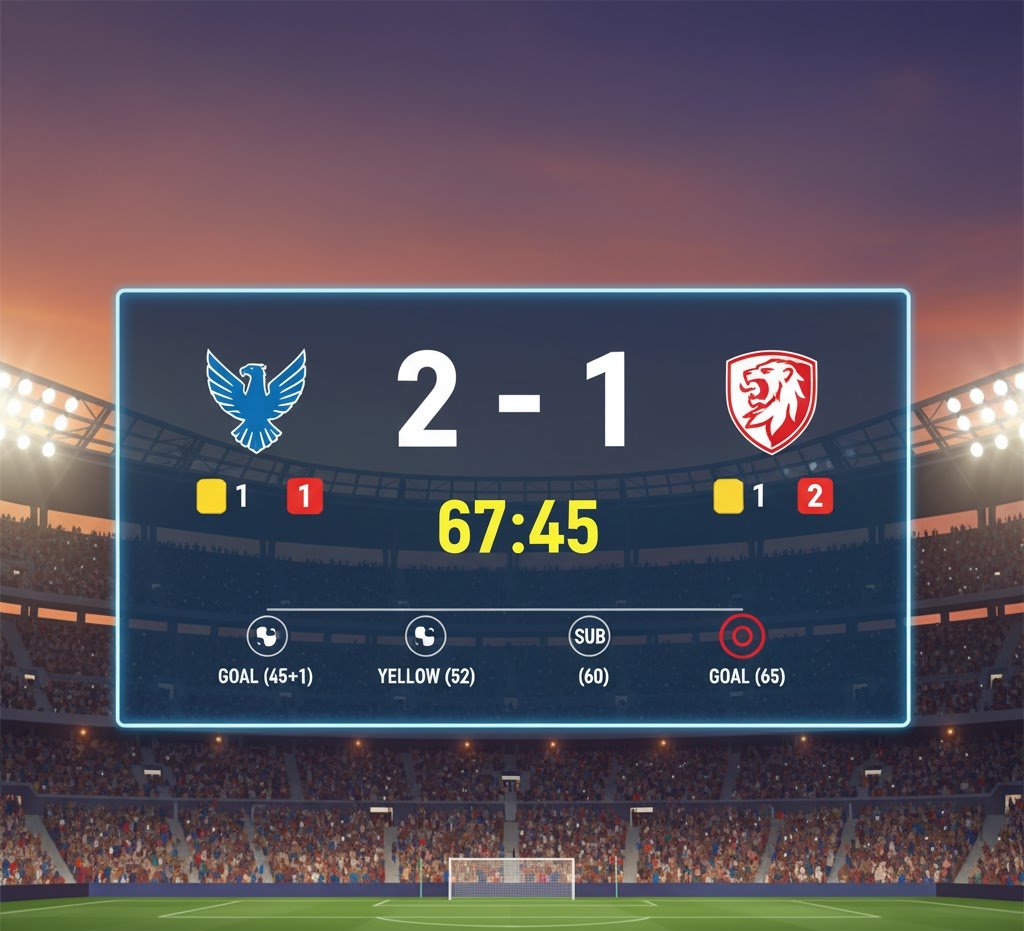
If you’ve ever watched a football (soccer) match on TV, in a stadium, or via streaming, you may have glanced at the scoreboard and thought: What do all these numbers and abbreviations mean? Understanding how to read a football scoreboard will greatly enhance your viewing experience.
In this guide, you’ll learn:
The key components of a standard football scoreboard
Variations (aggregate score, injury time, extra time)
Abbreviations, icons & ancillary elements
How to interpret advanced scoreboard features
Common mistakes & what people often misread
Let’s dive in.
1. The Basic Structure of a Football Scoreboard
A typical football scoreboard can be divided into these main components:
| Section | Description |
|---|---|
| Team names / designations | The two competing teams, often abbreviated |
| Match score | Goals scored by each team (e.g. 2 – 1) |
| Game clock / time elapsed | The minute and seconds of the current half |
| Half indicator / match phase | Which half (1st, 2nd, extra time) or whether it’s halftime, fulltime, etc. |
| Stoppage time / added time | Additional time added due to fouls, injuries, substitutions |
| Aggregate or tie score (if relevant) | Used in two-legged competitions to sum total goals over two matches |
| Other icons or stats | Cards (yellow/red), substitutions, possession, shots, etc. |
Let’s break down each in detail.
2. Understanding Team Names & Layout
Team placement & abbreviations / icons
Most scoreboards show the home team on one side (often the bottom or right side), and the away / visiting team on the other.
In televised graphics, sometimes the home team is on the right or the bottom; other times, it may appear on the left, depending on region and broadcast convention.
Team names are frequently shortened to three-letter abbreviations (e.g. MUN for Manchester United, BAR for Barcelona).
A small icon (like a stadium flag) or “(H)” / “(A)” may appear to denote home or away sides.
Understanding which side is the home team helps when interpreting stats like “shots for home vs away,” etc.
3. Reading the Score (Goals)
This is the central element:
A typical display is Team A 2 – 1 Team B, meaning Team A has scored 2 goals, Team B has 1.
Goals are counted simply — no fractional values.
The team with the higher number of goals at the end of the match wins (unless tie / penalty / extra time rules apply).
If the scoreboard shows 0 – 0, that means it’s still a goalless draw at that moment.
In knockout or two-leg ties, you may also see an aggregate score line (sum of goals over both matches).
4. Game Clock / Time Elapsed
Unlike many sports that count down, football scoreboards show time elapsed — i.e. how much time has passed in the current half.
Key points:
Each half is typically 45 minutes (in standard matches).
The scoreboard will show minutes and sometimes seconds (e.g. 34:25 means 34 minutes 25 seconds into the half).
When that 45 minutes is reached, the game doesn’t necessarily stop — stoppage / added time may be appended.
Stoppage time / Additional time
Due to injuries, substitutions, or delays, the referee adds “stoppage time” (also called “added time” or “injury time”) at the end of each half.
On the scoreboard, this is often indicated by a “+X” suffix (for example, 45 + 3′ means 3 minutes added).
During that added time, the clock continues beyond 45 (e.g. 45:30, 46:15, etc.).
The half ends when the referee whistles, even if technically more time might be expected.
Extra time / Overtime
In knockout stages or cup matches, if the game is tied after normal time, extra time (two 15‑minute periods) may be played.
The scoreboard will usually change to show “ET” or “Extra Time” to indicate that.
5. Aggregate Score & Away Goals (When Applicable)
In certain tournaments (e.g. Champions League, some domestic cups), ties are played over two legs (home and away). Here’s how scoreboards reflect that:
In those cases, a scoreboard may show a secondary score called the aggregate score, e.g., “Overall: 4 – 3”.
This means the sum of goals from both matches: e.g. Team A won 2–1 in first leg, and drew 2–2 in second leg → aggregate 4–3.
Some scoreboards will also show away goals, used as tiebreakers: e.g., “2 (away) – 1 (away)”.
If a match’s scoreboard shows Team A 1 – 1 (5 – 4 agg.), it means on the night it’s tied 1–1, but aggregate is 5–4.
When reading a scoreboard with aggregate, always note which numbers refer to current match and which refer to aggregate totals.
6. Additional Elements, Icons & Stats
Beyond score and time, modern scoreboard graphics often include extra info for insight into the match:
| Element | Meaning / Use |
|---|---|
| Yellow / Red card icons | If a player has been booked or sent off; the player’s number may be shown. |
| Substitution icons | Indicates player changes (incoming / outgoing) and the minute of substitution. |
| Possession %, shots on goal, corners | Some broadcasts show live stats next to or below the scoreboard. |
| Score bug or overlay | On-screen persistent graphic that displays score + clock + team names. Wikipedia |
| Match status indicators | “HT” (halftime), “FT” (fulltime), “ET” (extra time), “PEN” (penalties) |
| Minute of last event | Some scoreboards show “GOAL – 57’” or “RED – 73’” to mark when the last incident occurred. |
| Timeline / Event marker strip | A visual bar (at bottom) showing when goals, cards, etc., occurred during match. |
A well-designed scoreboard gives you more than just goals — it offers context.
7. Sample Interpretation: Walkthrough
Let’s consider a hypothetical scoreboard:
Here’s how to read it:
BAR vs RMA – Barcelona vs Real Madrid
Score: 2–1 in this match, Barcelona leading
Time: 67 minutes 45 seconds into the match; +2′ means 2 minutes of added time is being counted
ET indicates extra time is active (i.e. match is beyond normal 90′)
Agg: 4–4 indicates the aggregate over two legs is tied 4–4
Shots: 10 for Barcelona, 8 for Real Madrid
Possession: Barcelona holds 55% of possession, Real 45%
Cards: Yellow cards – Barcelona 1, Real 2
You can quickly infer who’s on the attack, who’s dominating possession, and potential danger from substitutions or cards.
8. Common Misreads & Mistakes
Even seasoned fans sometimes misinterpret scoreboards. Here are pitfalls to avoid:
Confusing aggregate vs current score — Always check which number is for tonight’s match vs total over multiple legs.
Misreading home vs away teams — Don’t assume left side = home; check context / local convention.
Mistaking stoppage time — A “+3′” isn’t extra time/ET, it’s added time for the half in progress.
Assuming the clock indicates time remaining — Football clocks count up, not down.
Not recognizing icons / abbreviations — E.g., “PEN” means game goes to penalty shootout; “ET” means extra time.
Overlooking events panel — A small “60’ GOAL” marker might explain changes in momentum you just saw.
By paying attention to labels and context, you can avoid these misunderstandings.
9. Tips to Read Scoreboards Quickly & Effectively
First glance: score – time — that tells you who’s winning and how far into the game you are.
Then check any suffix (like “+2′”) and half/phase labels (HT, FT, ET).
If there’s an aggregate line, read that separately from match score.
Look for extra icons / stats (cards, substitutions) to understand drama on the field.
Keep in mind: home/away side varies by region — glance at context (stadium name, color, phrasing) to know which is which.
Conclusion
Being able to read a football scoreboard is more than just knowing who’s winning — it gives you insight into the game’s flow, player actions, and overall context. From score and time to cards, substitutions, aggregate totals, and event markers, every number and icon has meaning.
The next time you watch a match, take a moment to decode the scoreboard. As you grow familiar, it becomes second nature — and your enjoyment of the match deepens.