
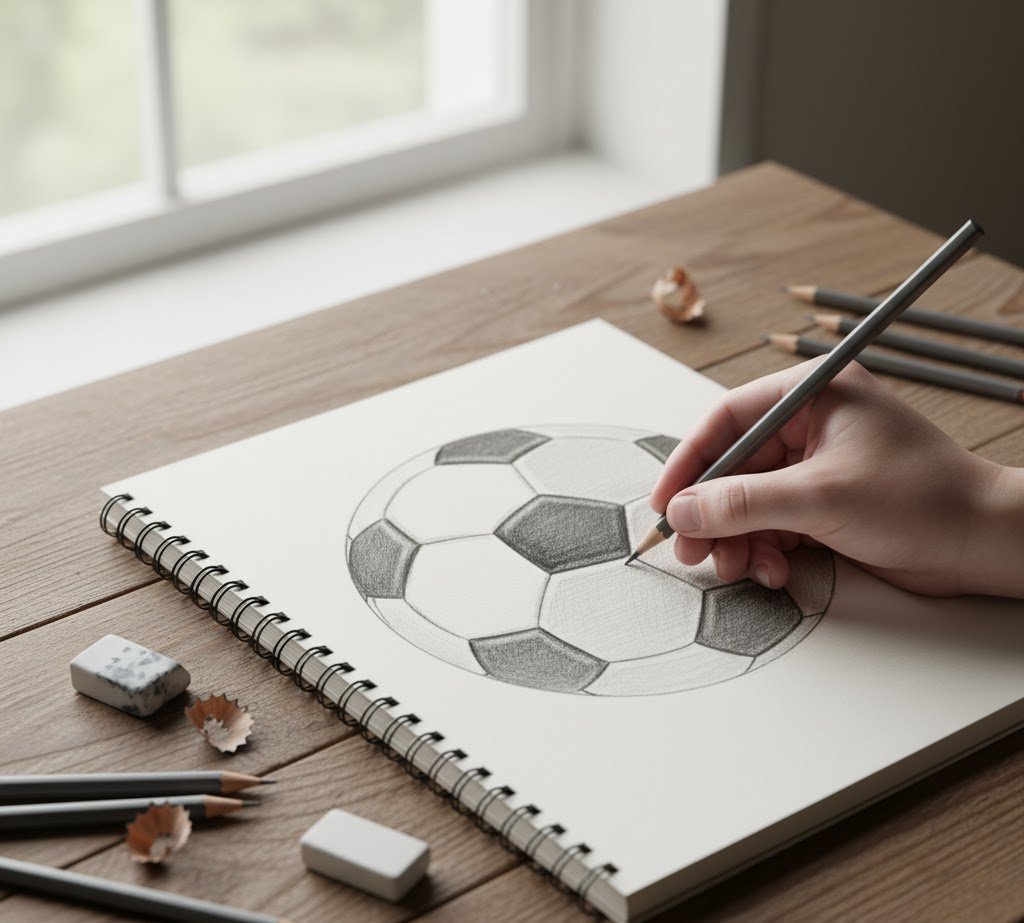
Introduction: The Art of Drawing a Soccer Ball
Whether you’re an aspiring artist, a soccer fan, or a parent teaching your kids to draw, learning how to draw a soccer ball is both fun and rewarding. A soccer ball may look simple at first glance, but its pattern — made of hexagons and pentagons — requires a bit of precision to look realistic.
In this guide, we’ll walk you through step-by-step instructions to draw a soccer ball, along with tips for shading, coloring, and adding details. You’ll also learn about the geometry and design behind the soccer ball, helping you draw it more accurately every time.
Understanding the Soccer Ball Pattern
Before you start drawing, it helps to understand how a real soccer ball is designed.
A traditional soccer ball is made up of 32 panels:
12 black pentagons (five-sided shapes)
20 white hexagons (six-sided shapes)
These panels fit together to form a perfect sphere, giving the ball its iconic black-and-white pattern.
Modern soccer balls may have different designs, but the classic hexagon-pentagon layout remains the most recognizable and easiest for beginners to draw.
Materials You’ll Need
To get started, gather these basic drawing supplies:
A pencil (HB or 2B for sketching)
A ruler or compass (for accurate circles)
An eraser
A black pen or fine liner (for outlining)
Colored pencils or markers (for shading and coloring)
Drawing paper or sketchbook
These tools will help you achieve a clean, professional-looking soccer ball drawing.
Step-by-Step Guide: How to Draw a Soccer Ball
Let’s break down the drawing process into simple, manageable steps.
Step 1: Draw a Perfect Circle
Start by drawing a perfect circle using a compass or by tracing around a round object like a cup or lid.
This circle will form the outer shape of your soccer ball.
Pro tip: Keep your lines light so you can easily erase and adjust them later.
Step 2: Mark the Center Point
Find the center of your circle and lightly mark it with a small dot. This will help you position the soccer ball’s pattern evenly.
Step 3: Draw the Central Pentagon
At the center, draw a small pentagon (five-sided shape). This will be the starting point of your ball’s pattern.
Try to make each side roughly the same length — about 1 to 1.5 cm for a medium-sized drawing.
If you’re new to geometry, you can sketch the pentagon freehand, then refine it with your ruler.
Step 4: Add Surrounding Hexagons
Around the central pentagon, draw five hexagons connecting to each of the pentagon’s sides.
Each hexagon should share one full edge with the center pentagon.
This step is key — it forms the foundation of the soccer ball’s pattern.
Step 5: Continue the Pattern
Now, continue adding alternating hexagons and pentagons until you fill the surface area of the circle.
Since a soccer ball is round, not all shapes will look perfectly geometric — they should slightly curve near the edges to create a 3D illusion.
Don’t worry if the pattern doesn’t look “perfect.” The key is maintaining symmetry and proportion.
Step 6: Add Curved Connection Lines
To make your soccer ball look realistic, slightly curve the lines where the panels meet, especially near the outer edges of the circle.
This gives the impression of a round surface instead of a flat pattern.
Step 7: Outline the Drawing
Once you’re happy with your pattern:
Trace your drawing with a black pen or fine liner.
Outline the panels clearly to highlight the pattern.
Erase the pencil guidelines after the ink dries.
This will make your drawing look clean and professional.
Step 8: Color the Panels
Traditionally, soccer balls have black pentagons and white hexagons.
Use a black pencil or marker to fill in the pentagon panels evenly, leaving the hexagons white.
For a modern look, you can experiment with:
Neon or gradient colors
Metallic silver or gold finishes
Custom team patterns or logos
Step 9: Add Shadows and Highlights
To give your soccer ball a 3D effect, add shading:
Darken one side of the ball (usually the lower left or right) to create shadow.
Leave the opposite side lighter to represent light reflection.
Blend with a soft pencil or your finger for a smooth gradient.
This step adds depth and realism to your drawing.
Step 10: Add Background Details (Optional)
If you want to make your drawing more dynamic, add a background such as:
A soccer field
A goalpost
A foot kicking the ball
Motion lines to show the ball moving
These details can make your artwork stand out and tell a story.
Alternative Methods: Easy Ways to Draw a Soccer Ball
Depending on your skill level, here are a few alternative techniques:
1. The Simple Method (For Kids and Beginners)
Draw a circle.
Add random pentagon-like shapes inside it.
Color some black and leave others white.
This simplified version still captures the look of a soccer ball without geometric precision.
2. The 3D Shaded Method
For more advanced artists:
Use curved lines for panels to simulate spherical distortion.
Apply gradient shading to emphasize lighting and curvature.
Add realistic highlights using a white gel pen or eraser.
3. The Cartoon Style
If you’re drawing for animation or illustration:
Exaggerate the ball’s outline.
Use bold, thick lines.
Add motion lines or a smiling face for a fun effect.
Common Mistakes to Avoid
Even though a soccer ball looks simple, there are a few common mistakes beginners make:
Flat Patterns – Forgetting to curve lines around the edges makes the ball look 2D.
Uneven Shapes – Keep your pentagons and hexagons consistent in size.
Incorrect Color Placement – Always color the pentagons black and leave hexagons white for accuracy.
No Shading – Without light and shadow, your drawing will lack depth.
Overcomplicating the Pattern – Simplicity often looks better, especially for beginners.
Tips for Drawing a Realistic Soccer Ball
Use references — Look at photos of real soccer balls to understand light and pattern.
Practice circles — A perfect circle is key to a professional drawing.
Draw lightly first — Always start with soft pencil lines for easy adjustments.
Work slowly — Precision matters more than speed.
Experiment with angles — Try drawing the ball tilted or in motion for a more dynamic look.
Fun Fact: The Science Behind the Soccer Ball Design
Did you know that the soccer ball’s classic 32-panel design is actually based on a truncated icosahedron, a complex geometric shape from mathematics?
This design allows for near-perfect sphericity and air distribution, making the ball stable in flight and easy to control.
So when you draw a soccer ball, you’re not just sketching sports equipment — you’re recreating a marvel of geometric engineering!
Coloring Ideas for Different Styles
Here are some creative coloring ideas if you want to go beyond the traditional look:
Modern Soccer Ball: Use blue and silver panels for a sleek design.
Team-Themed Ball: Add your favorite club’s colors or logo (e.g., Barcelona red & blue).
Vintage Style: Add light brown tones and stitching lines for an old-school look.
Cartoon Style: Bold black outlines with bright highlights.
You can even use digital drawing tools like Procreate, Adobe Illustrator, or Canva to create a vector-style soccer ball for digital art or logos.
Benefits of Learning How to Draw a Soccer Ball
Learning how to draw a soccer ball improves several artistic and cognitive skills:
Hand-eye coordination
Understanding of geometric patterns
Observation and attention to detail
Creativity and imagination
Patience and discipline
Plus, it’s a great way to relax while celebrating your love for soccer.
Step-by-Step Recap
Here’s a quick summary of the steps you learned:
Draw a perfect circle.
Mark the center.
Draw the central pentagon.
Add five surrounding hexagons.
Continue the pattern outward.
Curve the lines for 3D effect.
Outline with a black pen.
Color the pentagons black.
Add shading for depth.
Add background details (optional).
By following these 10 steps, you’ll have a realistic soccer ball drawing that’s perfect for school projects, artwork, or digital design.
Conclusion: Practice Makes Perfect
Now that you know how to draw a soccer ball, it’s time to grab your pencil and start practicing!
The more you draw, the better your circles, shapes, and proportions will become. Don’t aim for perfection right away — focus on enjoying the process and expressing your creativity.
Remember, every great artist started with basic shapes — and mastering the simple soccer ball is a big step toward improving your overall drawing skills.
So, get your sketchbook, start drawing, and soon you’ll be creating soccer balls that look ready to roll off the page!
Frequently Asked Questions (FAQs)
1. How do you draw a simple soccer ball for kids?
Draw a circle, add a few pentagon shapes inside, color some black and leave others white — keep it simple and fun.
2. How many shapes are on a soccer ball?
A traditional soccer ball has 32 panels — 12 black pentagons and 20 white hexagons.
3. What is the easiest way to draw a soccer ball?
Start with a circle and one central pentagon, then build out the pattern with hexagons. Outline and color afterward.
4. Can I draw a soccer ball digitally?
Yes! You can use apps like Procreate, Adobe Illustrator, or Canva to create clean, symmetrical soccer ball designs digitally.
5. How can I make my soccer ball look 3D?
Add shading on one side and highlights on the opposite side to simulate light and roundness.