
Introduction
Few players have ever changed the game of football the way Marshall Faulk did. The NFL Hall of Famer redefined the running back position with his rare combination of speed, vision, hands, and football IQ. In the NFL Network documentary A Football Life: Marshall Faulk, fans get an intimate look into his journey—from humble beginnings in New Orleans to becoming one of the most complete offensive weapons in NFL history.
This article explores the key highlights of A Football Life: Marshall Faulk, his incredible career milestones, his impact on modern football, and the legacy he continues to leave behind.
Early Life and Passion for Football
Marshall William Faulk was born on February 26, 1973, in New Orleans, Louisiana. Growing up in the Ninth Ward, he faced challenges that shaped his character and determination. From an early age, Faulk showed exceptional athleticism and focus.
While other kids played just for fun, Faulk studied the game. He idolized great running backs like Walter Payton and Tony Dorsett, but he also developed his own unique approach—mixing patience with explosive acceleration. His natural understanding of football became evident during his high school years at Carver High School, where he was a standout in both football and track.
His discipline, combined with his drive to succeed, earned him a scholarship at San Diego State University (SDSU)—a decision that would change his life forever.
College Stardom at San Diego State
At SDSU, Marshall Faulk quickly became a household name. As a freshman in 1991, he had one of the most remarkable college football performances ever recorded—rushing for 386 yards and 7 touchdowns in a single game against the University of the Pacific.
That performance announced his arrival as one of the most dynamic players in college football. Over three seasons with the Aztecs, Faulk accumulated 4,589 rushing yards, 57 touchdowns, and countless broken tackles that showcased his agility and football intelligence.
Despite his dominance, he never won the Heisman Trophy—a decision many still call one of the biggest snubs in college football history. However, Faulk’s college career cemented his reputation as a once-in-a-generation talent.
NFL Draft and Early Years with the Indianapolis Colts
Marshall Faulk entered the 1994 NFL Draft as one of the most hyped prospects of the decade. The Indianapolis Colts selected him as the second overall pick, and he made an immediate impact.
In his rookie season, Faulk rushed for 1,282 yards and 11 touchdowns, earning NFL Offensive Rookie of the Year honors. His ability to both run and catch made him an instant dual-threat weapon.
However, as the seasons went on, Faulk faced challenges with injuries and team struggles. While he continued to perform at an elite level, the Colts’ offense couldn’t fully maximize his skill set. Everything changed when he joined the St. Louis Rams in 1999.
The St. Louis Rams and “The Greatest Show on Turf”
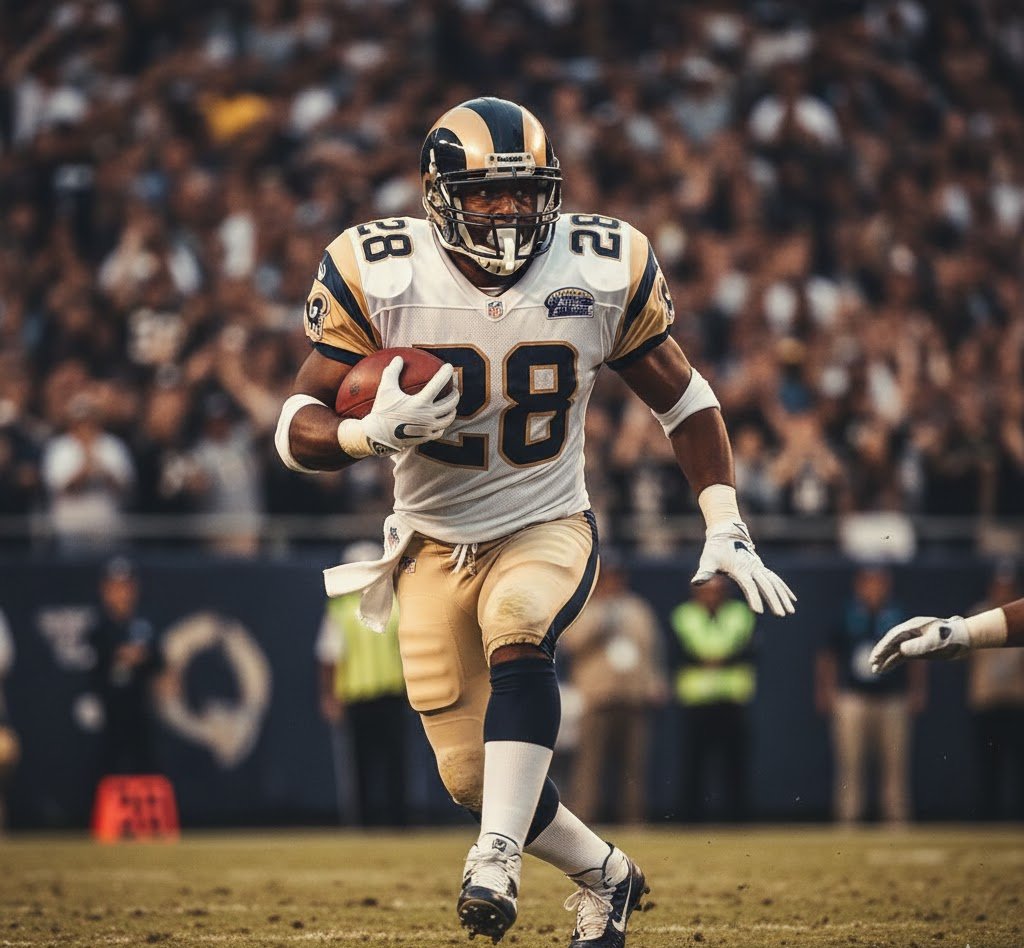
When Marshall Faulk was traded to the St. Louis Rams in 1999, his career reached legendary heights. Under head coach Dick Vermeil and offensive coordinator Mike Martz, the Rams built one of the most explosive offenses in NFL history—famously known as “The Greatest Show on Turf.”
With Kurt Warner at quarterback, Isaac Bruce, Torry Holt, and Az-Zahir Hakim as receivers, and Faulk in the backfield, the Rams offense became unstoppable. Faulk wasn’t just a running back; he was the engine that powered the entire scheme.
In the 1999 season, he recorded 2,429 yards from scrimmage, breaking the NFL record at the time. That same year, the Rams won Super Bowl XXXIV, defeating the Tennessee Titans in a thrilling finish.
From 1999 to 2001, Faulk earned three consecutive NFL Offensive Player of the Year awards and was named the 2000 NFL MVP. He became the only player in NFL history to rush for over 12,000 yards and record over 6,000 receiving yards, proving his unmatched versatility.
Playing Style and Impact on the Game
What made Marshall Faulk so special was his adaptability. He wasn’t just a runner—he was a complete football player.
Vision and Patience: Faulk had an uncanny ability to read defenses before the snap. His patience allowed blocks to develop perfectly before bursting through openings.
Route Running: Unlike traditional running backs, Faulk could line up as a wide receiver and run precise routes, creating mismatches against linebackers and safeties.
Football IQ: His deep understanding of offensive schemes made him a coach on the field. Quarterbacks trusted him to read defenses and adjust routes in real time.
Dual Threat Ability: Faulk’s receiving skills revolutionized the running back position. Modern stars like Christian McCaffrey, Alvin Kamara, and Austin Ekeler have modeled parts of their game after him.
In A Football Life: Marshall Faulk, former teammates and coaches discuss how his influence helped reshape offensive play-calling in the NFL, making running backs more valuable as receivers.
Later Career and Retirement
After several dominant years, injuries began to slow Faulk down in the mid-2000s. Still, he remained a respected leader in the Rams’ locker room, helping younger players understand the importance of preparation and professionalism.
He retired after the 2005 season with career totals of:
12,279 rushing yards
6,875 receiving yards
136 total touchdowns
Those numbers place him among the all-time greats, and his induction into the Pro Football Hall of Fame in 2011 was well-deserved.
Life After Football
Post-retirement, Marshall Faulk transitioned into broadcasting and philanthropy. He worked as an analyst for NFL Network, where his deep understanding of the game made him a fan favorite.
Beyond media, Faulk is dedicated to giving back to the community through the Marshall Faulk Foundation, which supports educational and youth programs. His work off the field reflects the same dedication and intelligence that defined his football career.
Key Takeaways from “A Football Life: Marshall Faulk”
The documentary offers fans more than just highlights—it tells the story of resilience, humility, and greatness.
Unmatched Versatility: Faulk could do it all—run, catch, block, and read defenses.
Hard Work Pays Off: From New Orleans streets to NFL glory, his journey is a testament to focus and determination.
Changing the Game: His unique skill set forever changed how teams use running backs in modern football.
Viewers also see the personal side of Faulk—his relationships, motivations, and lessons learned along the way. His story is not just about football; it’s about the pursuit of excellence.
Marshall Faulk’s Legacy
Even decades later, Marshall Faulk’s influence remains strong. Young running backs study his film to learn how to create space, catch out of the backfield, and anticipate defenses.
He set the standard for what it means to be a “complete running back.” Whether it’s his record-breaking seasons or his ability to inspire the next generation, Faulk’s name will forever be synonymous with greatness.
Conclusion
A Football Life: Marshall Faulk beautifully captures the essence of a true football genius. His journey from a small neighborhood in New Orleans to the grand stage of the NFL serves as a reminder that talent alone isn’t enough—it’s dedication, preparation, and love for the game that create legends.
Marshall Faulk didn’t just play football—he transformed it. His impact continues to shape the NFL today, making him one of the most influential players in the history of the sport.