
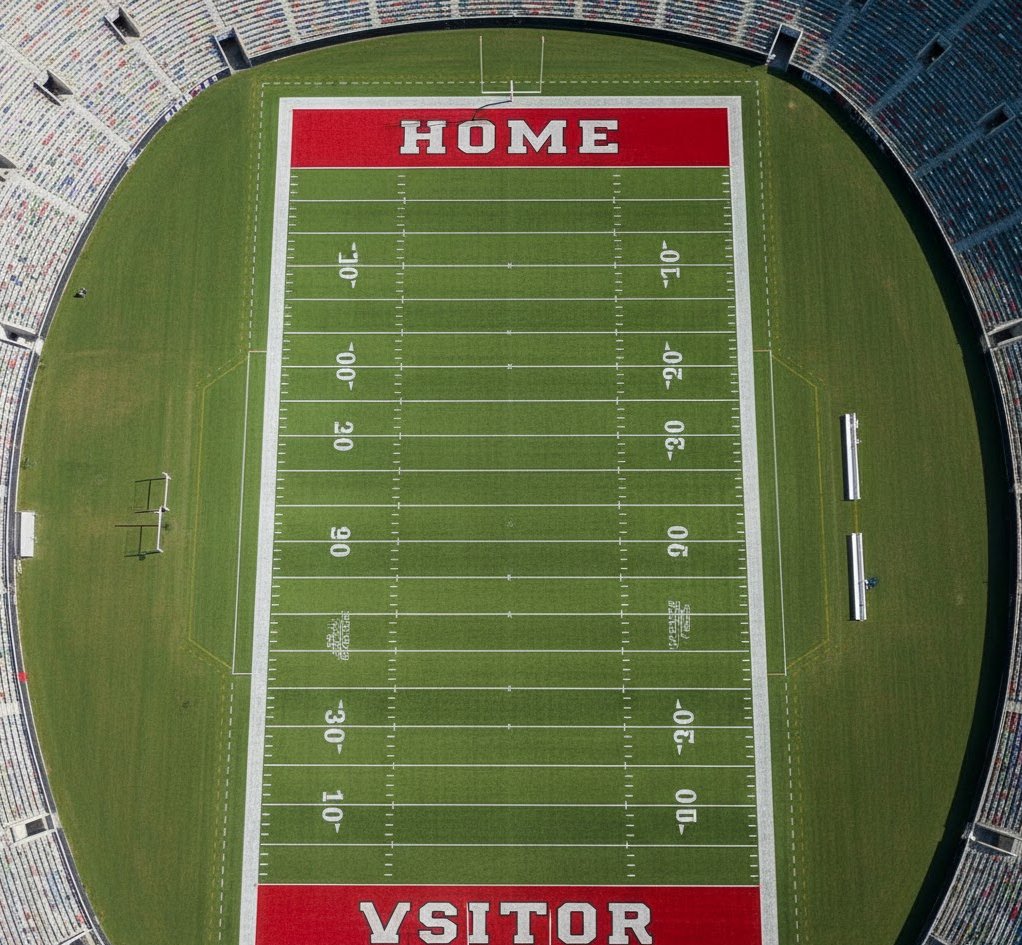
When people first learn that a football field is 120 yards by 53 yards, they often wonder how those numbers were decided and what they mean in real gameplay. These measurements aren’t random — they reflect over a century of refinement in the design of American football fields. Understanding these dimensions helps fans, coaches, and players appreciate how space, speed, and strategy combine to make football one of the most dynamic sports in the world.
In this article, we’ll explore what those dimensions really mean, how they evolved, and why they matter so much to the game’s structure, rules, and strategy.
Dimensions of a Football Field
A standard American football field measures 120 yards long and 53⅓ yards wide. This includes:
100 yards of playable field (from goal line to goal line).
Two 10-yard end zones, one at each end of the field.
Width: 53⅓ yards (160 feet).
To visualize it, imagine a long green rectangle, lined precisely with yard markers every five yards and smaller hash marks for each yard. These lines are not just for show — they guide referees in ball placement, player positioning, and play execution.
Why 120 Yards and 53⅓ Yards?
These measurements aren’t arbitrary. The 120-yard length evolved from the original rugby pitches that American football grew out of in the late 1800s. Early versions of football used uneven field sizes, but by the early 1900s, college football standardized the field to 100 yards plus two 10-yard end zones. The 53⅓-yard width (160 feet) was introduced to maintain balance between offensive and defensive play.
This ratio creates a perfect blend of space for tactical diversity and manageable viewing angles for spectators and broadcast cameras.
Converting Football Field Dimensions into Other Units
For quick reference:
120 yards = 360 feet = 109.7 meters
53⅓ yards = 160 feet = 48.8 meters
This means the total playing area (including end zones) equals about 1.32 acres — slightly larger than one acre of land.
That’s why you might hear people comparing a football field to a unit of land measurement — when someone says “about the size of a football field,” they usually mean one acre.
Field Markings Explained
The lines and markings on a football field are just as important as its size. Here’s what each set of markings means:
Goal Lines: The lines that define where the end zones begin.
End Lines: The lines marking the very back of each end zone.
Sidelines: The boundaries along the length of the field.
Yard Lines: Every 5 yards, a white line crosses the field.
Hash Marks: Short lines marking every single yard; used to align the ball for plays.
Numbers: Large white numbers (10, 20, 30, etc.) help players, referees, and spectators identify field position.
These markings create precision in gameplay — when a penalty is called, a referee knows exactly how far to move the ball.
Football Field Layout Compared to Other Sports
Football fields are uniquely proportioned. To understand how, let’s compare:
| Sport | Field/Court Dimensions | Area |
|---|---|---|
| American Football | 120 x 53 yards | ~1.32 acres |
| Soccer (FIFA Standard) | 120 x 75 yards | ~1.98 acres |
| Rugby | 122 x 74 yards | ~1.9 acres |
| Baseball (Outfield Variable) | ~400 feet max | Variable |
| Basketball (NBA) | 94 x 50 feet | 0.11 acres |
The narrower field in football creates more vertical play, allowing for speed and power rather than lateral passing like soccer or rugby.
Historical Evolution of Football Field Dimensions
When American football was first played in the late 19th century, the field looked more like a rugby pitch. There were no end zones, and scoring happened by simply crossing the opponent’s goal line.
In 1912, the NCAA officially standardized the 100-yard field and added 10-yard end zones. The width, 160 feet, remained consistent to balance player motion and crowd viewing.
As television broadcasting grew in the 1950s and beyond, these standardized dimensions made football easier to film and understand — another reason they haven’t changed since.
The Role of Field Size in Strategy
Every inch of a football field influences gameplay strategy.
Offensive Strategy:
A longer field (100 yards of play area) gives teams space to execute deep passes, screen plays, and rushing tactics. Offensive coordinators use spacing to stretch defenses horizontally and vertically, exploiting gaps between defenders.
Defensive Strategy:
The 53-yard width forces defenses to cover large zones. Cornerbacks and safeties rely on precise angles and positioning to close down fast receivers. The sidelines act like extra defenders, limiting running plays to the inside.
Special Teams:
Kickers and punters must consider both the length (for field goals and punts) and the width (for directional kicking). The field’s uniform dimensions ensure consistent kicking conditions in every stadium.
Comparison Between NFL, College, and High School Fields
While the overall size (120 x 53⅓ yards) remains standard, there are small differences in hash mark placement:
| Level | Field Length | Width | Hash Mark Placement |
|---|---|---|---|
| NFL | 120 x 53⅓ yards | Hash marks 18’6” apart (narrow) | |
| College (NCAA) | 120 x 53⅓ yards | 40 feet apart (wider) | |
| High School | 120 x 53⅓ yards | 53’4” apart (widest) |
This affects play design — college and high school teams benefit from wider hash marks, giving more room for outside runs and sideline plays.
Fun Facts About Football Field Dimensions
Every NFL stadium must meet the same field specifications, even those built indoors or on artificial turf.
The goalposts are 18 feet, 6 inches apart in the NFL and 23 feet, 4 inches apart in college football.
The distance between the two hash marks is almost the width of the goalposts in the NFL — a detail designed to make field goals more challenging.
The turf type (natural grass vs synthetic) doesn’t affect field size but can influence ball bounce and player speed.
End zones weren’t always part of the game — they were added when the forward pass became legal, to prevent confusion over scoring.
Why “120 Yards by 53 Yards” Is a Common Quizlet Search
Students and sports fans often turn to platforms like Quizlet to study the fundamentals of football, including field measurements. “A football field is 120 yards by 53 yards” is a frequent flashcard fact used in:
Sports management classes
Coaching certifications
High school physical education
Sports trivia quizzes
It’s a simple number pair that represents precision, regulation, and tradition — three qualities at the core of football’s enduring appeal.
Why Field Dimensions Matter Beyond the Game
Beyond the lines and numbers, football field measurements have symbolic and practical importance. They’re used in:
Land measurement comparisons: Real estate agents or engineers often say “about the size of a football field” for clarity.
Broadcast design: Cameramen and producers use these exact proportions for optimized framing during games.
Player training: Strength coaches base sprint drills and yardage-based conditioning on standard field lengths.
The 120-by-53-yard layout is more than a sports rule — it’s a universal benchmark of scale and precision.
Modern Technology and Field Measurement
Today, every football field is laser-measured for accuracy. Whether at an NFL stadium or a high school ground, the yard markers, hash marks, and sidelines are placed to within inches of exact regulation standards.
3D laser mapping and GPS line painting systems ensure consistency across venues, preserving fairness and professional standards.
Conclusion
When someone says “a football field is 120 yards by 53 yards,” they’re describing one of the most precisely engineered play surfaces in all of sports. These numbers balance athletic skill, tactical depth, and spectator experience perfectly.
From youth leagues to the Super Bowl, every game takes place on this familiar rectangle — a field that’s equal parts battlefield and stage, where teamwork, power, and precision meet.
The next time you step onto a football field or see it on TV, take a moment to appreciate those carefully calculated dimensions. They’re not just numbers; they’re the foundation of America’s favorite game.